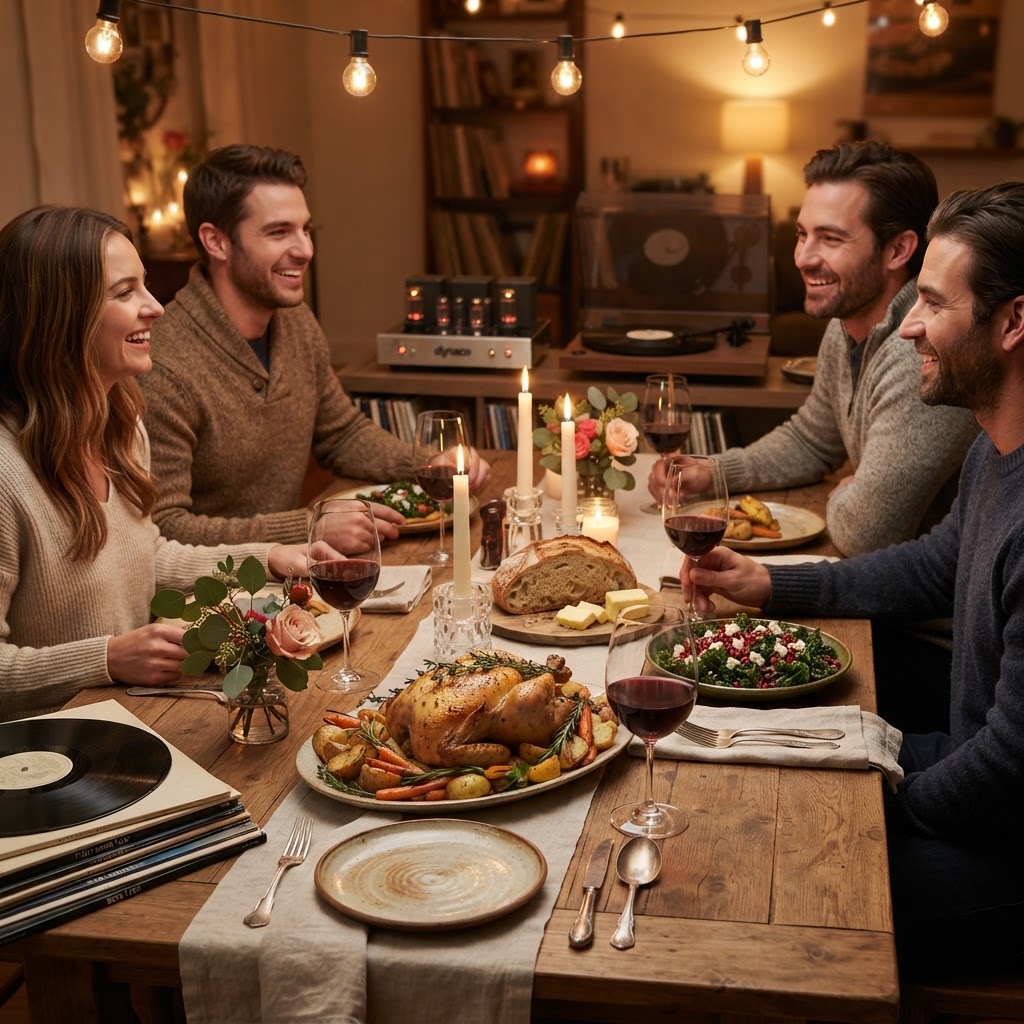
The Art of the "Acoustic" Dinner Party: Curating Playlists and Ambient Lighting for the Perfect Hosting Atmosphere
There is a certain alchemy that happens when you invite people into your home, a transformation that moves beyond the mere act of feeding them. As a chef, I have spent decades perfecting the culinary technicalities of a dish, from the precise emulsification of a beurre blanc to the Maillard reaction on a seared scallop. Yet, I have realized that the food is only half of the equation; the "Acoustic Dinner Party" is the holistic pursuit of creating a sensory environment that makes your guests feel both comfortable and elevated. It is about understanding that the dining room is not just a place to sit, but a stage where the lighting and the sound design dictate the pace of the meal. When the balance is struck, the conversation flows with an effortless, rhythmic cadence that lingers long after the final espresso has been served.
Curating this atmosphere requires a departure from the frantic, high-stress kitchen mentality and an embrace of the curatorial mindset. Many home hosts make the mistake of focusing solely on the menu, forgetting that human interaction is a biological response to the environment around it. Warm, amber-hued lighting can stimulate appetite and intimacy, while an ill-chosen playlist—perhaps something too jarring or rhythmically chaotic—can cause a subconscious spike in cortisol that inhibits digestion and relaxation. By intentionally designing these invisible layers of your party, you are essentially "plating" the dining room. You want your guests to walk in and feel as though the space has been tailored specifically to their presence, creating a sanctuary where time feels suspended.
To host an "Acoustic Dinner Party," you must approach your living space with the same rigor you apply to your mise-en-place. Every detail serves a function, and when those functions align, the result is nothing short of magical. This guide will walk you through the architecture of sound and light, ensuring that your home becomes the most desirable destination on the calendar. Whether you are hosting an intimate group of four or a bustling gathering of twelve, the principles of layering, volume control, and color temperature remain constant. Prepare to dismantle the standard expectations of home entertaining and reconstruct them into an experience that is as memorable as the meal itself.
The Soundscape: Architecture of the Acoustic Backdrop
The first mistake most hosts make is treating music as a background noise rather than a structural element of the meal. A professional soundscape should evolve alongside your dinner, matching the intensity of the service. You want to avoid anything with aggressive percussive elements during the appetizers, as this naturally forces guests to raise their voices to compete with the beat, leading to a loud, chaotic environment by the time the main course is served. Instead, focus on acoustic textures—think jazz trios, minimal ambient compositions, or soft, instrumental soul—that provide warmth without demanding cognitive attention.
Curating the Playlist Flow
You should think of your playlist in three distinct acts: Arrival, The Main Event, and The Wind-down. During the Arrival phase, aim for 60-70 BPM (beats per minute) tracks that occupy the mid-range of frequencies. This creates a "sonic blanket" that covers awkward silences while people are still getting their coats off. As you move into the main course, transition to music that is slightly more melodic but entirely wordless. Lyrics are the primary enemy of dinner conversation because our brains are hardwired to process language; if your music has lyrics, guests will inevitably stop listening to each other to listen to the song.
The Volume Sweet Spot
The secret to the perfect volume is the "conversation threshold test." You should be able to hear the music clearly, but if you have to tilt your head or raise your voice even an inch to be heard by the person sitting across from you, the volume is too high. A professional tip is to use equalization settings on your streaming service to reduce the bass levels. Lowering the low-end frequencies prevents the sound from feeling "boomy," which is particularly helpful in homes with hard flooring or high ceilings where sound tends to bounce and distort.
"The music should be like a gentle conversation in the next room—present, comforting, and entirely supportive of the humans sitting at the table."
The Art of Illumination: Painting with Light
Lighting is the primary tool for establishing the mood of a room. Harsh overhead lighting is the death of an intimate atmosphere, as it casts unflattering shadows and keeps the brain in a state of alertness. To achieve an "Acoustic" glow, you must eliminate the "big light" entirely. Instead, use a strategy of layering light sources at eye level or below. Table lamps, floor lamps, and, of course, the flickering glow of taper candles provide a soft, diffused light that makes every guest look radiant and makes the food look infinitely more appetizing.
The Importance of Color Temperature
In the world of professional design, the Kelvin (K) scale determines the color temperature of your light. For a dinner party, you should aim strictly for bulbs in the 2200K to 2700K range. This produces a warm, amber-leaning light that mimics the glow of a sunset or a fireplace. Anything above 3000K begins to look clinical or blue-shifted, which creates an immediate psychological distance between people. Your goal is to make the room feel like a cave of warmth, where the focus is drawn inward to the table.
Candle Placement and Safety
Candles are non-negotiable for a dinner party, but they must be placed strategically to avoid interfering with the service. Use tall, tapered candles in weighted holders so that the flame sits either well above eye level or well below it. This ensures that guests can maintain eye contact without having to peer around a flickering light. When using scented candles, be incredibly cautious; keep them restricted to the entryway or the bathroom. Never put scented candles in the dining room, as they will compete with the nuanced aromas of your culinary creations.
Culinary Pacing: Synchronizing Food and Atmosphere
When the atmosphere is set, the pace of your service should mirror the tone you have created. A common blunder is the "rushed plating" scenario where the host spends too much time in the kitchen, leaving guests in a silent or awkwardly managed space. You want your meal to follow a logical progression: the appetizers should be cold or room temperature, allowing you to have them ready before the first guest walks through the door. This allows you to focus entirely on the social architecture of the arrival.
Professional Timing Techniques
Plan your menu around items that can hold for 15-20 minutes without losing structural integrity. For example, a braised short rib is a far better choice for a host than a seared steak, which requires immediate attention and constant monitoring. If you are doing a complex main, consider the following prep schedule:
The Ratio of Engagement
Always aim for a 3:1 ratio of time spent with guests versus time spent in the kitchen during the actual dinner service. If you find yourself spending more than 25% of your evening checking the stove, your menu is likely too labor-intensive for the type of party you are trying to host. Professional chefs often use the "finished plate" principle: ask yourself if the dish requires a specific, last-second technical intervention. If it does, simplify it. A perfectly seasoned roast vegetable platter can be just as impressive as a complex reduction sauce if it is served with care and confidence.
"A relaxed host is the most important ingredient in any recipe. If you are stressed, the food will taste like it, regardless of how much time you spent in the kitchen."
The Tablescape: Tactile and Visual Harmony
Your table is the stage upon which the meal performs. While many are tempted by elaborate floral arrangements or heavy centerpieces, remember the principle of uninterrupted sightlines. If a guest cannot easily look at the person across from them without maneuvering around a giant vase, you have prioritized decoration over interaction. Keep your centerpieces low—no more than 8-10 inches in height—and prioritize textures that invite a sense of comfort, such as linen napkins or matte-finish stoneware.
Managing the Sensory Load
Avoid the "visual clutter" of too many serving dishes on the table. Instead, look to plated service where possible, or use a separate sideboard for serving. This keeps the table clean and provides more room for wine glasses, water, and the essential comfort of your guests. When choosing colors for your table, consider how they interact with your warm lighting. Deep, earthy tones like forest green, terracotta, or navy blue absorb light and create a cozy, ground-in feel, whereas stark white linens can reflect light too aggressively and make the space feel cold.
The Role of Texture
Think of the table as an extension of the food. If you are serving a rustic, slow-cooked meal, incorporate heavier textures like wooden boards or ironware. If you are serving a light, acidic, bright spring meal, use ceramic or glass. By matching the tactile nature of your dishware to the personality of the menu, you are subconsciously signaling to your guests exactly what kind of experience they are about to have. This alignment of expectation and delivery is the hallmark of a master host.
The Beverage Program as a Bridge
Alcohol is the traditional social lubricant, but a well-curated beverage program can act as an acoustic bridge between the Arrival and the Main Event. I recommend starting with a low-ABV (alcohol by volume) cocktail or a crisp, mineral-forward white wine. This keeps the palate clean and the guests alert. As the night progresses, you can shift to bolder flavors. The key here is accessibility; keep a selection of non-alcoholic alternatives that are treated with the same level of care as your cocktails, perhaps utilizing house-made shrubs or botanical tonics.
The Rule of Three
Do not overwhelm your guests with a massive wine list or an array of twelve different cocktails. Stick to a simple rule of three:
This keeps the host from becoming a bartender and allows you to focus on the flow of the conversation. When you remove the decision-making fatigue from your guests, they feel more cared for and relaxed.
Managing the Pour
When serving wine, practice the professional pour: limit each glass to roughly 4-5 ounces. This prevents the glass from becoming heavy and ensures that the wine stays at the appropriate temperature. If serving red wine, consider the temperature of your dining room. Many reds are served far too warm; a light chill—about 60 degrees Fahrenheit—can actually make the aromatics pop and make the wine feel much more refreshing as part of the meal.
Troubleshooting the Acoustic Atmosphere
Even the most carefully planned dinner party will encounter hitches. Perhaps the music cuts out, or the room becomes too warm, or a conversation hits a lull. Having a contingency plan for these moments is what separates a novice from a seasoned professional. If the playlist fails, have a secondary, pre-downloaded source ready to go instantly. Do not fiddle with the settings for more than 30 seconds; if it takes longer, apologize briefly, move on, and accept the silence. Sometimes, a lack of music is just as powerful as a well-curated track.
The Temperature Balancing Act
As the kitchen heats up and the wine begins to flow, the dining room temperature will naturally rise. Aim to set your thermostat at 68 degrees Fahrenheit an hour before the party begins. By the time your guests are seated and the food is on the table, the natural body heat and the residual heat from the kitchen will bring the room to the perfect ambient temperature of 70-72 degrees. If you start at 72, you will end at 78, which is a recipe for a sluggish and uncomfortable evening.
Navigating Conversation Lulls
If you feel the energy dipping, never force a topic. Instead, use your food as the catalyst. Ask a specific question about the flavor profile or the origin of an ingredient—not in a way that feels like a lecture, but in a way that invites personal anecdote. "I remember finding this specific variety of heirloom bean at a market in Provence" is much more engaging than "This is a bean." Weave your passion for the craft into the story of the night, and you will find that the energy naturally reignites.
Final Thoughts
Hosting is an act of generosity, a silent promise to your guests that for the next few hours, they are safe, they are cared for, and they are part of something special. By curating your lighting, your soundscape, and your culinary pacing, you are stripping away the friction of modern life and replacing it with intentionality. Remember that your goal is not perfection—your goal is connection. If the soufflé collapses or the playlist loops, do not apologize. Own it, pour more wine, and keep the conversation moving.
The "Acoustic" dinner party is ultimately about the human resonance that occurs when all the variables are aligned. It is the sound of clinking glass against the backdrop of a soft, rhythmic melody. It is the way the warm light catches the steam rising from a bowl of risotto. It is the feeling of being exactly where you are meant to be. As you begin to experiment with these techniques, you will find that the greatest "chef's secret" isn't a technique at all; it is the ability to hold the space for others to thrive. Your home has the potential to be a sanctuary, and every dinner party is an opportunity to prove it.
Take these principles, adapt them to your unique space, and most importantly, remember to enjoy the process. The preparation of a home-cooked meal is a ritual of love, and the curation of an atmosphere is an extension of that love. Do not be afraid to dim the lights further than you think is necessary, or to lower the music to a whisper. Trust your instincts, prioritize your guests, and always, always keep the wine flowing. After all, the best parties are the ones that start with a intention and end with a long, lingering laugh. Blame the chef for the mess in the kitchen, but take the credit for the warmth in the room.
To summarize, your checklist for the next successful gathering should be as follows:
As you look toward your next hosting endeavor, remember that every dinner party is a unique composition. You are the conductor, the chef, and the host all in one. There is no greater joy than seeing a table full of people who have forgotten about their phones, their emails, and their stresses, simply because you provided the right environment for them to be human. Go forth, keep your lighting low, your music soft, and your heart open to the beautiful chaos of hospitality. Your kitchen is the heart of your home, but the dining room is where the soul of the evening truly lives. Stay curious, stay hungry, and keep the atmosphere humming.
Finally, keep in mind that the gastronomic experience is inherently fleeting. It disappears the moment it is consumed. By focusing on the acoustic and visual surroundings, you are extending the life of that memory. Your guests may not remember every ingredient in the sauce, but they will remember the way the room felt, the warmth of the lighting, and the ease with which they were able to connect with the people around them. That is the true art of the "Acoustic" dinner party—creating a moment that defies the pressure of time and leaves a lasting impression on the spirit.
Continue to refine your process with every gathering. Maybe next time you play with the scent of the room using citrus peels in a simmer pot, or maybe you adjust your playlist to include more jazz-fusion elements to see how it changes the conversational pace. Hosting is a lifelong craft, just like cooking. There is always a new technique to master, a new aesthetic to explore, and a new group of friends to welcome into your fold. The art of the dinner party is the most rewarding labor you can undertake. It demands your patience, your creativity, and your presence, but it returns a thousandfold in memories and shared joy.
As I sit back and reflect on my own experiences hosting, I am reminded that the best nights were never the ones where the food was perfect, but the ones where the environment allowed for the "perfect storm" of laughter, stories, and genuine human connection. The light was dim, the music was just loud enough to fill the void, and the host—me—was sitting at the table, not standing over a stove. That is the ultimate goal. When you reach that point of seamless integration, you stop being just a cook and start being a true architect of experience.
I look forward to seeing how you apply these strategies to your own dining room. Remember that the "Blame The Chef" approach is all about taking the intimidation out of high-end hosting and replacing it with practical, actionable wisdom. Whether you are serving a simple pasta or a complex, multi-course feast, the atmosphere you create will do the heavy lifting for you. Keep it warm, keep it melodic, and keep it intentional. Your guests will thank you, and more importantly, you will find that you enjoy the act of hosting just as much as they enjoy the dinner.
The final piece of advice I offer is to always keep a journal of your evenings. Note what songs played when the energy reached its peak, which lighting setups felt the most intimate, and which menu items allowed you the most time at the table. Over time, you will develop your own "signature" atmosphere, a recognizable style that becomes the hallmark of your home. That is the true success of an "Acoustic" dinner party: creating a space that feels distinctly, uniquely, and wonderfully yours. Happy hosting, and remember, in the end, it is always the atmosphere that keeps them coming back.
The last thing I want you to consider is the emotional legacy of your dinner parties. We are living in an era where we are more connected than ever but often feel more isolated. By hosting, you are countering that trend in a very real, tangible way. You are inviting people to slow down, to engage, and to share in the basic, ancient, and deeply meaningful act of breaking bread. Do not underestimate the power of that. Every time you host, you are building community. Every time you curate an atmosphere of warmth and ease, you are providing a service that is essential to our collective wellbeing.
So, go ahead and turn down the lights. Hit play on that carefully curated playlist. Step away from the stove and join your guests at the table. You have done the work, you have set the stage, and now it is time to enjoy the symphony of the evening. The art of the "Acoustic" dinner party is yours to master, and it all starts with the courage to make your home a place where the outside world falls away and only the beauty of the moment remains. Your kitchen is the heart, your dining room is the soul, and you are the architect of it all. Good luck, and may your evenings be filled with warmth, sound, and excellent company.
One final note on the importance of spontaneity. While planning is the key to a relaxed host, leave a little room for the unexpected. If your guests want to linger over wine for an extra hour, move the dessert, or abandon the planned schedule entirely, let it happen. The best atmospheric design is flexible enough to accommodate the natural ebb and flow of human joy. When you have successfully balanced your music, your lighting, and your menu, you will find that you don't need to force the evening—it will unfold on its own, naturally and beautifully, exactly as it was meant to. Enjoy the journey of the evening, and remember that you are the primary ingredient in your own success. Cheers to many more nights of acoustic magic.


Get the Next Recipe
Weekly recipes, techniques, and gear picks — straight to your inbox.
