The Art of the "Cook-Along" Dinner Party: How to Host an Interactive Meal Without the Kitchen Chaos
There is a specific kind of panic that sets in for the home host about forty-five minutes before guests arrive. The kitchen is usually a disaster zone of vegetable peelings, flour-dusted countertops, and pots bubbling over with half-finished sauces. We often hold onto the archaic idea that the host must remain sequestered in the kitchen, sweating over a stove while guests sit awkwardly in the living room nursing tepid drinks. This traditional model of hospitality isn't just exhausting; it is fundamentally antisocial, creating a divide between the "server" and the "served" that keeps everyone from actually enjoying the communal experience of a shared meal.
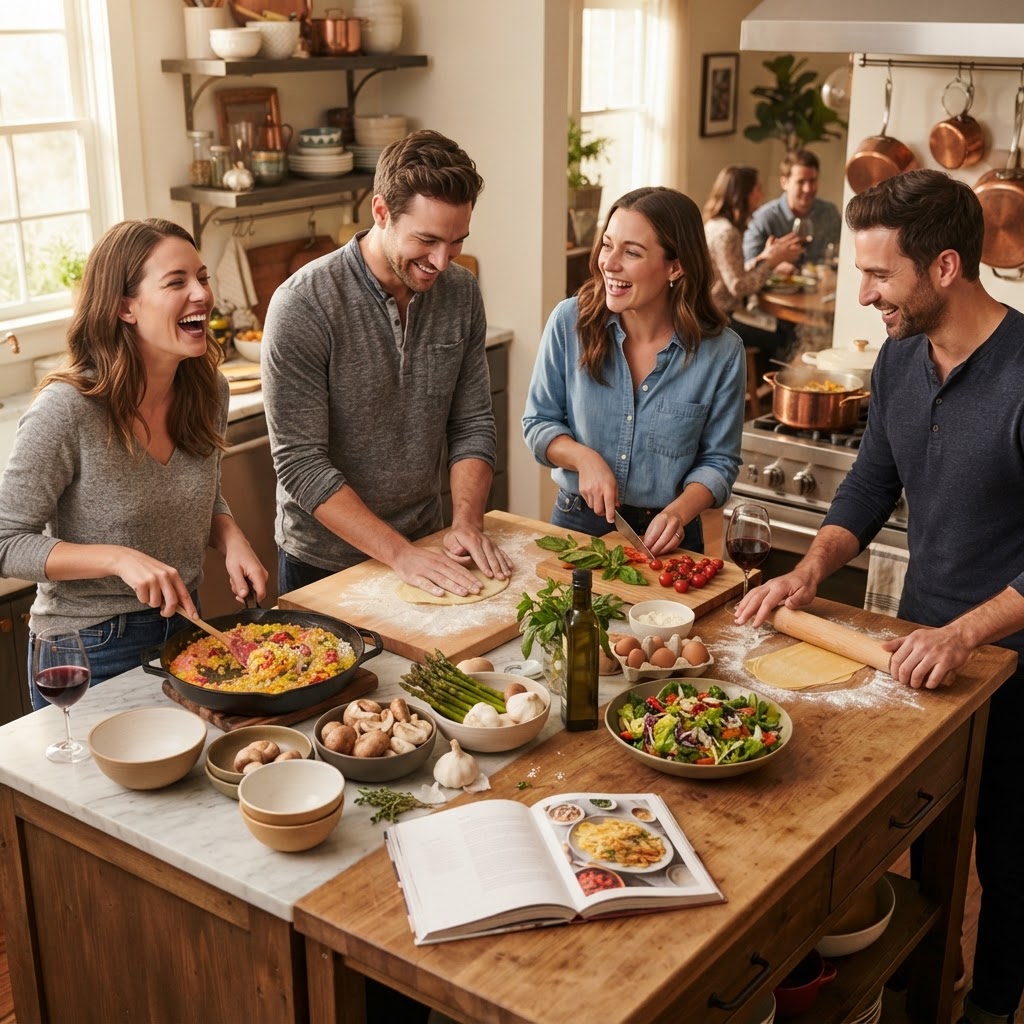
The solution, which I have championed in my own home for years, is the interactive "Cook-Along" dinner party. By inviting your guests to step behind the curtain and participate in the preparation of the meal, you transform the kitchen from a place of stress into the vibrant, beating heart of the evening. This approach demands a shift in mindset—you aren't trying to deliver a Michelin-starred execution in total isolation; you are curating an experience centered on connection, education, and the tactile joy of food. When guests are involved in the process, they become invested in the outcome, leading to a much more relaxed and meaningful culinary event.
Of course, this strategy requires a level of logistical precision that many home cooks overlook. It isn't about letting guests run wild in your workspace; it is about providing clear, structured tasks that allow everyone to contribute without turning your kitchen into a chaotic free-for-all. With the right mise-en-place, a well-planned menu, and a firm grasp on the rhythm of a kitchen, you can host an evening that feels professional yet intimate. Let us discard the pretense of the perfect, solitary host and embrace the collaborative magic of cooking together, where the "Blame The Chef" attitude is replaced by a team effort that tastes twice as good.
Planning the Menu for Maximum Participation
The first mistake most hosts make is choosing a menu that is far too technically difficult for a room full of people. If you are planning to host a cook-along, you must select dishes that are modular—meaning they can be broken down into discrete steps that don't require professional training. Think of components like assembly-based appetizers, fresh pasta, or customizable garnishes. The goal is to provide your guests with enough activity to feel engaged, but not so much pressure that they feel like they are working a double shift in a restaurant.
Choosing "Low-Risk" Components
When you are selecting your menu, prioritize dishes that have a high "wow" factor but a low barrier to entry. Fresh pasta is a classic choice for a reason: it is tactile, forgiving, and requires nothing more than high-quality flour and farm-fresh eggs. Another great option is a raw bar setup or a sophisticated taco night where the focus is on the precision of the toppings. You want to avoid recipes that require constant monitoring or high-stakes timing, such as a temperamental soufflé or a perfectly seared steak that needs to rest at an exact temperature.
"The true success of an interactive dinner party lies in the ability to give guests a sense of ownership over the final dish without sacrificing the quality of the meal itself."
Organizing the Workflow
Think like a restaurant chef and create a prep list for your guests before they even walk through the door. If you want everyone to help make ravioli, have the pasta dough already kneaded and rested, and have the filling pre-portioned into piping bags. By doing the heavy lifting yourself in the hours leading up to the event, you ensure that the guest participation remains fun rather than tedious. Break the cooking process into stations: one for rolling, one for filling, and one for boiling. This keeps traffic flow manageable and ensures that no one is bumping elbows.
The Importance of Mise-en-Place
In professional kitchens, mise-en-place—literally "everything in its place"—is the religion that keeps us from sliding into madness. For an interactive party, this principle is doubly important. If your ingredients aren't measured, washed, chopped, and set out in accessible containers, you will spend your entire night hunting for the salt or explaining where you keep the extra dish towels. Your goal is to create a station for each guest or team of guests, ensuring that they have every tool they need within arm's reach.
Setting Up Stations
Imagine your kitchen as a series of work cells. Each station should be equipped with a cutting board, a sharp knife, a clean kitchen towel, and a small scrap bowl for waste. Having these items pre-arranged communicates professionalism and makes it clear to your guests exactly where they should be working. It prevents the "what do I do now?" confusion that typically stalls a group dynamic. When everything has a dedicated spot, the kitchen becomes a calm environment rather than a scene of chaos.
Ingredient Prep and Ratios
Before the party begins, spend time doing the "grunt work." If you are making a pesto, have the basil leaves picked and washed, the pine nuts toasted, and the parmesan grated. If you are making a cocktail, have your syrups, citrus juices, and garnishes ready to go in organized glass vessels. Use a 1:2 ratio for your vinaigrettes or a 2:1:1 ratio for your cocktail bases to make it easy for guests to follow instructions without asking you a dozen questions about measurements.
Guiding the Flow: The Chef as Facilitator
When you move from being a solo cook to an interactive host, your role changes significantly. You are no longer just the person cooking; you are now the culinary facilitator. This means your success is measured by how well your guests understand their tasks, not by how perfectly you can dice an onion in under ten seconds. You need to be able to delegate clearly, provide positive reinforcement, and keep an eye on the clock without appearing stressed.
Delegation and Instruction
Clear, concise instructions are vital. Avoid jargon unless you explain it, and always demonstrate a task once before letting a guest take over. For example, if you are teaching someone how to properly slice scallions for a garnish, hold the knife correctly yourself, show them the grip, and then let them practice on a few pieces while you provide feedback. Use phrases like "keep your fingertips tucked under" or "let the weight of the knife do the work." This empowers your guests and makes them feel like they are learning a genuine skill.
Managing the Timing
One of the most difficult parts of a cook-along is managing the transition from cooking to eating. You must build in "cushion time" to account for the fact that a group of amateurs will always cook slower than a professional. If you expect a recipe to take twenty minutes of active work, budget forty minutes for your party to complete it. Use the natural lulls in the cooking process to pour wine, top off glasses, or encourage conversation. The goal is to keep the energy moving without making it feel like a race.
"A great host knows that the dinner party isn't just about what is served on the plate; it is about the story told by the people who helped prepare it."
Safety First: Creating a Controlled Environment
It might be a party, but your kitchen is still a workplace with sharp blades, open flames, and high-heat equipment. Safety is non-negotiable. Before you allow guests to pick up a knife or handle a hot pan, you must establish some ground rules. This doesn't need to be a lecture, but a quick, friendly briefing at the start of the evening is essential. It keeps your guests safe and protects your own peace of mind.
Knife Skills and Safety
Start by ensuring your knives are exceptionally sharp; a dull knife is more dangerous than a sharp one because it requires more pressure and is prone to slipping. Briefly demonstrate the claw grip (curling the fingers of the non-dominant hand to guide the knife) to everyone who will be doing prep work. If you have guests who are clearly uncomfortable with knives, give them tasks that don't involve chopping, such as mixing ingredients, plating, or garnishing.
Heat Management
Keep a designated "hot zone" on your stove where only you or very experienced guests operate. Use clear communication: if you are moving a hot pot, announce "behind" or "hot pan coming through." Keep pot handles turned inward away from the edge of the stove to prevent accidental spills. If you have a deep-frying or high-heat searing element, consider keeping that entirely off-limits to guests to prevent oil splatters or burns. Safety is about setting boundaries so that everyone feels comfortable enough to relax.
Selecting the Right Recipes for a Group
The biggest trap for the interactive host is choosing recipes that are too complex to manage with multiple sets of hands. You want to look for dishes that rely on high-quality ingredients and straightforward techniques rather than complex culinary physics. The best interactive dinner party recipes are those where the assembly is the point of the dish, such as build-your-own spring rolls, a sprawling mezze platter, or a dessert station that requires guests to torch their own crème brûlée.
Pasta and Doughs
Fresh pasta is the gold standard for cook-alongs. The dough can be made ahead of time, and the act of rolling and cutting is incredibly social. Provide a few different shapes and offer a selection of sauces so that guests can customize their portions. This allows for a great deal of personalization and keeps everyone actively engaged in the creation of their own dinner. Remember, you want to focus on high-hydration doughs which are easier for beginners to work with.
The "Build-Your-Own" Concept
"Build-your-own" is your best friend when it comes to stress-free hosting. Whether it is a taco bar with pickled red onions, fresh cilantro, charred corn, and lime wedges, or a composed salad station where guests assemble their own bowls with artisanal greens, vinaigrettes, and toasted nuts, these setups take the pressure off the host. You are providing the components; the guests are providing the creativity. This style of dining ensures that every guest has something they enjoy and eliminates the "I don't like mushrooms" problem entirely.
Creating the Atmosphere: Music, Lighting, and Wine
A kitchen is not just about the food; it is about the environment. If you want people to feel comfortable, you have to curate the sensory experience. Music should be upbeat but not so loud that it interferes with instructions. Lighting should be bright enough to work by but warm enough to feel inviting. And the wine? Keep it flowing, but offer something that is easy to drink while standing up and moving around—a crisp white or a light, chilled red is often better than a heavy, complex vintage that demands deep contemplation.
Curating the Vibe
Think about the flow of the evening. Start with high-energy music while you are doing the initial prep work, and then transition into something a bit more mellow as you sit down to eat. Keep your lighting warm. If your kitchen has harsh overhead lights, consider using under-cabinet lighting or small lamps to create a more intimate feel. The kitchen should feel like a destination, not just a service area.
Wine Pairings for Participation
Don't worry about perfect, sommelier-level pairings. Choose wines that are crowd-pleasers. Since your guests are participating in the process, they will be appreciative of whatever you serve, but it helps if you explain why you chose a particular bottle—perhaps it highlights the acidity of the lemon in the sauce, or it pairs beautifully with the earthy notes of the herbs you are using. This adds another layer of education to the evening without being overbearing.
The Art of Plating and Presentation
Even if your guests are involved in the cooking, the final presentation still matters. This is where you can take the meal from "home cooking" to "restaurant quality." Use the time while the pasta is boiling or the roast is resting to set the table properly. Even if you are eating in the kitchen, a beautiful table set with linen napkins, fresh flowers, or simple candles elevates the experience significantly. Teach your guests the basics of plating: height, contrast, and clean edges.
The "Clean Rim" Rule
A simple rule to teach your guests: never serve a plate with smudges on the rim. Use a clean, dry cloth to wipe the edges of every plate before it hits the table. This one small action immediately makes the meal feel more intentional and polished. Encourage guests to add a garnish at the last second—a dusting of fresh herbs, a drizzle of high-quality olive oil, or a crack of black pepper—to provide that final visual pop.
Enjoying the Result
When the food is ready, the transition from "cook" to "eater" should be seamless. Gather everyone around the table, pour a fresh round of wine, and take a moment to acknowledge the team effort. By involving your guests in the process, you have created a shared experience that goes far beyond just eating. You have built a memory, and that is the true purpose of a dinner party.
Final Thoughts
The "Cook-Along" dinner party is ultimately a lesson in letting go. As a host, your job is to create the space, provide the tools, and guide the process, but the magic happens when you hand over a portion of that control to your friends. When we remove the performance pressure of being the perfect chef, we open the door to genuine connection. Yes, there will be flour on the floor and perhaps a sauce that is slightly too salty, but these are the moments that make a dinner party memorable.
Remember that the success of these evenings is not measured by the absolute perfection of the final dish, but by the level of joy in the room. If your guests are laughing, learning, and feeling like they contributed to the meal, you have succeeded. Do not be afraid to lean into the imperfections. In the world of "Blame The Chef," we know that the best meals are the ones where we embrace the chaos and enjoy the company. So, clear off the counter, sharpen your knives, and invite your friends into the kitchen. You might be surprised by how much better the food tastes when everyone has a hand in the pot.
Hosting is a craft, much like cooking. It requires practice, patience, and a willingness to adapt. As you continue to refine your cook-along events, you will find that you become more confident in delegating tasks and more comfortable in the role of a facilitator. Each event will become easier and more rewarding. Start with a small, manageable menu, work on your communication, and prioritize the comfort of your guests. Before long, your dinner parties will be the highlight of your social calendar, not just for the food, but for the collaborative spirit that defines them.
If you find yourself worried about the outcome, remember the ultimate culinary philosophy: keep it fresh, keep it simple, and keep it fun. Your guests are not there to judge your kitchen skills; they are there to share in your company and your home. By shifting the focus from individual performance to team effort, you eliminate the stress that so often keeps people from hosting. It is time to reclaim the kitchen as a space for hospitality, not just a site for labor. The next time you plan a dinner, don't try to be a lone hero—be a team leader, and enjoy the result.
After all, the kitchen is the soul of the house. When you open it up to your guests, you are opening up your home and your life to them in a way that goes far beyond a simple dinner. Whether you are rolling pasta dough, assembling a complex taco spread, or just pouring a glass of wine while a colleague whisks a sauce, you are building relationships through the universal language of food. Trust the process, trust your guests, and remember that even if the souffle falls, the company is what will be remembered years from now. This is the art of the cook-along, and it is a craft worth mastering.
Finally, do not forget the post-dinner ritual. A good host helps with the cleanup but doesn't make the guests feel like they are doing manual labor. Keep the conversation flowing, maybe open a digestive, or put on a record. The evening ends when the last guest leaves, but the sense of accomplishment you feel will last much longer. By embracing this collaborative style of entertaining, you ensure that you aren't just a chef in the kitchen; you are a host in the true, welcoming sense of the word. Keep cooking, keep hosting, and keep sharing the joy. That, in essence, is the "Blame The Chef" way.
To summarize the key takeaways for your next event:
By following these principles, you will find that the chaos you once associated with hosting a dinner party is replaced by a sense of calm and genuine enjoyment. You will be able to engage with your guests, participate in the cooking process, and actually eat the food you helped prepare. It is a win-win for everyone involved, and once you make the switch to this style of entertaining, you will likely never go back to the solitary, stressful dinner party model again. Embrace the cook-along, and watch your social life—and your kitchen skills—thrive.

Get the Next Recipe
Weekly recipes, techniques, and gear picks — straight to your inbox.
