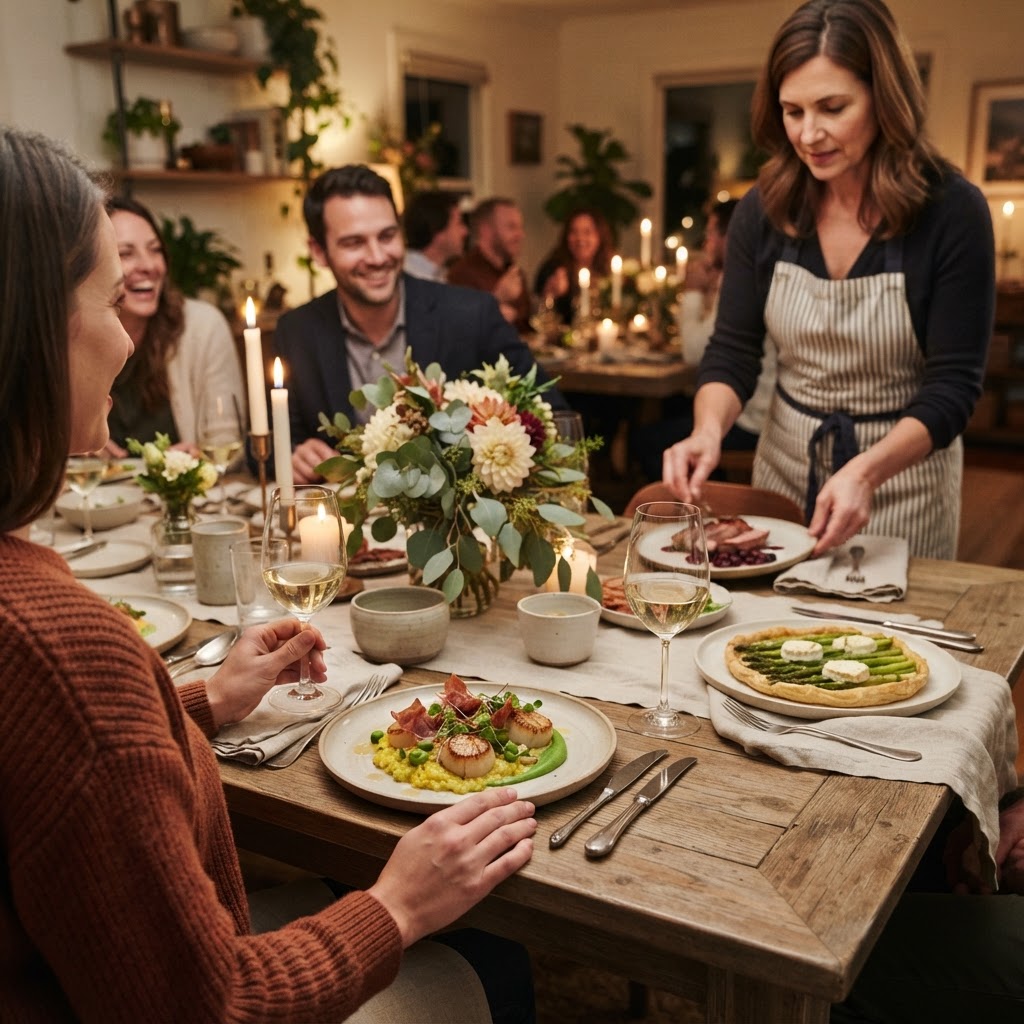
The Art of the "Course-by-Course" Pacing: Mastering Time-Cushioned Prep for Stress-Free, Multi-Course Hosting
The intimidation factor of hosting a multi-course dinner party often stems from a fundamental misunderstanding of the kitchen workflow. Many home cooks view a four-course menu as a series of chaotic sprints, racing to plate the appetizer while simultaneously monitoring the roast for the main. This adrenaline-fueled approach is a recipe for scorched sauces, tepid soups, and a host who spends the entire evening sequestered behind the stove rather than engaging with guests. True culinary hospitality is not defined by how much sweat you break, but by the seamless fluidity of the transition between plates. By shifting your mindset from "cooking a meal" to "curating a timeline," you transform your kitchen into a professional-grade environment where timing is a tool rather than a tyrant.
Mastering the art of time-cushioned prep requires a departure from the "cook as you go" mentality that many amateur chefs cling to. Instead, we must embrace the philosophy of mise en place—the French culinary practice of having everything in its place before the flame is ever ignited. When you decouple the heavy lifting of prep from the high-pressure window of service, you reclaim your role as a host. It is about understanding that heat management, ingredient resting times, and structural integrity are variables you can control hours before the first doorbell rings. If you find yourself chopping onions while your guests are already sipping their pre-dinner cocktails, you have already lost the battle against the clock.
In this guide, we will dismantle the complex anatomy of a multi-course dinner to show you how to build a production schedule that ensures you remain calm, composed, and present. Whether you are orchestrating an intimate dinner for four or a grand affair for twelve, the principles of professional pacing remain universal. We will explore how to manipulate temperatures, leverage low-and-slow cooking, and utilize strategic holding techniques to keep your food at its peak without requiring your constant presence at the range. Forget the frantic kitchen panic; it is time to learn how to host with the calculated, cool precision of a seasoned executive chef.
The Foundation of The Timeline: Reverse Engineering Your Menu
The biggest mistake most home cooks make is working forward from the start time, rather than backward from the desired serving moment. If you want your guests to be eating their main course at 8:00 PM, you must work backward to determine when the protein needs to go into the oven, when the vegetables should be blanched, and when the sauce reduction needs to reach its final viscosity. A production sheet is your most important tool, acting as a tactical map that prevents the cognitive overload of trying to keep track of four different recipes at once.
Why You Need a Production Sheet
A production sheet should be broken down into discrete phases: advance prep, day-of prep, holding phases, and service execution. When you write down these tasks, you aren't just making a list; you are allocating the energy required for each culinary component. By identifying which tasks can be completed 24 hours in advance, such as making stocks or marinating proteins, you ensure that your work on the actual day is limited to final assembly and heat application.
"A kitchen is not a place for improvisation during a dinner party; it is a laboratory where the results of your preparation are finally revealed to the world. If you haven't prepared the path, you are simply walking into a trap."
The 24-Hour Rule
Professional kitchens operate on a system where 80% of the work is done before service begins. Aim for this same ratio in your home kitchen. If you are serving a slow-braised short rib, the braising liquid should be reduced and the meat finished a day early. This allows the flavors to meld and, more importantly, permits the meat to firm up, which makes slicing or portioning significantly cleaner and easier. When you remove the pressure of "finishing" everything at once, you find that the actual plating process becomes a rhythmic, meditative experience.
Strategic Temperature Management: The Power of Low-Heat Holding
Temperature control is the hidden architecture of a successful multi-course meal. When hosting, you often face the problem of a large roast or a vegetable side losing its luster because it has been sitting in a pan that is slowly cooling. To master the art of time-cushioned prep, you must learn to utilize your oven's "warm" setting or a dedicated warming drawer as a legitimate station for food stabilization. This isn't about keeping food "hot"; it's about holding it in the thermal sweet spot.
Mastering Resting Times
Protein resting is perhaps the most neglected aspect of home cooking. For a large roast, such as a ribeye or a tenderloin, you should plan for a minimum of 30 to 45 minutes of resting time under loose foil. During this period, the internal juices redistribute, ensuring that every slice is succulent. This resting period acts as your greatest asset—it is a built-in time buffer that allows you to finish your side dishes or plate the previous course without hovering over the protein.
The Role of Insulated Holding
Invest in high-quality insulated thermal containers or simply use a heavy-duty cooler. If you have prepared a side dish like a complex grain salad or a potato gratin that is fully cooked, wrapping it in foil and placing it in a well-insulated cooler will keep it at a perfect serving temperature for up to two hours without the need for reheating, which often dries out or alters the texture of the food.
Proteins:* 120°F (rare) to 135°F (medium) before resting.
Vegetables:* Held at 140°F in an oven-safe dish.
Sauces:* Held in a double boiler or a thermos if consistency allows.
Plating Strategies: The Art of the "Cold-to-Hot" Transition
The transition from a cold appetizer or salad to a hot main course is where most dinner parties fall apart. The temptation is to bring the plates out and then realize the main course components are either cold or unplated. The secret here is plate warming. You should treat your ceramic plates as part of the culinary equipment. Warming plates in a low oven (150°F) or a specialized plate warmer ensures that the heat you’ve painstakingly applied to your food isn't lost the moment it hits the china.
The Mise en Place of the Plating Station
Designate a specific counter space solely for plating. This "line" should contain everything you need to execute the dish: your primary components, garnishes, sauces, and clean towels. When you plate, work in a sequence:
"Plating is the final symphony of the kitchen. If the notes are out of order, the audience will know. Keep your movements deliberate and your station clean, because visual clarity is the hallmark of a professional approach."
Managing the "Bridge" Course
If you are doing a soup or a small intermediate course, use this as a psychological break. By serving a soup, you provide yourself with a five-to-seven-minute window where you can focus entirely on finishing the searing or glazing of your main protein. Never plan a main course that requires active cooking after the soup has been served, unless that cooking is a quick 60-second sear that can be done while guests are enjoying their wine.
Ingredient Ratios and The Chemistry of Prep
To achieve professional results, you must move beyond "a pinch of this" and "a splash of that." Precision in your ratios is what allows you to predict how a dish will behave under heat. For example, a proper beurre blanc requires a precise ratio of acid to fat to maintain its emulsion. If you make it too far in advance, it will break. Knowing which components are heat-stable and which are sensitive to time is the difference between a master of the kitchen and a flustered amateur.
Understanding Component Stability
Certain ingredients thrive on time, while others perish under it.
Time-Friendly:* Braised meats, root vegetable purees, stocks, pickled elements, and certain slow-roasted vegetables.
Time-Sensitive:* Emulsified sauces (Hollandaise, Beurre Blanc), delicate herbs, fresh seafood (searing must be immediate), and crispy fried elements.
The Rule of Three for Components
When designing a complex dish, try to limit it to three main textures: a soft base (purée), a firm main (protein), and a crisp finish (garnish). By adhering to this rule, you streamline your prep. Instead of making five different components that all need to be finished at the same time, you focus on three. This reduces the number of pans on the stove, which directly correlates to less stress during the "service" window.
Equipment as an Extension of Your Workflow
Your tools are your assistants. If you are struggling with poor-quality pans that fluctuate in temperature, you will struggle to maintain the pacing of your meal. High-mass cookware, such as cast iron or tri-ply stainless steel, is essential for hosting because it holds heat efficiently, allowing for a more forgiving margin of error. If you remove a pan from the heat, a heavy-duty pan will stay warm enough to finish the process, whereas a thin pan will lose its heat instantly.
The Utility of the Vacuum Sealer
If you have access to a sous-vide machine or even just a standard vacuum sealer, you have found the ultimate secret to stress-free hosting. Vacuum-sealing your proteins with herbs and aromatics allows you to cook them perfectly in a water bath, where they can hold at the target temperature for hours without ever overcooking. When the time comes to serve, you simply remove the meat, pat it dry, and give it a hard sear in a hot pan for thirty seconds. This eliminates the "is it done yet?" panic entirely.
Measuring and Labeling
Do not trust your memory. Use deli containers to portion out your mis-en-place and label them with masking tape and a sharpie. Labeling the contents and the time they need to be introduced to the heat ensures that you can delegate tasks if someone offers to help. A well-labeled kitchen is one that can be navigated by anyone, keeping the "Chef" (you) free to manage the overall flow rather than getting stuck in the weeds of searching for a missing spice jar.
The Art of the "Cool-Down" and Reheating
Sometimes, you need to cook a dish entirely, cool it down, and then reheat it to service temperature. This is a common practice in restaurants known as "retherming." The key to successful retherming is understanding the moisture-to-fat ratio. If a dish loses moisture, it becomes grainy or tough. To prevent this, always reheat your components with a small amount of liquid—a splash of stock, a knob of butter, or a teaspoon of cream—to restore the original integrity of the emulsion or the sauce.
The "Refresh" Technique
When reheating vegetables, use a steam basket rather than a microwave or a pan. Steaming gently warms the product without subjecting it to the harsh direct heat of a burner, which can overcook delicate greens like asparagus or haricots verts. A quick 60-second steam with a light seasoning of finishing salt and high-quality olive oil will make the vegetables taste as though they were cooked seconds before hitting the plate.
Managing Sauce Reductions
If your sauce is intended to be a concentrated glaze, do not reduce it to the final consistency until the moment of service. Reduce it to 90% of the desired viscosity, hold it, and then add the final splash of liquid or cold butter to bring it to a glossy finish right before the plate leaves the kitchen. This technique, called mounting with butter (monter au beurre), adds a professional sheen and ensures the sauce doesn't break or become overly salty as it sits.
Managing Your Guests: The "Host as Conductor"
Hosting is not just about the food; it is about the pace of the room. As the chef and host, you are the conductor of the evening’s tempo. If you are rushing through the courses because you feel the need to "get it over with," your guests will feel that anxiety. Conversely, if you are lingering in the kitchen, the disconnect will be palpable. The goal is to be in the kitchen only when necessary. If you have followed the time-cushioned prep plan, you should only be in the kitchen to perform the final "assemble and plate" maneuvers.
The Role of Conversational Buffers
Plan your courses around the natural flow of conversation. An appetizer that is light and easy to handle allows for continued dialogue. The main course should be substantial enough to warrant a slightly longer break in the conversation, allowing guests to focus on the dining experience itself. Between courses, offer a light palate cleanser or simply allow the wine to breathe. This spacing is vital for the digestion of the meal and the enjoyment of the night.
Handling the "Kitchen Intruder"
Every host knows the guest who insists on helping in the kitchen. While well-intentioned, this can be a disaster if you are on a tight schedule. Direct them to tasks that are low-risk and high-reward: pouring the next round of wine, lighting candles, or clearing the appetizer plates. Never let a guest manage a burner or a knife if you have a complex sequence of plates to execute. Kindly but firmly maintain your station; it is for their safety and for the success of your meal.
Final Thoughts
The art of the multi-course dinner is a performance, but the performance should be invisible to your audience. When you master the timing of your prep, you move from a state of reactive panic to one of proactive choreography. You learn that by investing time in the early stages—by creating the production sheet, by managing your temperatures, and by respecting the science of ingredient stability—you are actually buying yourself the most valuable ingredient of all: time. Time to converse, time to pour a glass of wine, and time to enjoy the very meal you have worked so hard to create.
Remember that perfection is not about the absence of mistakes, but the ability to manage the variables. Even the most seasoned professional chef experiences a dish that doesn't plate quite right or a reduction that needs a little extra coaxing. The difference is that the professional knows how to fix it without the guests ever noticing the discrepancy. When you approach your kitchen with a clear head and a well-mapped plan, you are no longer just cooking for others; you are crafting an experience that lingers in their memory long after the last course has been cleared.
As you move forward, keep your tools sharp, your production sheets detailed, and your focus on the rhythm of the evening. Hosting is a gift of hospitality, and the greatest gift you can provide is a host who is present, relaxed, and ready to share in the joy of the meal. Take these techniques, apply them to your next gathering, and watch as your kitchen transforms from a place of pressure into a sanctuary of culinary success. The stress of the dinner party is a choice; today, you have chosen to leave it behind.
Get the Next Recipe
Weekly recipes, techniques, and gear picks — straight to your inbox.
