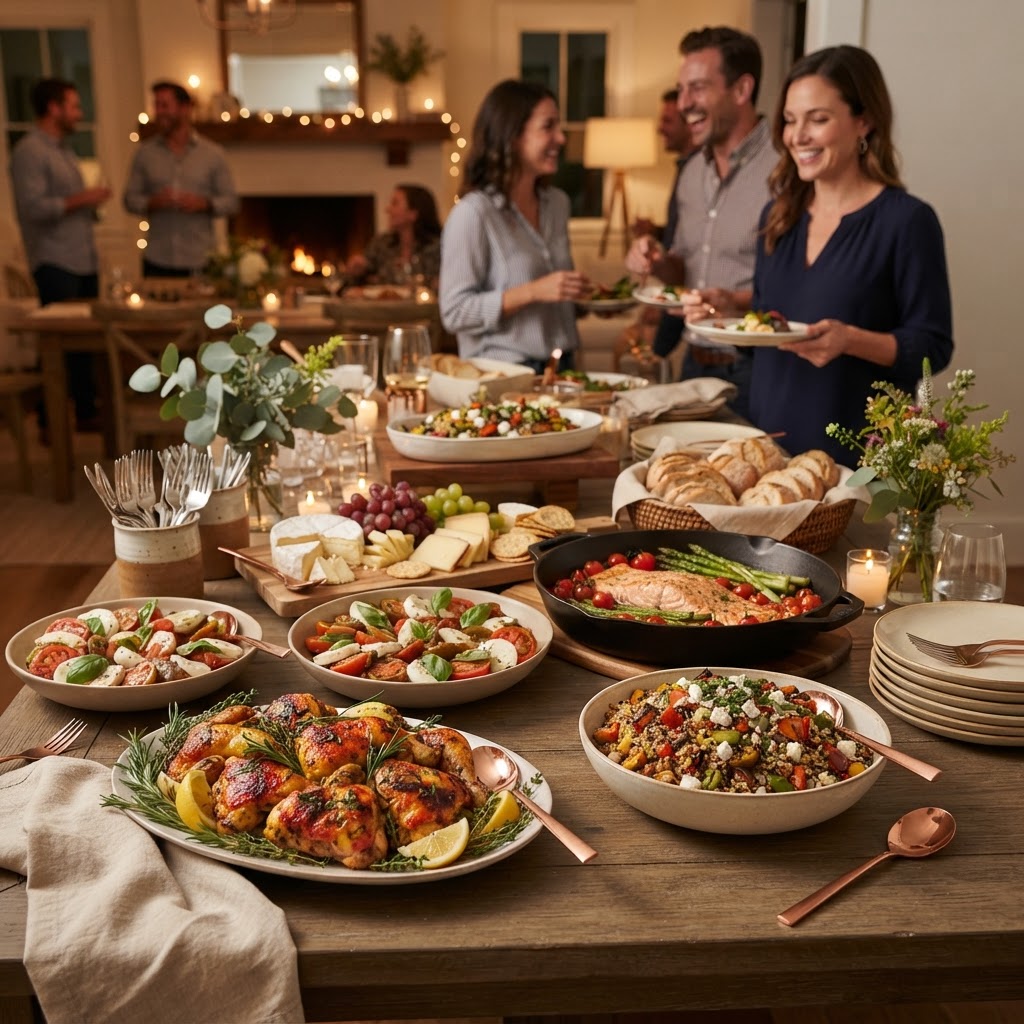
The Art of the "Help-Yourself" Buffet: Designing Self-Service Stations That Keep Guests Mingling and Your Kitchen Stress-Free
There is a persistent, nagging myth in the world of home entertaining that suggests a successful party requires the host to be a tethered servant, eternally bound to the oven or the stove while guests hover awkwardly in the living room. We have all been there—trying to balance a tray of appetizers in one hand while frantically checking the internal temperature of a roast in the other, feeling the distinct sting of social isolation even in a room full of people. This approach to hosting is, quite frankly, a recipe for exhaustion that leaves you with nothing but a pile of dirty dishes and the hollow feeling of having missed the actual event. The "Help-Yourself" buffet, when executed with the precision and foresight of a professional caterer, dismantles this barrier entirely, shifting the focus from labor to luxury. By transforming your kitchen or dining area into a curated ecosystem of self-service stations, you reclaim your role as the life of the party rather than the martyr of the kitchen.
At its core, a well-designed buffet is a exercise in culinary logistics, requiring the same attention to flow, temperature control, and accessibility that we apply in a high-volume restaurant. Many home cooks make the mistake of setting out a sprawling table of food that creates a bottleneck, leading to frustrated guests and neglected dishes that sit too long in the "danger zone." A professional strategy involves mapping out your space to encourage organic movement, ensuring that a guest’s journey from plate to cocktail is seamless and intuitive. When you strategically place drinks, silverware, and side dishes in different zones, you eliminate the single-point congestion that characterizes amateur hosting. It is about creating a rhythm where people can graze at their leisure without ever feeling like they are interrupting the kitchen workflow.
The beauty of the self-service model lies in its ability to be pre-planned, allowing you to execute the vast majority of your mise-en-place before the doorbell even rings. By choosing dishes that hold their integrity at room temperature or benefit from gentle warming, you effectively fire your own internal "chef" and hire a more relaxed version of yourself. This shift is not just about convenience; it is about providing a high-quality experience that feels intentional and elegant. We are moving away from the clutter of mismatched plastic containers and toward the curated aesthetic of a bistro display. When you master these principles, the kitchen ceases to be a place of stress and instead becomes the vibrant, beating heart of your home where lingering conversations and delicious food become synonymous.
The Architecture of Flow: Designing Your Service Zones
The single biggest mistake home hosts make is the "Single Table Trap," where every item of food, drink, and hardware is jammed onto one surface. This guarantees a line, a spill, and a guest who feels guilty for taking too long to choose their entree. To host like a pro, you must embrace spatial segmentation. Divide your offerings into distinct stations: the Beverage Bar, the Main Platter Station, and the Dessert or Digestif Nook. By spreading these across different rooms or corners of a large room, you invite guests to move through your home, keeping the energy dynamic and preventing any one area from becoming a static trap.
The Power of Peripheral Placement
For an efficient flow, always place your beverage station furthest from the food. Guests will naturally gravitate toward a drink upon arrival, and if that station is positioned near the entrance, you prevent the initial "landing" crowd from clogging up the kitchen space where the main food resides. Use a dedicated cart or a side table for glasses, ice, and beverages, keeping it stocked with proportionate glassware. A professional tip: ensure your beverage station is at least ten feet away from the hot food service. This separation encourages guests to wander, mingle, and engage with different pockets of your home.
Creating Efficient Traffic Lanes
When you organize your buffet table, think in terms of a linear assembly line. Always start with the plates—stacks of ten or twelve are ideal to prevent tipping—and end with the flatware and napkins. This way, guests do not have to juggle their cutlery while they are trying to serve themselves delicate items like a salmon fillet or a roast. If you have the space, create a "double-sided" buffet where guests can access the food from both sides of the table. This effectively cuts your service time in half and keeps the flow moving at a steady, manageable pace.
"A buffet is not merely about food; it is a masterclass in social physics. If you control the path of the guest, you control the atmosphere of the room. Keep the movement fluid, keep the stations distinct, and never let the line come to a standstill."
Managing Temperature and Food Integrity
The greatest enemy of the buffet is the inevitable slide from "perfectly cooked" to "lukewarm and unappetizing." In a professional environment, we use chafing dishes and heat lamps, but at home, you can achieve similar results with simple, clever techniques. The key is to understand that food quality is dictated by thermal mass. If you serve a large, room-temperature pasta dish in a shallow bowl, it will lose heat rapidly. If you serve that same dish in a deep, pre-heated ceramic vessel, the thermal retention is significantly higher, keeping your food in the "flavor window" for much longer.
The Art of Pre-Warming Serviceware
Before you start plating, place your serving dishes in a low-temperature oven set to 150°F (65°C). This simple step ensures that when your piping-hot main course lands on the dish, the ceramic doesn't act as a heat sink, sucking the temperature out of the food. For cold salads or chilled shrimp cocktails, do the opposite: put your glass or stainless steel bowls in the freezer for twenty minutes before service. This thermal shock prevention keeps your ingredients crisp and food-safe throughout the duration of the event.
Sustaining the Flavor Window
For dishes that require constant heat, such as braised short ribs or vegetarian curries, utilize slow cookers on their "keep warm" setting. However, ensure that you are not just dumping the food in; use a water bath technique (bain-marie) for delicate sauces to prevent them from scorching on the bottom. If you are serving proteins that need to rest, such as a whole tenderloin, slice it only partially. By leaving a portion whole, you retain the juices and prevent the meat from drying out while the rest of the piece is exposed to the air.
Temperature Safety:* Always keep hot foods above 140°F (60°C) and cold foods below 40°F (4°C).
The 2-Hour Rule:* Never leave perishable items out for more than two hours; rotate dishes out for fresh ones if the party lasts longer.
Insulation:* Use insulated serving vessels for soups or stews to maintain internal temperature without constant heat sources.
Strategic Menu Planning: The "Buffet-Ready" Checklist
Not every dish is destined to be a buffet star. When planning, you must avoid items that require last-minute assembly, such as individual seared scallops or complex pan sauces that break if they sit for five minutes. Focus on resilient ingredients that improve with time or hold their structure perfectly at room temperature. Root vegetables, sturdy grains, and slow-braised meats are the backbone of a successful self-service menu because they possess a deep, layered flavor profile that is not compromised by a little cooling.
The Role of Braising and Roasting
Braised dishes like osso buco or lamb shanks are essentially the gold standard for buffet hosting. Because they are cooked in liquid, they are self-basting and naturally resistant to the drying effects of a buffet table. For a classic, crowd-pleasing option, consider a slow-roasted brisket or a balsamic-glazed chicken thigh. These dishes are easy to serve with tongs, they look beautiful on a platter with minimal garnish, and they are forgiving if the timing of your party shifts by thirty minutes.
Texture and Acid: The Forgotten Elements
A common critique of buffet food is that it becomes "mushy" or one-dimensional. To counter this, introduce high-impact textures and bright acidity. A platter of slow-cooked meat should be paired with a bright gremolata or a crisp radish salad. This contrast serves to "cleanse" the palate between bites, making the meal feel lighter and more sophisticated. Avoid heavy, cream-laden sauces that tend to congeal; instead, opt for vinaigrettes, herb-infused oils, or reduction-based glazes that maintain their sheen and consistency for hours.
"A great buffet menu relies on the 'three-texture rule': you need something soft, something crunchy, and something vibrant. Without that contrast, your food—no matter how high the quality of the ingredients—will eventually feel like a chore to eat."
Professional Mise-en-Place for the Home Chef
If you want to be a host who actually enjoys their own party, you must adopt the philosophy of extreme preparation. In a professional kitchen, we operate on the premise that nothing is cooked "to order" if the volume is high enough. You should aim to have 90% of your cooking completed at least one hour before the first guest arrives. This is not about rushing; it is about the structural integrity of your ingredients. Many dishes, particularly stews and roasted vegetables, actually benefit from resting while the flavors marry.
The "Assembly-Only" Workflow
Your goal is to reach a state where you only need to perform "finishing" tasks once the party starts. This includes tasks like adding fresh herbs, drizzling a final vinaigrette, or setting out a garnish. These are high-impact, low-effort activities that make your food look freshly prepared without requiring you to stand over a frying pan. By prepping your aromatics, citrus zests, and microgreens in advance, you can finish a platter in thirty seconds, ensuring that your food looks like it just came out of a restaurant kitchen.
Hardware and Utensil Logistics
Nothing kills the momentum of a buffet like a guest trying to serve a scoop of mashed potatoes with a soup spoon. Ensure you have the right tools for the job. You need high-quality tongs, slotted spoons, and ladles for every single dish. If the serving utensil is too small, people will resort to using their hands or a fork, which is both unhygienic and messy. Take the time to label your dishes, especially if you have guests with dietary restrictions. A simple card with the dish name and a note about gluten, dairy, or nuts saves you from answering the same question forty times throughout the night.
Managing the "Post-Dinner" Lull
A buffet is not just about the consumption of food; it is about the transition from dinner to conversation. Once the main course is done, you want to avoid the "plate mountain" phenomenon where guests are left holding used dinner plates while they try to find a drink. Designate a bussing station—a discreet area where guests can stack their used plates. If you keep this area clear, you don't have to hover over your guests, and the room stays looking clean and inviting throughout the entire evening.
The Dessert and Digestif Strategy
Transitioning to the dessert station is the perfect time to reset the energy of the party. If your budget and space allow, set up a separate area for sweets and coffee. This acts as a "magnetic pull," encouraging guests to move from the dining space to the living area. Consider offering a self-serve coffee or tea bar with high-quality additions like cinnamon sticks, star anise, or high-end chocolate shavings. This small touch adds a layer of café-like sophistication that guests find incredibly welcoming.
Why Less Is Often More
One of the most important lessons in professional hospitality is knowing when to stop. Don't feel pressured to serve six different main courses. A perfectly executed two-protein, three-side, and one-dessert menu is vastly superior to a chaotic spread of fifteen mediocre dishes. When you focus on quality over quantity, your kitchen remains manageable, your stress levels stay low, and your guests leave with a memorable impression of a host who was present, relaxed, and genuinely enjoying their company.
The Psychology of Self-Service
There is an underlying social benefit to the "help-yourself" model that many hosts overlook. When you force guests to interact with the food, you empower them. They have the agency to decide how much of a specific dish they want, which ingredients they prefer, and how they want to assemble their plate. This reduces the pressure on you to cater to everyone’s specific palate at the table, as guests become their own curators. This shift in autonomy often leads to more adventurous eating and prevents the awkwardness of a guest receiving a large portion of something they might not be fond of.
The Art of the Conversation Piece
Use your food display as a conversation starter. A visually striking platter, such as a large roasted cauliflower with a vibrant herb oil, or a beautifully arranged board of artisanal cheeses and charcuterie, naturally draws people in. When guests congregate around a well-curated station, they are more likely to strike up a conversation with someone they don't know. By setting up the buffet as an interactive experience, you are essentially acting as a social facilitator, providing the backdrop for new connections to form.
The Importance of Confidence
Finally, remember that the most successful "help-yourself" buffets are those hosted by someone who is clearly enjoying themselves. If you are visibly stressed, running back and forth to the kitchen, or apologizing for the food, your guests will mirror that anxiety. Confidence, even if it is faked, is the secret ingredient. When you present your food with pride, explain a dish with a quick anecdote, and then step away to join the conversation, you signal to your guests that it is time for them to do the same.
"True hospitality isn't about doing everything for your guests; it is about creating an environment where they feel comfortable enough to do for themselves. When you give them permission to be at home in your space, the party truly begins."
Final Thoughts
The art of the buffet is a balancing act between structure and spontaneity. It requires you to be a strategist in the days leading up to your event, a technician during the execution, and a ghost during the service. By shifting your focus from the "doing" of the party to the "designing" of the experience, you transform your role from a harried chef into an elegant host. Remember that the ultimate goal is not a pristine kitchen or a five-course meal; it is the feeling of warmth, connection, and joy that lingers long after the last guest has walked out the door.
To master this style, start by focusing on one or two elements at a time. Perfect your braising technique, experiment with the flow of your floor plan, and practice the art of the pre-service garnish. Once you see how much freedom this approach provides, you will likely never look back at the rigid, sit-down dinner party model again. It is a liberating way to entertain that honors the food, the space, and, most importantly, the people who have gathered under your roof.
As you look forward to your next event, embrace the challenge of designing your own service zones. Test different placements for your beverage bar, experiment with the height of your serving platters, and refine your menu until it feels both personal and professional. With every party, you will learn more about what works for your specific home and your unique circle of friends. Hosting is a practice, a culinary craft that is refined through repetition and, occasionally, the helpful chaos of a well-planned gathering. So, put down the apron, step away from the stove, and let your guests do some of the heavy lifting. You have done the hard work—now it is time to enjoy the fruits of your labor with a glass of wine in hand, surrounded by the people you love. That, after all, is the true secret behind the best parties, and it is exactly why you will find that "blaming the chef" is never even an option when the host is this well-prepared. Happy entertaining, and may your next buffet be the smoothest one you have ever hosted.
Get the Next Recipe
Weekly recipes, techniques, and gear picks — straight to your inbox.
