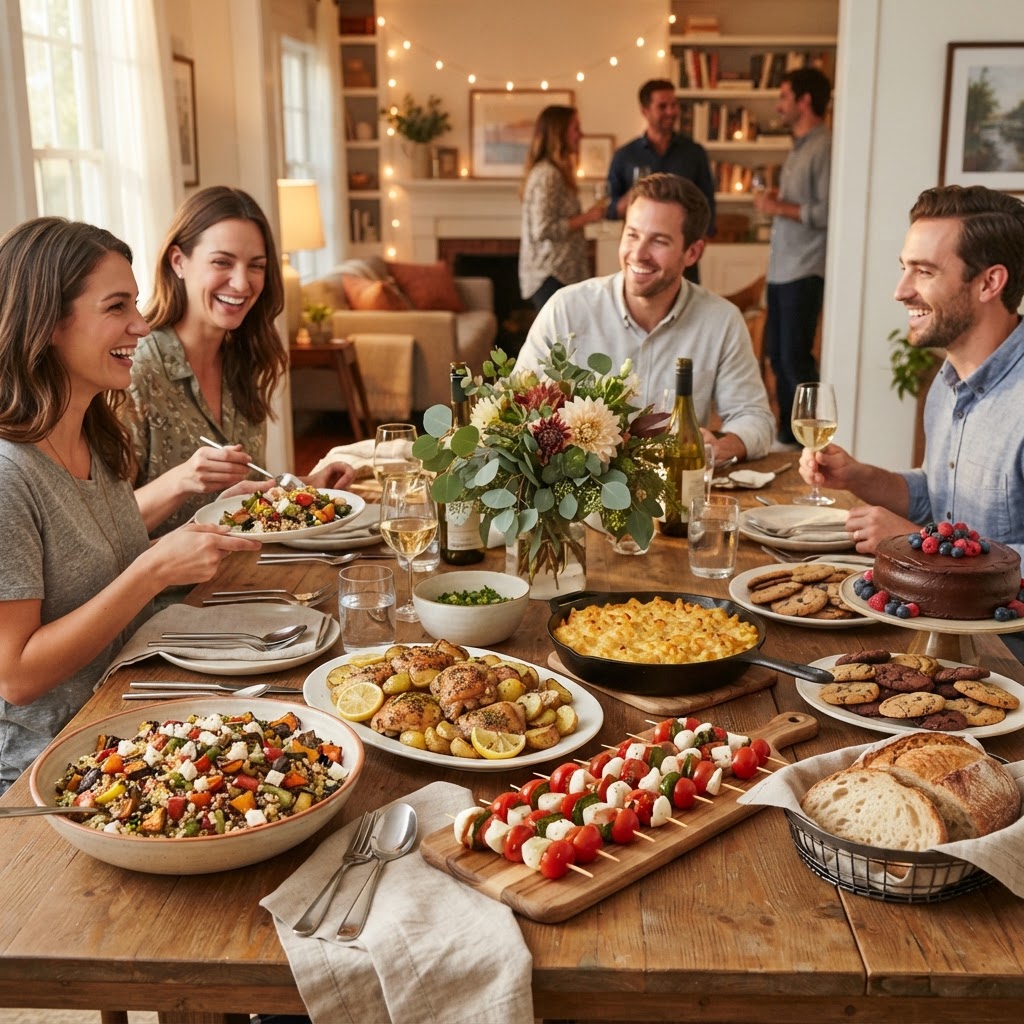
The Art of the "Progressive Potluck": Mastering Recipe Coordination and Guest Assignments for a Cohesive Hosting Experience
There is a persistent, nagging anxiety that bubbles up in the heart of even the most seasoned home cook the moment they decide to host a dinner party. It is the fear of the disjointed menu, the tactical nightmare of five people showing up with three variations of potato salad, or the dreaded "appetizer-heavy" spread that leaves guests starving for a proper main course. We have all been there, standing in a kitchen filled with aromatic but conflicting flavors, wondering why no one thought to check if the lasagna would clash with the spicy Thai basil chicken. Hosting should be an act of joyful communion, not a high-stakes logistical puzzle that leaves you frazzled before the first glass of wine is poured. By shifting our perspective from "let’s just throw some food together" to a more intentional, curated strategy, we can reclaim the evening.
The "Progressive Potluck" is not about relinquishing control or settling for a hodgepodge of leftovers; it is about orchestrated collaboration. When you host a dinner party with a theme or a specific culinary framework, you transform your guests from mere attendees into vital participants in a cohesive experience. This requires a shift in how you communicate, how you define your expectations, and how you design the flow of the meal from the first cocktail to the final scraping of the dessert plates. It turns the kitchen into a conductor’s podium, where you lead the ensemble toward a harmonious, multi-course symphony of flavors. The secret lies in the art of Recipe Coordination, a skill that balances the flexibility of a potluck with the refinement of a structured menu.
Mastering this style of entertaining requires you to lean into your identity as the architect of the evening. You are not just the person who happens to have a dining table; you are the curator of the culinary narrative. Through strategic communication—the "invite-as-manifesto"—and a keen eye for flavor profiles, textures, and dietary requirements, you can build a menu that feels effortless yet impressive. This guide will walk you through the nuances of assigning dishes, managing the logistics of temperature and timing, and ensuring that every contribution arrives at the table with the integrity your guests deserve. Let us move away from the chaos of the random contribution and toward the elegance of the coordinated feast.
Defining the Culinary Narrative: The Foundation of Cohesion
Before a single invitation is sent, you must establish the culinary arc of your evening. A cohesive meal is defined by Thematic Integrity, which ensures that the appetizers, mains, and desserts speak the same language. Whether you are aiming for a rustic Italian harvest, a vibrant Mediterranean spread, or an elevated take on classic American comfort food, every dish should feel like it belongs on the same stage. Without this framework, a guest might bring a heavy, cream-laden pasta to a menu built around light, acidic seafood, resulting in a clashing sensory experience.
Establishing Flavor Profiles
To achieve a professional level of balance, consider the Flavor Wheel. You want to ensure that your menu spans a variety of tastes—salty, sweet, acidic, bitter, and umami. If you are planning a menu featuring deep, rich, umami-forward dishes like a braised short rib, you must coordinate with your guests to ensure they are bringing sides that cut through that fat, such as a sharp, citrusy arugula salad or a pickled vegetable medley. Communication is the tool that prevents a "one-note" table.
Balancing Dietary Realities
A successful host anticipates the dietary needs of the group long before the guest list is finalized. By requesting preferences—not just allergies, but genuine aversions or lifestyle choices—you allow your guests to contribute dishes they can actually eat. This removes the stress of the host trying to accommodate twelve different dietary restrictions while simultaneously managing a roast in the oven. When everyone knows the constraints, the potential for creative, inclusive cooking expands significantly.
"A well-coordinated potluck is not a surrender of the menu; it is a masterclass in collaboration. By setting the tone, the host empowers the guest to create dishes that elevate the entire evening rather than detracting from it."
The Art of the "Invite-as-Manifesto"
Communication is the single most important factor in a successful Progressive Potluck. If you simply say "bring a dish," you are inviting chaos. Instead, frame your invitation as a mission statement. Use platforms like shared spreadsheets, group chats, or even a simple email thread to list specific categories of food you need to round out the table. Be explicit about the role each guest is playing in the culinary narrative, and watch as they rise to the occasion.
Categorization Strategies
Divide your menu into logical buckets: Amuse-bouche or Appetizers, Starch/Grains, Proteins, Seasonal Vegetables, and Desserts. When assigning these, consider the capabilities of your guests. Do not ask a novice cook to manage a complex soufflé that requires precise timing and immediate serving. Instead, ask them to provide a robust salad, a high-quality loaf of artisanal bread, or a selection of local cheeses and charcuterie.
Providing Specific Guidance
When you send the assignments, provide enough information to ensure success without stifling creativity. For example, instead of saying "bring a vegetable," say "we are looking for a bright, acidic vegetable side to cut through the richness of the main roast, perhaps something like charred broccolini with lemon and chili flakes." This gives the guest a clear target while leaving the specific execution up to their interpretation. It ensures the Flavor Balance of the meal is maintained.
Mastering Logistics: Temperatures, Timings, and Oven Real Estate
The biggest challenge in home hosting is the physics of a limited number of oven racks. When five people show up with items that all need to be baked at 350 degrees for 45 minutes, your kitchen becomes a bottleneck. Your role as the host is to act as the traffic controller, staggering arrivals and utilizing auxiliary heating methods to ensure everything arrives at the table hot.
The Strategy of Temperature Management
Always ask guests to bring dishes that are "Stable at Room Temperature" or easily reheated. A perfectly cooked piece of salmon is a disaster if it arrives lukewarm and requires ten minutes under a broiler while your guests are already hungry. Encourage guests to bring components that can be assembled on-site, such as a salad where the dressing is added at the last second, or a main dish that benefits from a brief "resting" period, allowing you to use your oven for a final, quick reheat of sides.
Utilizing Non-Oven Heat Sources
Professional chefs rely on more than just the oven. Use your slow cooker for keeping starches warm, a sous-vide bath if necessary for proteins, or even a countertop induction burner to keep sauces simmering. If a guest arrives with something that needs a quick crisping, have a designated "warm-up" station ready. Keeping the kitchen flow smooth means avoiding the "clog" where everyone is fighting for space to finish their prep work right before the meal begins.
"The true measure of a host is not in how much they cook, but in how effectively they orchestrate the flow of time and temperature. A cold dish served at the right moment is infinitely better than a hot dish served after an hour of frantic hovering."
Curation and Quality Control: Setting the Standard
There is a fine line between a potluck that feels like a shared celebration and one that feels like a collection of disparate leftovers. The key to staying on the professional side of that line is Curation. As the host, you are the quality control officer. This does not mean critiquing your friends' cooking, but rather guiding them toward success so that the entire meal feels cohesive.
The Role of Garnishes
You can bridge the gap between different culinary styles through the strategic use of garnishes. If three different people bring starch-based sides, unify them on the table by using the same garnish technique—perhaps a consistent sprinkle of fresh, vibrant herbs like chives, parsley, or microgreens, or a final drizzle of a bright, house-made chili oil. These small, Uniform Finishing Touches pull disparate dishes into a visual and flavor-based whole.
Managing Plate Architecture
Think about the table as a whole. You want a variety of heights and colors. If the table is dominated by beige starches, you have failed the visual test of a Progressive Potluck. When assigning dishes, explicitly ask for variety. "I have the beef, can someone bring a vibrant, green, crunchy vegetable and someone else bring a bright, acidic salad?" This ensures that the final result on the plate is visually balanced and nutritionally diverse.
The Art of the Table: Atmosphere as the Final Ingredient
A dinner party is more than just food; it is an environment. Even the most perfectly coordinated menu can fall flat if the atmosphere is sterile or the lighting is harsh. The Progressive Potluck should feel like a celebration of the community you have built around your table. Your job is to set the stage—literally—so that the food is received in the best possible light.
Sensory Cues
Lighting is paramount. Turn off the overhead fluorescents and embrace the warmth of lamps and candles. Curate a playlist that evolves with the meal; start with something upbeat and melodic during the appetizers, move to something jazzier and lower-tempo for the main course, and transition to ambient, soft instrumentals for dessert. These subconscious cues signal to your guests when to speed up their pace and when to linger in conversation.
The "Hosting Buffer"
Always allow for a 30-minute "buffer zone" between the arrival of your first guest and the time you intend to serve the first course. This time is for drinks, for the "assembly" of the final touches of the potluck, and for the energy of the room to stabilize. Never feel rushed, because if you are stressed, your guests will be stressed. The Progressive Potluck relies on the host’s ability to remain the calm center of the storm.
Advanced Troubleshooting: When Things Go Sideways
Even with the best planning, a disaster will occasionally strike. Maybe the oven fails, a dish arrives completely frozen, or a guest forgets their assignment entirely. The mark of a seasoned host is not perfection, but the ability to pivot. Agility is a culinary technique in itself. Always have a "pantry emergency" kit—things like high-quality crackers, quick-pickled onions, good olive oil, and sea salt—that can fill a gap if a dish arrives compromised.
The "Recovery" Mindset
If a guest brings a dish that clashes or is poorly executed, do not hide it. Instead, find a way to integrate it. Can the over-salted side be balanced with a dollop of Greek yogurt or a squeeze of fresh lemon? Can the watery vegetable be strained and tossed with a vinaigrette? Your goal is to keep the momentum going. Your guests will follow your lead; if you treat a minor mishap as a fun challenge, they will likely find it endearing rather than disappointing.
Lessons Learned
After the party, take a moment to reflect on what worked and what didn't. Did the "appetizer-heavy" problem persist? Did you have too much starch and not enough acidity? Keep a Hosting Journal. Note the successes—"the guests loved the specific pairing of the roasted carrots with the pomegranate molasses"—and the failures—"don't ask Sarah to bring dessert again, she prefers savory." This log will become your most valuable resource for future gatherings.
"True hospitality is not the absence of imperfection, but the presence of grace. When a dish fails, the host’s reaction defines the mood of the room. Keep your pantry stocked, your sense of humor sharp, and your focus on the company, not the catastrophe."
Final Thoughts
The Progressive Potluck is the ultimate expression of modern, collaborative entertaining. It shifts the burden of labor from the shoulders of one individual onto the collective joy of the group, while retaining the structure necessary for a truly sophisticated dining experience. By mastering the art of recipe coordination, clear communication, and the logistical management of your kitchen space, you are not just hosting a dinner—you are conducting an event.
Remember that the goal is always connection. Your guests are not there to critique your culinary expertise; they are there to share in the warmth of your home and the company of their friends. When you remove the stress of doing everything yourself, you open up the space to actually engage with your guests, to share stories, and to enjoy the food you have all painstakingly prepared together.
Take these principles, apply them to your next gathering, and watch how the energy changes. You will find that when everyone has a role, everyone feels a sense of ownership over the evening. The table becomes a reflection of your community, and the food becomes the medium through which you celebrate that bond. Host with intention, cook with confidence, and always—always—blame the chef if the soufflé falls. After all, the best parties are the ones where the effort is invisible, the conversation is flowing, and the food is just one part of a truly unforgettable night.
In the pursuit of the perfect Progressive Potluck, never lose sight of the fact that the secret ingredient is always the atmosphere you foster. Use your kitchen as a lab for experimentation, your living room as a sanctuary for conversation, and your planning tools as a map for success. As you continue to refine your hosting style, you will find that these strategies become second nature, allowing you to scale up from a small dinner for four to a grand feast for twenty without breaking a sweat.
We hope this guide has provided you with the foundational confidence to step into your role as a curator of experiences. The culinary world is vast and the possibilities are endless; all you need to do is organize the chaos, communicate the vision, and let the magic happen. May your ovens stay at the perfect temperature, your guests be ever-punctual, and your Progressive Potlucks be the highlight of every social season. Happy hosting, and remember: if there is a problem, simply look at your apron and shrug—the chef is only human, after all.
The evolution of your hosting journey starts with a single, well-coordinated meal. Don't be afraid to step outside your comfort zone, to try new flavor combinations, or to invite a mix of new and old friends. The dynamics of a potluck are unique because they allow for a variety of perspectives, culinary backgrounds, and tastes to collide in a single, shared space. By curating this intersection, you are creating something far more substantial than a simple dinner; you are building a tradition of shared discovery that will be talked about long after the last guest has walked out the door and the kitchen has finally been cleaned.
Stay tuned for more deep dives into the mechanics of high-functioning kitchens, the science of flavor balancing, and the philosophy of hosting in a way that prioritizes the host’s enjoyment just as much as the guests'. Until then, keep your knives sharp, your ingredients fresh, and your expectations high. The next time you find yourself staring at an empty calendar, remember that you have the tools to create a masterpiece of community and cuisine. The Progressive Potluck is waiting to be realized, one dish at a time.
For those of you looking to further refine your process, consider hosting a monthly series with a changing theme. One month might be "Street Food from Around the World," another might be "The Art of the Ancient Grains." By creating a recurring event, you build a rhythm with your guest list, allowing them to better understand your expectations and become better "Progressive Potluck" contributors over time. This reduces the friction of communication and increases the synergy of the menu. You will find that your friends start to take pride in their assignments, researching recipes that fit the theme and bringing their best efforts to the table. This is the true success of a host: inspiring others to take part in the creation of a beautiful experience.
As you close out your evening, take a moment to look at the wreckage—the empty platters, the scattered crumbs, the wine-stained glasses. These are the marks of a successful night. They are the physical evidence that you have succeeded in your primary task: gathering people together to share in the universal language of food. The work of coordination was worth it. The logistics were managed. The food was consumed with joy. And tomorrow, when you wake up, you will realize that you didn't just survive the event—you mastered it. Keep these notes, keep these lessons, and keep your doors open. The culinary life is a long one, and you have only just begun to scratch the surface of what it means to be a truly great host.
Final piece of advice: invest in good serving platters and a high-quality thermometer. These are the unsung heroes of the Progressive Potluck. They allow you to present disparate dishes with a sense of visual unity and ensure that every item brought to your kitchen arrives safely and is served at its peak. Small investments in your hosting toolkit will pay dividends for years to come. Now, go forth and coordinate. Your guests are waiting, and your next menu is already taking shape. Remember: the art of the Progressive Potluck is a journey, not a destination. Each dinner is a step toward perfection, and you are exactly the person to lead the way. Happy cooking, and may your kitchen always be a place of warmth, laughter, and perfectly balanced flavors.
Consider the role of the "host's assistant." If you have a friend who is particularly organized, don't be afraid to delegate the "spreadsheet duties." Giving someone else a role in the logistics doesn't diminish your authority as the host; it increases the sense of communal effort. This is, after all, the spirit of the potluck. When people participate in the planning, they feel a greater stake in the success of the evening. They aren't just eating your food; they are eating the food that they helped to create. This fosters a sense of pride and shared purpose that makes the meal taste even better.
Always keep an eye on the clock, but never let it rule you. A host who is constantly checking their watch is a host who isn't present. Use your phone or a smart-home timer to handle the reminders for you. Have a subtle system—a vibrating watch, a smart speaker announcement in the kitchen—that lets you know when it’s time to pull a dish out of the oven or transition to the next course. This technology allows you to be the gracious host your guests deserve, rather than the harried cook hidden in the kitchen.
Finally, remember that the most important element of any dinner party is the feeling of ease. If you are tense, your guests will be tense. If you are having fun, your guests will be having fun. The Progressive Potluck is designed to minimize your stress and maximize your enjoyment. If something isn't perfect, ignore it. Focus on the wine, the conversation, and the joy of having your favorite people under one roof. The food is merely the bridge between you and your guests. The real magic is the connection that happens across the table.
We have explored the logistics, the communication, the curation, and the atmosphere. You have the tools, the techniques, and the mindset. You are ready to host the kind of evening that lingers in the memories of your friends for months, if not years. There is no better way to spend an evening than in the company of those you care about, sharing a meal that was built through collaborative intent. You are the architect, the conductor, and the curator. Now, go make it happen. The table is set. The guests are ready. And the chef? Well, the chef is having the time of their life.


Get the Next Recipe
Weekly recipes, techniques, and gear picks — straight to your inbox.
