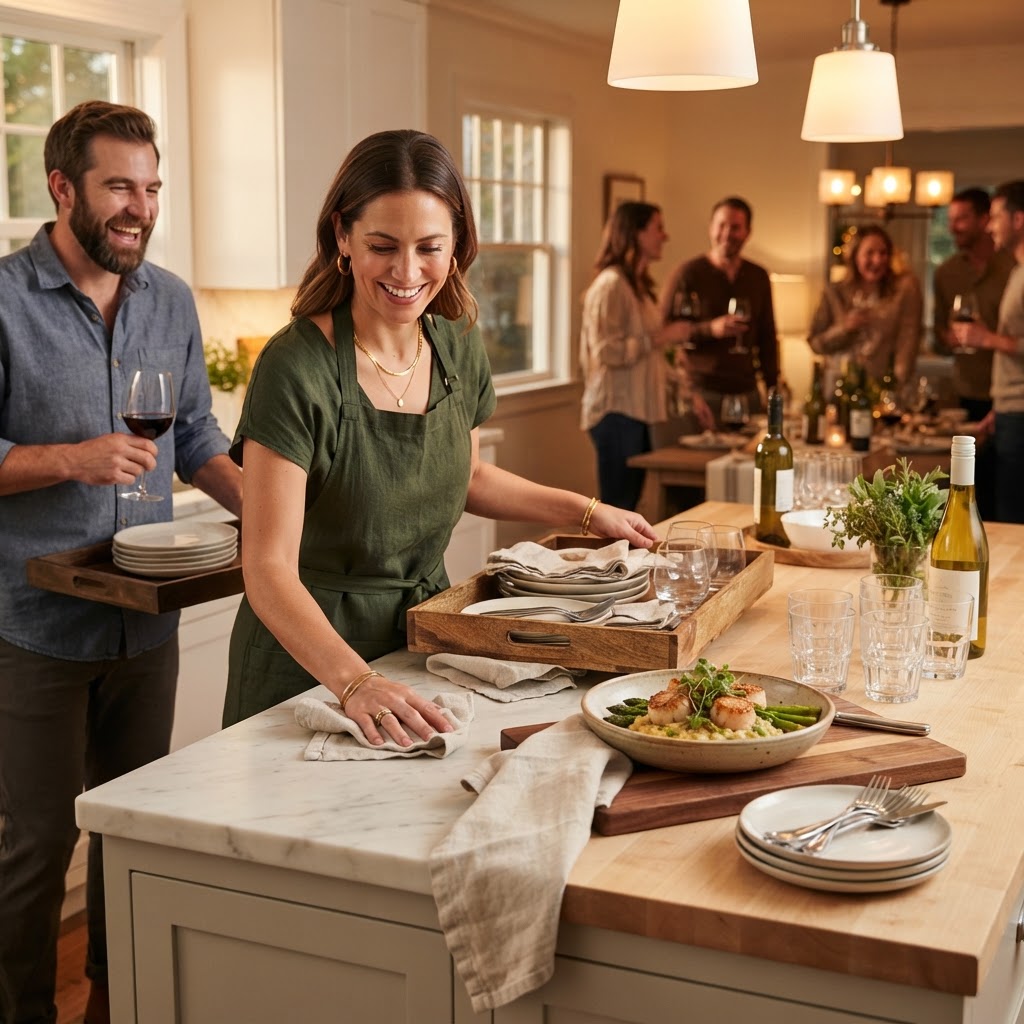
The Art of the "Strategic Refresh": Mastering Mid-Party Kitchen Resets for Seamless Dinner Flow
There is a specific, adrenaline-fueled moment in every dinner party that determines whether the host remains a calm conductor of a culinary symphony or descends into the frantic, sweat-drenched chaos of a short-order cook. It usually occurs right after the appetizers have been cleared, when the wine is flowing, the conversation is hitting its stride, and the kitchen looks like a culinary bomb went off. Most amateur entertainers make the fatal error of ignoring the wreckage in favor of the guests, only to find themselves paralyzed by a mountain of dirty prep bowls and empty ramekins when it is time to plate the main course. The secret to professional-grade hosting isn't doing everything perfectly in advance; it is mastering the Strategic Refresh, a timed, deliberate intervention that resets your workspace and your mindset. By reclaiming your perimeter mid-event, you turn a potential disaster into a choreographed performance that feels entirely effortless to your lucky attendees.
This philosophy of constant renewal is the heartbeat of a high-end restaurant kitchen, where a station that is messy for more than ten minutes is considered a fireable offense. You do not need to be a professional chef to adopt this, but you do need to understand that the kitchen is a living, breathing tool that requires maintenance throughout the night. If you allow your mise en place to disintegrate into clutter, your cognitive load increases, your timing slips, and the quality of your final dish inevitably suffers. The Strategic Refresh isn't about scrubbing the baseboards while your friends are sipping cocktails; it is about high-impact, low-effort organizational tasks that clear the mental and physical bottlenecks blocking your success. When you learn to weave these moments into the rhythm of your evening, you effectively buy yourself the most valuable ingredient in the kitchen: time.
Welcome to "Blame The Chef," where we believe that entertaining should never feel like a high-stakes endurance test. In this guide, we are going to deconstruct the anatomy of a perfect evening and show you exactly where to inject these critical resets to keep your flow seamless. We will cover the specific tools you need at the ready, the psychological triggers that signal a need for a reset, and the technical maneuvers that turn a disaster zone into a pristine plating station in under five minutes. By the time you reach the end of this post, you will view your kitchen not as a place of stress, but as a command center designed for your victory. Let us stop apologizing for the state of the kitchen and start orchestrating our hosting success with the precision and grace of a seasoned professional.
The Psychology of the Mid-Party Reset
The mental fatigue that sets in about an hour into a party is real, and it usually correlates directly with how much "visual noise" you have allowed to accumulate on your countertops. When you are surrounded by stained cutting boards, used tasting spoons, and stacks of plates, your brain is forced to process excess information, which slows your reflexes and dulls your culinary intuition. A Strategic Refresh acts as a mental "hard reboot," allowing you to refocus on the plating, seasoning, and temperature management required for the main event. By clearing the stage, you clear your head, ensuring that the second act of your dinner party is as vibrant and composed as the first.
Understanding the Cognitive Load
When you are hosting, you are constantly multitasking—monitoring the oven, checking the wine, and engaging in lighthearted banter. This is why task batching is essential. If you attempt to clean as you go in tiny, microscopic increments, you lose your flow. Instead, wait for the natural "lulls" in the evening. The best time for your first major refresh is typically the window between the end of the appetizers and the final heat-up for the main course. By training yourself to recognize these lulls as professional "reset windows," you transform a stressful period of waiting into an opportunity for organization.
The Power of the "Reset Window"
A reset window is a brief, 3 to 5-minute period where you intentionally step away from the social group to address the kitchen. Do not try to deep clean the stove; instead, focus on sanitation and staging. Use a "go-to" bin for trash, quickly wipe down your primary workspace with a damp microfiber cloth, and stack dirty dishes in a designated corner where they remain out of sight. This is not about perfection; it is about creating a clear workspace that allows you to execute your plating with confidence.
"A kitchen is not a laboratory, but it should function like one. If your workspace is cluttered, your mind is cluttered, and your food will reflect that lack of clarity."
Equipping Your Command Center
Success in the kitchen is 20 percent cooking and 80 percent preparation, and the same holds true for the organization of your hosting station. If you have to walk across the kitchen four times to find a clean towel, a spatula, or a specific spice, you are failing your own process. A Strategic Refresh requires you to have the right infrastructure in place before the first guest even knocks on the door. You should designate a "Refresh Kit" that stays accessible throughout the evening, keeping your most-used cleaning and prep items within a literal arm’s reach of your plating station.
The Essential Refresh Kit
Your kit should be minimal but highly effective. It should include the following items, kept in a small, easily accessible basket or under-counter drawer:
The Importance of "Stationary Efficiency"
Professional chefs are taught to keep their bodies centered in one spot whenever possible. This is called the "Stationary Efficiency" model. Every move you make should be calculated. By keeping your refresh tools together, you eliminate the "search time" that usually turns a two-minute reset into a ten-minute ordeal. Before the party starts, stand in your kitchen and act out the process of plating your main course; if you find yourself reaching for a tool that is across the room, relocate it to your immediate staging area. This small adjustment will save you immense amounts of energy as the night progresses.
The Art of the "Quiet Cleanup"
The sign of a truly great host is that the guests never see the effort behind the curtain. The Quiet Cleanup is a sub-discipline of the Strategic Refresh, focusing on how to manage the mess without creating a scene. This is not the time to run the dishwasher or clatter pots and pans in the sink; it is a time for silent, methodical movements that keep your workspace functional while maintaining the convivial atmosphere of the party. Use your body to mask your work, keeping your back to the guests only when necessary and utilizing silent cleaning techniques.
Silent Clearing Techniques
Avoid the dreaded clatter of metal on metal. When handling used plates or prep bowls, stack them gently. If you are cleaning a surface, use a smooth, sweeping motion with a damp towel rather than a loud, scrubbing motion that draws attention. Silence is an indicator of control; if you are making noise, you are likely rushing, and if you are rushing, you are prone to accidents. Always prioritize the acoustic environment of your kitchen as much as the cleanliness of it.
The "Under-the-Radar" Strategy
If you have a sous-chef or a partner helping, delegate the cleaning tasks that involve noise to them while you focus on the plating. If you are solo, save the heavy dishwashing for after the party ends. During the Strategic Refresh, simply "stage" your dirty dishes. Fill a large plastic tub or a corner of the sink with hot, soapy water and submerge the items. This hides the clutter, prevents crusting, and keeps your kitchen looking tidy without requiring a loud and disruptive cleanup session mid-event.
"The guest should experience the meal, not the labor. A truly seamless dinner flow is one where the host seems to have magicked the dirty dishes away, leaving only the beautiful final result."
Managing Temperature and Timing
The Strategic Refresh is the perfect time to audit your oven and stove settings. Many hosts get caught up in conversation and forget that their oven temperatures might need to be adjusted or that a sauce might need to be taken off the heat. By incorporating a Thermal Audit into your reset routine, you ensure that you never overcook a protein or break a sauce. This is the moment to check your internal probe thermometers, verify the simmer level of your stove, and make any necessary micro-adjustments to keep your food at the perfect service temperature.
The Thermal Audit Protocol
During your reset, perform these three quick checks:
The Oven Scan:* Check your oven thermometer for fluctuations. If you have multiple items in the oven, rotate the pans to ensure even browning and heat distribution.
The Sauce Check:* Taste your sauces. If they are getting too thick, have a small pitcher of stock or warm water ready to whisk in and adjust the consistency.
The Protein Probe:* If you have meat resting, check the internal temperature. If it is dropping too quickly, move it to a warmer spot or tent it more securely with foil.
Precision Timing for Service
As you approach the end of the party, your timing needs to be tighter. Use the final Strategic Refresh to set a "countdown" in your head. If the main course needs 15 minutes to reach the perfect temperature, set a silent timer on your phone. This allows you to relax and engage with your guests, knowing that you have a "hard stop" triggered by the technology in your pocket. Precision in your timing allows you to be present, because you are not living in fear of missing the window for serving your dish.
Mastering the Plating Perimeter
Plating is the final hurdle, and it is where most home cooks lose their nerve. A cluttered plating perimeter is the primary cause of sloppy, unappealing presentations. Your plating area should be as clean as a surgical theater before you begin putting food onto the final serving dishes. Use your Strategic Refresh to wipe down the rims of your serving plates with a clean, lint-free cloth. This is a small, professional touch that immediately elevates the perceived quality of your meal, making it look like it came from a five-star kitchen rather than your home stove.
The "Clean Rim" Technique
Never serve a plate with a smear or a splash on the rim. It screams "amateur." Use a soft cloth lightly dampened with high-proof vodka or a bit of water to wipe the edges of every plate before it leaves the kitchen. This technique takes seconds but transforms the visual impact of your food. It shows that you have paid attention to detail, which is the hallmark of a master host.
Organizing the Plating Line
If you are serving multiple components, treat your counter like a restaurant plating line. Place your plates in a row, then add your base (like a starch), followed by your protein, and finally your garnish or sauce. By working in a series, you ensure consistency across all plates. This also allows you to complete the entire plating process in one focused motion, minimizing the time the food spends sitting out and losing heat.
The Psychological Refresh: Reclaiming Your Host Persona
The final, and perhaps most important, aspect of the Strategic Refresh is the one that happens inside you. It is easy to get bogged down by the "host’s stress" that stems from worrying if the meal is good enough or if the guests are having fun. Your mid-party reset is the perfect time for a 30-second reset ritual. Take a deep breath, wash your hands, check your appearance in a mirror, and remind yourself that you are the architect of the evening’s joy. If you are calm, your guests will be calm. Your energy is the most important component of the entire event.
The 30-Second Ritual
When you step into the kitchen for your reset, do not just work with your hands. Work with your mind.
Step 1:* Breathe in for four counts, out for four counts. This resets your nervous system.
Step 2:* Look at your kitchen, identify one thing that is going well, and acknowledge it.
Step 3:* Put on your "host smile"—a genuine, relaxed expression that you will take back into the dining room.
This ritual helps you transition from the "cook" role to the "host" role seamlessly. You are not a servant to the kitchen; you are the master of the environment.
Managing Guest Expectations
If guests wander into the kitchen during your refresh, do not panic. This is a common occurrence. Use it to your advantage by offering them a drink or a small task. "I’m just doing a quick reset to get ready for the next course, would you mind grabbing the wine bottle from the table?" By involving them, you remove the pressure to be perfect and instead turn the kitchen into a collaborative, social space. This makes the evening feel more intimate and less like a formal, rigid production.
"The host who is having fun is the best garnish for any dish. When you master your flow, you grant yourself the permission to actually enjoy the party you’ve spent so much time organizing."
Final Thoughts
Mastering the Strategic Refresh is a journey toward becoming a more confident, relaxed, and professional home entertainer. It is not about reaching an impossible standard of perfection; it is about building a framework that supports your success so that you can focus on what truly matters: the people around your table. By implementing these resets, you create the space to be creative, the time to be present, and the calm required to handle any minor kitchen hiccups that might come your way.
Remember, the goal is not to be a chef who is chained to the stove, but a host who treats the kitchen as an extension of their social grace. The next time you find yourself staring at a pile of dishes and feeling that familiar surge of anxiety, remember the principles we have discussed today. Take a moment to reset your station, breathe through the stress, and approach your plating with the focus of a professional. You have prepared for this, you are ready for this, and your guests are going to have an incredible experience because you have taken control of the rhythm of the evening.
When you look back on your dinner party, you should remember the laughter, the stories shared, and the warmth of the room—not the pile of dirty mixing bowls in the corner. By shifting your focus from the chaos of the work to the flow of the experience, you elevate your hosting to an art form. Keep your refresh kit close, your timing tight, and your demeanor cool. At "Blame The Chef," we know that the secret to the best meals is the person holding the spoon, and with these techniques, that person is going to be the most relaxed, capable, and graceful host in the room. Now, go forth and enjoy the rest of your party—you have more than earned it.
(To ensure we continue to emphasize the importance of these rituals, consider creating a "reset checklist" for your own kitchen that you can tape to the inside of your cabinet. This acts as a physical prompt for your brain to engage in these behaviors automatically. Over time, you will find that you no longer need the list; the Strategic Refresh will simply become the natural cadence of your hosting style, woven into the fabric of every great evening you host.)
Finally, do not be afraid of the occasional imperfection. If a sauce breaks or a garnish is slightly off-center, remember that the warmth of your hospitality far outweighs the technical precision of the plate. Your friends are not there to grade your performance; they are there for the connection. By managing your kitchen effectively, you are simply removing the obstacles that prevent that connection from blossoming. Use these tools, trust your preparation, and celebrate the fact that you have mastered the art of the Strategic Refresh. You are now the captain of your kitchen, and the night belongs to you. Keep cooking, keep hosting, and never blame the chef—especially when you are the one in command. Continue to refine these steps, adapt them to your unique kitchen layout, and make them your own. The perfect party is not a destination, but a process, and you are now equipped with the map to navigate it with absolute poise. Enjoy the journey, and happy hosting!


Get the Next Recipe
Weekly recipes, techniques, and gear picks — straight to your inbox.
