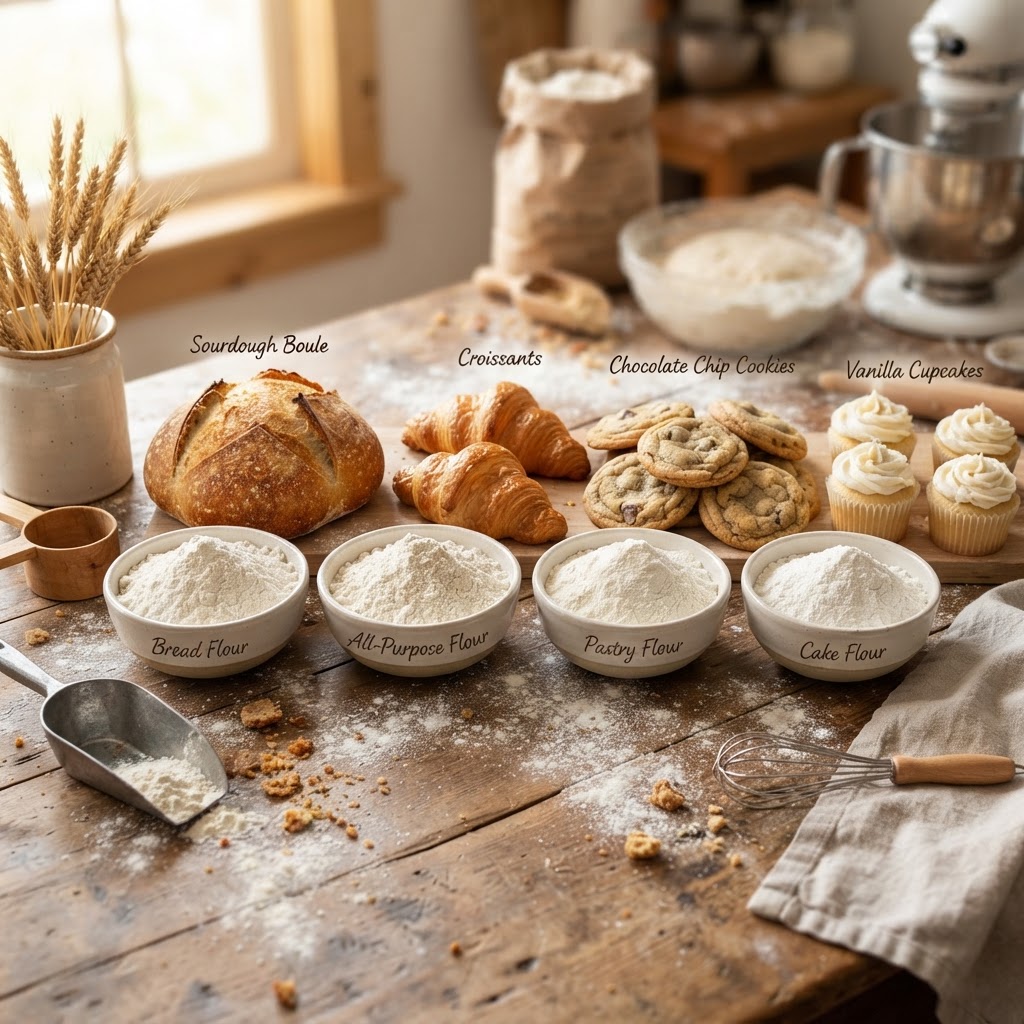
The Baker’s Guide to Flour Types: Matching Protein Content to Your Perfect Crust, Crumb, and Cookie Texture
Every home baker has stood in the grocery store aisle, paralyzed by the sheer volume of white powder staring back at them from the shelves. Is there really a difference between all-purpose and bread flour, or is it just clever marketing designed to make us clutter our pantries with specialized sacks? The truth is that flour is the literal foundation of every baked good you will ever create, and understanding its composition is the single most important step in graduating from a casual hobbyist to a confident baker. By mastering the science behind protein content and milling, you gain the power to dictate the texture of your loaves, the snap of your cookies, and the tenderness of your cakes.
At its core, flour is essentially pulverized grain, most commonly wheat, and its quality is determined by what happens after the husks are stripped away. When wheat is milled, the endosperm—the starchy interior of the kernel—is ground into the fine powder we recognize as flour. What distinguishes one bag from another is the protein content, which directly correlates to the formation of gluten when combined with water. Gluten is the elastic network of proteins that provides structure, chew, and shape to your doughs. Whether you are aiming for a pillowy, soft crumb or a dense, chewy baguette, selecting the right flour is the mechanical lever you pull to achieve your specific culinary goal.
Welcome to "Blame The Chef," where we believe that baking isn’t just about following a recipe, but about understanding the variables that make a recipe succeed or fail. Today, we are going to dismantle the mystery of the flour aisle once and for all. We will explore how different milling processes, protein percentages, and wheat varieties influence your final results. Once you grasp the relationship between protein and hydration, you won’t just be following instructions; you will be writing your own rules for the perfect crust, the most tender crumb, and the ultimate cookie texture. Grab your apron, preheat your oven, and let’s get into the nitty-gritty of grain science.
The Role of Protein: Why It Matters More Than You Think
When we talk about flour, we are really talking about two primary proteins: gliadin and glutenin. When you add liquid to flour and begin to mix or knead, these two proteins link up to form gluten. Think of gluten as a series of tiny, microscopic balloons that trap gas as it is produced by yeast or baking powder. The more protein a flour has, the stronger and more extensive this balloon network becomes. If you want a product that needs to hold its shape under the pressure of yeast fermentation, you need a high-protein flour. If you want something delicate and airy, you need low-protein flour to prevent that network from becoming too tough.
The range of protein content in commercial flours typically spans from 7% to 15%. Flours with higher protein levels are labeled as "hard" wheats, while those with lower protein levels are known as "soft" wheats. The environment where the wheat is grown, the specific variety of the grain, and the refining process all play a role in where that flour lands on the scale. For the home baker, this means that substituting one flour for another without adjusting your hydration or mixing time can lead to a flat, dense, or overly chewy failure.
Understanding Flour Strength
The term flour strength is often used by professionals to describe the flour’s ability to handle long fermentation and high hydration. High-strength flours, like bread flour, can withstand the mechanical stress of kneading without tearing. Weak flours, like cake flour, will fall apart if you try to build a significant gluten structure, which is exactly why they produce such a delicate, tender texture.
The most common mistake home bakers make is assuming that all-purpose flour is a universal tool. While it is incredibly versatile, it is often a compromise, leaning slightly toward the lower end of the protein spectrum, which makes it perfect for cookies but sometimes disappointing for rustic, high-hydration sourdough loaves.
All-Purpose Flour: The Great Compromise
If there is a workhorse in the professional and home kitchen, it is all-purpose flour. It is designed to be just that—suitable for everything from pie crusts and cookies to quick breads and pancakes. Most standard brands of all-purpose flour land between 9% and 11% protein. This moderate range is safe enough to ensure you don’t accidentally create a rubbery loaf of bread, but high enough to give a structure to muffins and tea cakes. Because it is a blend of both hard and soft wheat, it offers a balanced profile that handles a wide variety of tasks without being particularly specialized.
However, the "all-purpose" label is a bit of a misnomer. Because companies can blend different wheats to achieve their target protein number, the all-purpose flour you buy in the American South—which is often milled from softer, lower-protein winter wheat—will behave differently than the flour milled in the Midwest or the Pacific Northwest. When you are looking for consistency, check the label for protein content. If you are baking something delicate, look for a brand on the lower end (around 9-10%); if you are making a structural dough, look for one toward the 11-12% mark.
Tips for Success with All-Purpose
When using all-purpose flour, you have to be mindful of your mixing technique. Because the protein content is moderate, you don’t need to worry about over-kneading it as much as you would bread flour, but you shouldn’t ignore the risk of gluten development in cakes. For muffins and pancakes, mix only until the flour is hydrated—tiny streaks of flour are actually fine. For cookies, you can cream your butter and sugar aggressively, but once the flour is added, stop as soon as the dough comes together to ensure the resulting cookie stays tender rather than tough.
Bread Flour: When Strength is Required
For those who aspire to bake the perfect sourdough or a crusty, chewy artisan boule, bread flour is your best friend. With a protein content usually hovering between 12% and 14%, it is specifically milled to provide the structural integrity required to trap carbon dioxide during long, slow proofing cycles. This creates the large, open, and airy crumb that we all dream of when we cut into a fresh loaf. The higher protein allows the dough to stretch and expand without collapsing, leading to that coveted chewy texture.
If you are a fan of high-hydration recipes, bread flour is non-negotiable. If you try to mix a 75% or 80% hydration dough with cake or pastry flour, you will end up with a sticky, unmanageable mess that refuses to hold its shape. Bread flour requires more water to fully hydrate, so you may find that recipes calling for bread flour seem a bit "thirstier." Don't be afraid to add that extra splash of water; bread flour loves it, and it will reward you with a better crumb.
Developing the Gluten Network
When using bread flour, you are playing the long game. You need to develop that gluten network through folding or kneading. I recommend the autolyse technique: mix your flour and water and let it sit for 30 to 60 minutes before adding salt or yeast. This hydrates the protein molecules fully, allowing the gluten network to begin forming on its own. This reduces the total manual kneading time needed and results in a much more extensible dough that is easier to shape.
Cake, Pastry, and The Soft Side of Baking
On the opposite end of the spectrum lies cake flour and pastry flour. Cake flour is milled from soft wheat and is often chlorinated, which lowers the pH level of the flour. This process weakens the gluten even further and improves the flour's ability to absorb fat and sugar, resulting in a cake with a fine, velvet-like crumb. It typically sits between 6% and 8% protein. You will notice that cake flour is incredibly fine—often silky to the touch—and feels almost like cornstarch.
Pastry flour is a bit of a middle ground, usually landing around 8-9% protein. It is excellent for biscuits, pie crusts, and scones where you want a tender, flaky texture but still need a little bit of structural integrity. If you have ever wondered why your pie crusts turned out tough or "bready," the answer is almost certainly that you were using all-purpose flour with too much manipulation. For the flakiest result, keep your fats ice-cold and use a lower-protein flour to minimize gluten formation.
The Substitute Hack
If you don’t have cake flour in your pantry, you can make a very effective substitute. Measure out one cup of all-purpose flour, remove two tablespoons, and replace those two tablespoons with cornstarch. The cornstarch acts as a physical barrier between the flour proteins, preventing them from linking up as effectively. Whisk it together thoroughly or sift it twice to ensure even distribution. This is a pro-level move that will immediately elevate the tenderness of your homemade birthday cakes.
"A great pastry is an exercise in restraint. The less you work the flour, the more room you give the fat to create those beautiful, distinct layers."
Whole Wheat and High-Extraction Flours
When we talk about whole wheat flour, we are talking about the entire kernel—the germ, the bran, and the endosperm. While refined white flour is shelf-stable, whole wheat flour contains the oily germ, which can go rancid if not stored in a cool, dark place or the freezer. Because the bran particles are sharp and jagged, they physically cut through the gluten strands as you knead the dough. This is why whole wheat loaves are naturally denser and have less volume than white loaves.
If you are transitioning to baking with whole wheat, do not expect a 100% whole wheat loaf to behave like a white loaf. It will be heavier, darker, and more flavorful, with a distinct nuttiness. To manage the sharpness of the bran, try soaking your whole wheat flour in water for at least an hour before mixing your dough. This softens the bran and makes it less destructive to your gluten network. Alternatively, mix 50% bread flour with 50% whole wheat to get the benefits of the whole grain while maintaining a bit of that light, airy structure.
The Rise of Heritage Grains
We are currently living in a golden age of grain. Heritage grains like Spelt, Einkorn, and Kamut are gaining popularity for their unique flavor profiles and digestibility. These grains possess different gluten structures than modern hybridized wheat. For instance, Spelt has a very delicate gluten structure that breaks down easily; if you over-knead Spelt, it will turn into a puddle of batter. Treat these grains as the delicate, flavorful ingredients they are, rather than direct substitutes for commercial bread flour.
Measuring: Volume vs. Weight
No discussion about flour would be complete without addressing the elephant in the room: how you measure it. In the United States, we are obsessed with measuring cups, but in the professional culinary world, we rely exclusively on scales. A "cup" of flour can vary by as much as 20% depending on how tightly you pack it into the measuring cup. If you scoop directly from the bag, you are likely using 140-150 grams of flour per cup, whereas if you spoon and level, you might be at 120 grams. That difference of 30 grams is enough to turn a light, fluffy muffin into a dry, dense brick.
If you don’t have a scale, you must use the "spoon and level" method. Use a spoon to gently lift the flour into your measuring cup until it is overflowing, then use the flat back of a knife to sweep away the excess. Never, ever use the measuring cup to scoop the flour directly from the container. This compresses the flour and leads to significantly over-measured recipes. Investing in a digital kitchen scale is the single best way to improve your baking results immediately.
Why Your Flour Might Be "Wrong"
Storage:* Flour absorbs humidity. If your kitchen is damp, your flour will contain more water weight, which can affect your hydration percentages. Keep it in airtight containers.
Altitude:* At high altitudes, flour is subject to lower air pressure, which makes cakes rise faster and then collapse. You may need to increase the protein (add a tablespoon of vital wheat gluten) or decrease the leavening agents.
Age:* Flour does oxidize over time. While it takes a long time to spoil, very old flour can lose its elasticity and protein performance. Always smell your flour; if it smells musty or sour, discard it.
The Secret to Texture: Vital Wheat Gluten and Enzymes
Sometimes, you have a recipe that calls for a strong bread flour, but all you have is a pantry full of all-purpose. This is where vital wheat gluten becomes your secret weapon. This is essentially pure protein that has been extracted from wheat. By adding just a tablespoon or two to your all-purpose flour, you can artificially boost the protein percentage to mimic bread flour. This is particularly useful for bagels or pizza dough, where you need a very high protein count for that characteristic chewy, "bready" resistance.
On the other hand, if you find your dough is too tough and you are having trouble shaping it, you might be dealing with "over-developed" flour. Some professional flours are treated with enzymes like amylase, which break down starches into sugars during fermentation. This can make the dough more extensible and help with crust browning. As a home baker, you rarely need to worry about added enzymes, but if you find your loaves are browning too quickly or not at all, consider the sugar content of your dough—flour can only brown as well as the sugars available for the Maillard reaction.
The Maillard Reaction
The Maillard reaction is the chemical interaction between amino acids and reducing sugars that gives browned food its distinctive flavor. When baking bread, you want a balance of high-heat temperatures and sufficient moisture. If your crust is pale, your flour might be lacking in the sugar content required for the reaction, or your oven temperature might be too low. A quick spritz of water in the oven during the first 10 minutes of baking can help gelatinize the starches on the surface of the loaf, leading to a much better, deep-colored, and crunchy crust.
"Baking is essentially a controlled explosion of chemistry. Once you understand that you are manipulating proteins and sugars, you stop being a cook and start being a scientist."
Final Thoughts
The journey of a baker is never truly finished because the ingredients we work with are alive and ever-changing. Understanding flour isn't just about reading a nutrition label; it’s about observing how the dough feels in your hands, how it springs back after a poke, and how it transforms in the heat of the oven. By taking the time to learn which flours provide the structure you need for your specific project, you remove the guesswork from your baking.
Stop blaming the oven or the recipe when your cookies spread too much or your bread doesn't rise. Start looking at the protein. Start weighing your ingredients. Start experimenting with small adjustments. Whether you are aiming for the ultimate crusty sourdough, a delicate sponge cake, or a chewy, professional-grade bagel, the path to perfection starts with the flour. Now that you have the knowledge, it’s time to head back into the kitchen, grab that sack of flour, and bake something spectacular. You are the master of your crumb; use your tools wisely and enjoy every single slice of the process.
When you start viewing your pantry not as a collection of static ingredients, but as a chemistry lab full of potential, you will find that the "failure" rate of your baking drops significantly. There is a deep, soul-satisfying reward in knowing exactly why a loaf turned out the way it did. You will learn to recognize the signs of an under-proofed dough versus an over-worked gluten structure, and you will eventually move past recipes entirely. That is the moment where "Blame The Chef" really comes into play—you are the chef, and you are no longer the one to blame, but the one to celebrate.
Finally, keep an open mind about different brands. Even within the same protein category, different milling techniques produce different results. A small, locally milled flour might have a higher ash content (which adds flavor and color) than a mass-produced grocery store version. Don't be afraid to try new things. The beauty of baking is that even your experiments—the ones that didn't go quite right—usually taste pretty good with a little bit of butter. Keep baking, keep testing, and above all, keep enjoying the process of turning simple dust into bread.

Get the Next Recipe
Weekly recipes, techniques, and gear picks — straight to your inbox.
