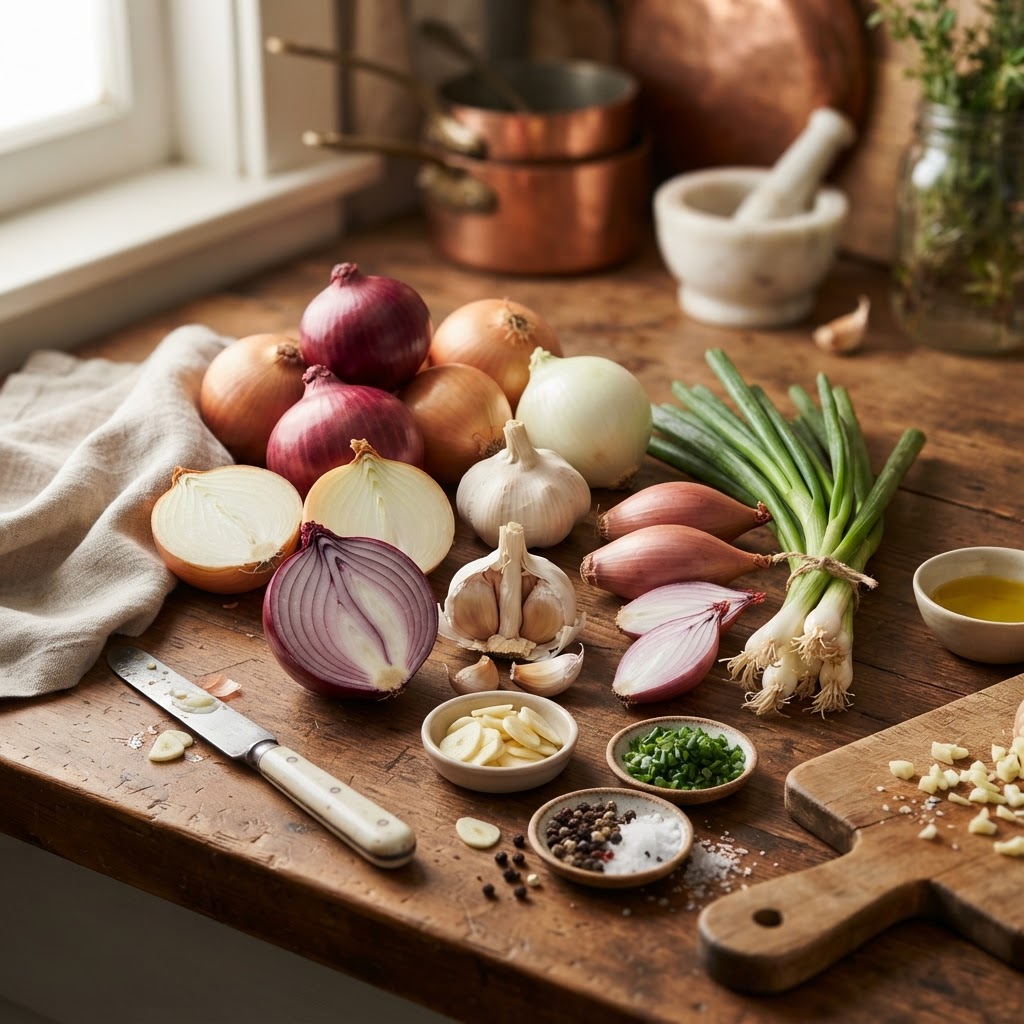
The Home Cook’s Guide to Allium Varieties: Understanding Pungency, Sweetness, and Flavor Profiles for Every Dish
The world of cooking is often defined by the boldest flavors, yet it is the subtle, foundational aromatics that truly build the architecture of a great meal. At the very heart of this foundation lies the Allium genus, a diverse family of bulbous vegetables that includes everything from the humble yellow onion to the delicate, nuanced chive. Understanding these ingredients is not merely a matter of following a recipe; it is about grasping the chemistry of flavor, heat, and texture. Whether you are searing a steak or simmering a delicate consommé, knowing exactly which allium to reach for can mean the difference between a dish that is merely edible and one that is transcendent.
Many home cooks approach the onion bin with a sense of indifference, treating all members of the family as interchangeable components. This is a common mistake that can stifle your growth as a culinary artist, as the variance in sulfur compounds and sugar content across this family is vast. Some alliums are meant to be the star, providing a sharp, aggressive punch to a vinaigrette, while others are intended to melt into a background note, providing a sweet, savory umami base. By learning to identify the flavor profile of each variety, you empower yourself to make intentional decisions in the kitchen that heighten the complexity of your final plating.
At "Blame The Chef," our mission is to peel back the layers of these ingredients—literally and figuratively—to help you master your craft. This guide will walk you through the nuances of pungent bulbs, sweet stalks, and everything in between, providing you with the technical knowledge to season your food with precision. We will cover the science of heat application, how to store your aromatics for maximum shelf life, and the specific ratios that turn a pile of raw vegetables into a sophisticated mirepoix or soffritto. Prepare to change the way you view the pantry and start cooking with the confidence of a seasoned professional.
The Chemistry of the Allium: Understanding Pungency
The characteristic "bite" of an onion or a clove of garlic is a defense mechanism developed over millions of years to deter pests. When you slice into an allium, you are rupturing the cells, which releases an enzyme called alliinase. This enzyme interacts with sulfur-containing amino acids to produce sulfenic acids, which then rearrange themselves into the volatile compounds that sting your eyes and define the flavor profile. Controlling this reaction is the first step toward becoming a better cook, as temperature and cutting techniques directly influence how intense these flavors become in your finished dish.
Heat is the primary tool for modulating this pungency. Raw alliums are high in volatile sulfur compounds, which provide that sharp, sinus-clearing heat. When we apply heat, however, we initiate a chemical breakdown that converts those sharp compounds into sweeter, more stable molecules. This is why a raw onion on a burger feels aggressive, while a caramelized onion develops deep, jammy notes of brown sugar and molasses. The length of your cook time—and the intensity of your heat—will dictate how much of that original bite remains in the final bite.
The secret to a perfect flavor base lies not in how much onion you use, but in how you treat it. Never rush the process of softening your alliums; true depth of flavor is a product of time, patience, and the gentle evaporation of water that allows sugars to concentrate and turn golden.
Managing Pungency at Home
If you find the heat of a raw onion overwhelming in a salad or a salsa, you can mitigate it with simple prep techniques. Soaking thinly sliced red onions in cold water for 15 minutes acts as a "rinse" for the surface sulfur, effectively removing the raw edge without sacrificing the crunch. For cooking, consider the difference between a dice and a mince; a finer mince creates more surface area, releasing more enzyme and resulting in a more intense, uniform flavor distribution. Larger chunks will provide a milder, more distinct textural experience.
The Workhorses: Yellow, White, and Red Onions
The yellow onion is the undisputed workhorse of the professional kitchen, and for good reason. It boasts an ideal balance of sugar and sulfuric pungency, making it the perfect candidate for high-heat sautéing, braising, and soups. When you are building a mirepoix—the holy trinity of onions, carrots, and celery—the yellow onion provides the savory spine of the dish. It stands up well to long cooking times, holding its structural integrity while releasing its juices into the base of a stew or a ragu.
White onions, by contrast, have a sharper, cleaner, and more immediate bite. They are the preferred onion for Mexican cuisine, where they provide the necessary crunch and zest to offset rich, fatty meats in tacos or beans. Because they contain less sugar than yellow onions, they do not caramelize as effectively or as richly. If you are making a quick pico de gallo, reach for the white onion; if you are making a French onion soup, the yellow onion is your non-negotiable partner.
Red onions exist somewhere in the middle, prized more for their vibrant color and mild, slightly fruity flavor than for their ability to withstand long cooking. When cooked, red onions can lose their pigment and turn a muddy grey, which is why they are best showcased raw or pickled. A quick pickle—using a ratio of 1:1 vinegar to water, a pinch of sugar, and salt—will transform the red onion into a bright, acidic topping that cuts through the richness of roasted pork or fatty salmon.
Garlic: The Most Versatile Flavor Bomb
Garlic is the powerhouse of the allium world, and its impact is entirely dependent on how it is processed. Whole cloves roasted in their skins result in a creamy, mild, and nutty paste that can be spread on toast or whisked into aioli. Finely minced or pressed garlic, however, is significantly more potent. The finer you cut the garlic, the more allicin is released, creating a pungent, spicy note that can easily overwhelm a dish if you are not careful. Always wait for the oil to shimmer in your pan before adding garlic, and remember that garlic burns quickly; usually, 30 to 60 seconds is all it takes to become fragrant without turning bitter.
When working with garlic, consider the concept of the "flavor stage." If you add garlic at the very beginning of a sauté, it becomes a background note that permeates the entire dish. If you add it at the end, it functions as a fresh, bright highlight. Never ignore the germ—the green sprout in the center of the clove. While it is not toxic, it can be bitter and difficult to digest, so for refined dishes, slice the clove in half and remove the green bit with the tip of your knife.
Great cooking is often about knowing when to stop. With garlic, the moment the aroma fills the kitchen, it is time to move to the next step. If you smell that acrid, burnt note, there is no recovering—toss it out and start over. A bitter base will ruin everything that follows.
Professional Tips for Garlic Prep
The Sweet and Elegant: Shallots and Leeks
Shallots are the darling of the professional kitchen, offering a sophisticated middle ground between the sharpness of an onion and the subtle depth of garlic. They contain less water than yellow onions, meaning they caramelize faster and with a more concentrated, complex sweetness. Because they are smaller, they are best suited for pan sauces, vinaigrettes, and delicate sautés where you want the allium flavor to be present but not dominating. A classic beurre blanc relies almost entirely on the delicate, fragrant reduction of shallots and wine.
Leeks are an entirely different animal, prized for their mild, buttery, and clean flavor. They are structurally different, growing in layers that can trap dirt and sand. To properly clean a leek, you must slice it lengthwise and rinse it thoroughly under cold running water, fanning out the layers to ensure no grit remains. Unlike the sharp punch of an onion, leeks melt into a soft, velvety texture when braised in butter or cream.
When preparing leeks, remember that the dark green tops are fibrous and tough, though they are an incredible addition to a bouquet garni or a vegetable stock. The white and light-green sections are the culinary gold. Sweat them low and slow in butter at a temperature of around 250°F to 300°F. This technique preserves their pale color and ensures they become tender enough to practically dissolve, which is the hallmark of a properly executed potato-leek soup.
Scallions and Chives: The Fresh Finish
Scallions—also known as green onions—are the ultimate garnish, providing a fresh, grassy, and mild bite that acts as a bright contrast to salty, fatty, or savory dishes. They are truly two ingredients in one: the white parts can be treated like a mild onion and sautéed, while the green tops should be sliced thinly and added at the very last second to maintain their vibrant color and crisp texture. In many Asian cuisines, the green of the scallion is an essential component, balancing the heavy umami of fermented pastes and soy sauce.
Chives are the most delicate of all. They have an incredibly faint, onion-like aroma and a fleeting, crisp texture. Because they are so fragile, they should never be cooked. They are intended to be folded into soft scrambled eggs, sprinkled over a chilled cucumber soup, or stirred into a compound butter just before serving. When cutting chives, ensure your knife is razor-sharp; a dull knife will crush the cells, leading to bruised, soggy chives rather than beautiful, crisp rings.
Mastering the Mirepoix and Its Variations
At the base of almost every great soup, stew, or sauce is the mirepoix. Traditionally, this is a mixture of two parts onion, one part carrot, and one part celery. However, the true secret lies in the quality of your dice. You want a uniform cut—roughly 1/4 inch—so that each component cooks at the same rate. If your onion pieces are tiny while your carrots are large, the onion will disintegrate before the carrots are tender.
Beyond the classic French mirepoix, there are other essential "flavor bases" used throughout the world. The Italian soffritto often relies on a slower, more deliberate cook in olive oil, sometimes including garlic or herbs. The Cajun "holy trinity" swaps out the carrot for bell pepper, reflecting the specific regional availability of ingredients and the need for a savory, smoky base for gumbos and jambalayas.
If you want to take your cooking to the next level, start by mastering the mirepoix. It is the signature of a cook who understands that foundation is everything. Once you can produce a perfectly sweated base, every other component of your dish will harmonize with greater clarity.
When constructing these bases, it is vital to keep the heat controlled. You are not looking to brown the vegetables unless the recipe explicitly calls for it. You are looking to sweat them, which means cooking them in a small amount of fat until they are translucent and soft. This process should take between 8 and 12 minutes on low-to-medium heat. By keeping the lid off, you allow the moisture to evaporate, which concentrates the natural sweetness of the alliums and provides the perfect backdrop for your proteins or stocks.
Advanced Techniques: Confit, Char, and Ferment
Once you have mastered the basics of chopping and sweating, you can begin to explore advanced allium techniques. An onion confit is a revelation; by slowly poaching sliced onions in a large amount of olive oil at a very low temperature—think 200°F—for several hours, you create a spread that is intensely savory and silkily smooth. This is not about browning; it is about the gentle breakdown of fibers. The resulting oil is also a goldmine of flavor, perfect for finishing roasted vegetables or drizzling over a fresh salad.
Charring is another powerful technique, particularly for leeks, green onions, and whole garlic. By placing these ingredients directly over the high heat of a grill or a gas flame, you blister the outer layers, creating a smoky, bitter char that protects the soft, sweet interior. This provides a stunning depth of flavor. A charred leek salad with a vinaigrette made from the charred leek scraps is the kind of dish that demonstrates high-level professional technique using only the simplest of ingredients.
Finally, consider the power of fermentation. Quick-pickling is one thing, but allowing sliced shallots or onions to ferment in a light brine creates a tangy, probiotic-rich condiment that lasts for months. These fermented alliums develop a complex, funky acidity that pairs perfectly with rich meats like duck or lamb. The salt ratio for a safe fermentation is usually 2% of the total weight of the vegetables and water, a simple calculation that yields a professional-grade pantry staple.
Final Thoughts
The journey to becoming a better home cook is rarely about learning more complicated recipes; it is about refining your understanding of the essential ingredients you use every day. Alliums are the silent partners in our culinary success, providing the backbone of flavor, the essential sweetness, and the sharp relief needed to balance complex dishes. By paying attention to the specific variety, the way you slice it, and the precise temperature at which you cook it, you shift from being a recipe follower to a culinary craftsman.
Treat your onions, garlic, shallots, and leeks with respect. Store them properly in cool, dry places, choose the right variety for the specific dish you have in mind, and never underestimate the power of a perfectly executed mirepoix. The next time you begin to slice an onion, take a moment to smell the aromatics and think about the flavor profile you want to achieve. That intentionality is the difference between a meal that is served and a meal that is truly crafted. Keep exploring, keep tasting, and most importantly, keep cooking. Your kitchen is your laboratory, and the humble allium is the most versatile tool you have at your disposal.


Get the Next Recipe
Weekly recipes, techniques, and gear picks — straight to your inbox.
