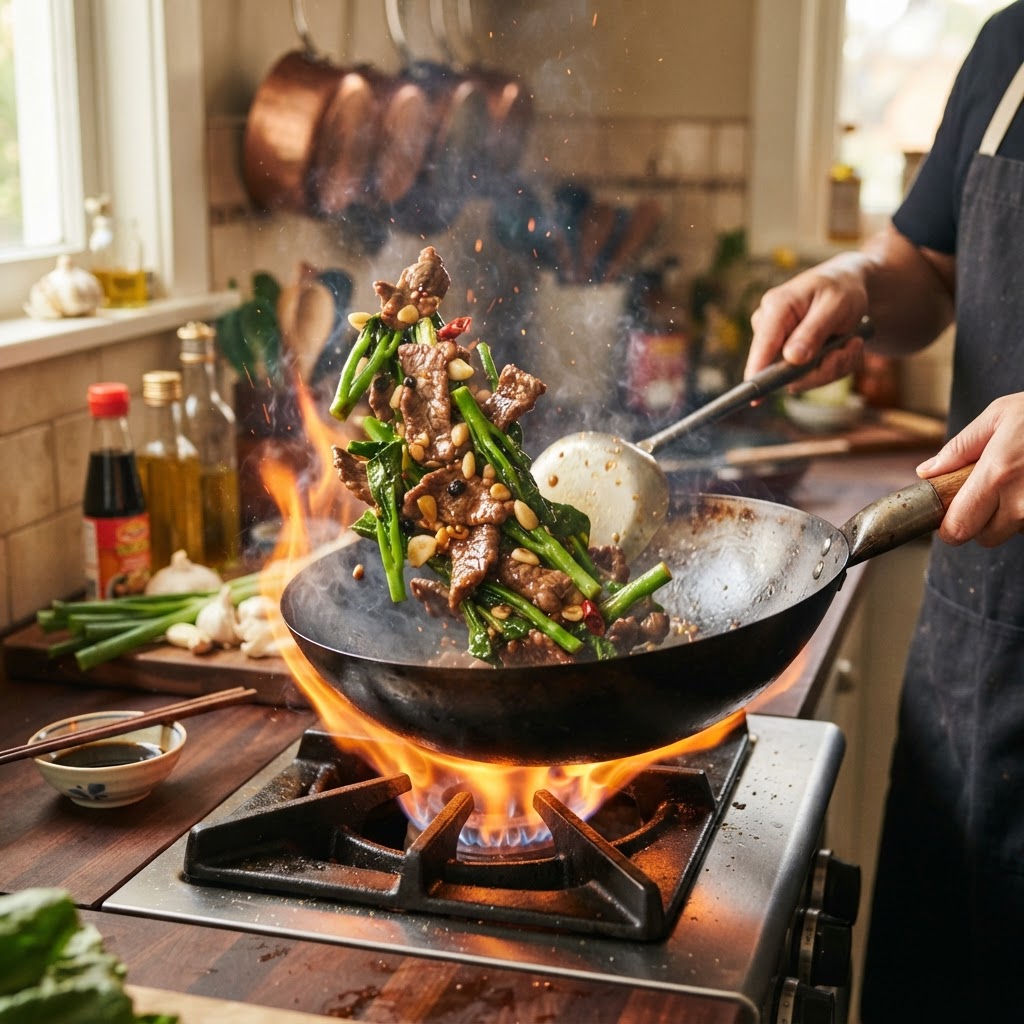
The Home Cook’s Guide to Cantonese Stir-Frying: Mastering Wok Hei for Restaurant-Quality Aromatics at Home
There is a specific, haunting aroma that defines the very soul of Cantonese cuisine, one that you have likely encountered in the bustling night markets of Hong Kong or the back-alley eateries of Guangzhou. It is not merely the smell of garlic, ginger, or scallions hitting a hot pan, but rather the complex, smoky, almost ethereal breath of the flame itself. This is Wok Hei, or "wok breath," the elusive hallmark of professional Cantonese stir-frying that many home cooks believe is impossible to achieve in a domestic kitchen. We often blame our equipment, our stoves, or even our lack of formal training for the discrepancy between our home-cooked meals and those served at our favorite local restaurant. The truth, however, is that while high-output commercial burners provide an advantage, the secret lies in understanding the physics of heat transfer, the preparation of your ingredients, and the meticulous management of your workflow.
Mastering the art of the stir-fry is as much about mindset as it is about culinary technique, requiring a disciplined approach to preparation known as mise en place. Because a stir-fry happens in a matter of seconds rather than minutes, there is no room for hesitation once the flame is lit. You must have every vegetable chopped to uniform size, every sauce whisked in a bowl, and every protein marinated to perfection before you even consider turning on the heat. By treating your kitchen like a professional line, you strip away the chaos that often leads to soggy vegetables or overcooked, rubbery meats. This guide is designed to bridge the gap between your home kitchen and the professional wok station, providing you with the tools to harness the heat and coax that signature smokiness out of your ingredients.
In the following sections, we will break down the essential anatomy of the stir-fry, from the selection of the right wok to the precise chemical reactions that produce maillard browning and that coveted char. You will learn why the sequence of adding ingredients matters, how to properly season your carbon steel, and the importance of "velveting" your proteins to ensure they remain succulent under intense heat. We are going to demystify the process, turning you from a frustrated home cook into a confident stir-fry master. Put on your apron, sharpen your cleaver, and prepare to elevate your home cooking to a standard that will make even the most seasoned chef take notice. By the end of this journey, you will realize that "Blaming the Chef" was never the answer—the power to recreate the magic of the wok has been in your hands all along.
The Foundation: Choosing and Seasoning Your Wok
Why Carbon Steel is Non-Negotiable
When it comes to stir-frying, your choice of cookware is the most critical decision you will make. While non-stick pans are excellent for eggs or delicate fish, they are fundamentally ill-suited for the aggressive, high-heat environment required for Cantonese stir-frying. A professional-grade carbon steel wok is the gold standard because it possesses the perfect balance of thermal conductivity and weight. It heats up rapidly, allowing you to sear ingredients instantly, and it reacts quickly to changes in flame intensity. Unlike cast iron, which holds heat too long and can lead to uneven cooking, carbon steel allows for the rhythmic motion of the "toss," ensuring that every piece of food spends time in direct contact with the hottest surface.
The Art of the Seasoning Process
A new carbon steel wok is not ready for duty the moment it leaves the box; it arrives with a factory-applied protective oil to prevent rust, which must be scrubbed off thoroughly. Once cleaned, you must perform a seasoning ritual that transforms the metal into a naturally non-stick surface. This involves heating the metal until it changes color, from a dull grey to a deep, iridescent blue, and then applying thin layers of high-smoke-point oil (like grapeseed or avocado oil) and heating it until it smokes. This polymerizes the oil, creating a sleek, dark patina that protects the metal and imparts a subtle depth of flavor to every dish you cook. Treat this layer with respect, avoid harsh soaps, and your wok will improve with age and frequent use.
"A well-seasoned wok is not just a tool; it is a living document of every meal you have prepared, carrying the flavor history of your kitchen into the next dish."
The Science of Mise En Place and Prep
Achieving Uniformity for Even Cooking
The secret to the speed of a stir-fry is that all your ingredients must finish cooking at exactly the same time. If your broccoli florets are massive and your ginger is paper-thin, you will end up with a dish where half the ingredients are raw and the other half are mushy. Precision knife work is the bedrock of Cantonese technique. Vegetables should be cut into bite-sized, uniform pieces—often using the "roll-cut" method for carrots or cucumbers, which increases the surface area for sauce adhesion. When your ingredients are uniform in size, they absorb heat at the same rate, allowing you to maintain the integrity and crunch of the vegetables while ensuring the centers are perfectly cooked.
The Philosophy of Pre-Mixing Sauces
One of the most common mistakes home cooks make is trying to season the dish in the pan by reaching for individual bottles of soy sauce, sugar, vinegar, and cornstarch. By the time you find your rice wine, your scallions have already burned. A professional chef always prepares a stir-fry sauce mixture in a small bowl before the heat goes on. This mixture typically includes a combination of light soy sauce for saltiness, dark soy sauce for color, a pinch of sugar for balance, a splash of Shaoxing rice wine for aroma, and a small amount of cornstarch or potato starch to act as a thickening agent. Adding this pre-mixed sauce in the final thirty seconds of cooking ensures a glossy, uniform coating that clings to every ingredient.
The Secret Technique: Velveting Your Proteins
What is Velveting?
Have you ever wondered why the chicken in your favorite takeout dish is so impossibly smooth and tender? The secret is a technique called velveting. This involves marinating your sliced protein—usually chicken, pork, or beef—in a mixture of cornstarch, a splash of oil, and a small amount of liquid, such as egg white or rice wine. The cornstarch creates a protective barrier around the meat, shielding it from the harsh, direct heat of the wok. This prevents the moisture from escaping, resulting in a protein that is silky, succulent, and tender, regardless of the cut you choose to use.
Executing the Technique
To properly velvet, toss your sliced protein with the marinade ingredients and let it rest for at least 20 minutes in the refrigerator. Before stir-frying, you have two options: the "oil blanch" or the "water blanch." In the oil blanch, the meat is quickly passed through hot oil until it is 80% cooked, then removed and set aside. In the water blanch, the meat is dropped into simmering water until it turns opaque. Both methods serve the same purpose: they lock in the juices and prepare the protein for the final, rapid flash-fry that completes the dish. Never try to cook your meat from raw directly in a dry wok; you will inevitably end up with dry, tough results.
"Velveting is the difference between a home-cooked stir-fry that feels like an afterthought and a restaurant-style dish that feels like a masterpiece of texture and flavor."
Mastering Wok Hei: Taming the Fire
The Physics of the Flame
Wok Hei is essentially the flavor produced by the high-temperature caramelization and maillard reaction that occurs when food is tossed in a hot wok. In a professional kitchen, the burner puts out upwards of 100,000 BTUs, which is exponentially more than a residential stove. To emulate this at home, you must work in smaller batches. If you fill your wok with too many ingredients, the temperature of the metal drops, the moisture releases faster than it can evaporate, and you end up stewing your food instead of searing it. Work in batches so that the wok remains searingly hot throughout the process.
The Rhythmic Toss
The motion of the wok is not just for show; it is an essential part of the heat distribution process. The goal is to keep the food moving so that no single piece remains stationary against the metal for too long, which would cause burning. A gentle, controlled flick of the wrist allows the food to airborne briefly, picking up the aromatic, smoky notes of the scorched oil as it passes through the flame. Start by practicing with room-temperature ingredients or even dried beans until you get the rhythm down. Once you master the toss, you will find that the ingredients stay crisp, the sauces caramelize beautifully, and the final dish develops that deep, charred complexity that defines true Cantonese stir-fry.
* Always preheat your empty wok until it just begins to smoke before adding oil.
* Coat the sides of the wok with oil using a circular motion.
* Add aromatics (garlic, ginger, scallions) first to perfume the oil, but keep them moving.
* Add the proteins, sear, and remove.
* Stir-fry the vegetables until vibrant, then reintroduce the protein and sauce.
Ingredient Ratios and Flavor Profiles
The Balancing Act
Cantonese cuisine is rooted in the philosophy of balance, or heung (fragrance) and mei (flavor). A great stir-fry should have a clear, distinct flavor profile that is never muddied by too many competing ingredients. Use the "rule of three" for your vegetables—choose one primary vegetable (like bok choy or gai lan), one aromatic base (garlic and ginger), and one texture enhancer (like water chestnuts or wood ear mushrooms). By keeping the ingredient count focused, you allow the natural flavors of the produce to shine through, supported rather than overwhelmed by your sauce.
The Role of Shaoxing Wine
If there is one ingredient that separates "authentic" from "generic" in your pantry, it is Shaoxing rice wine. This amber-colored fermented grain wine is the secret weapon of every Cantonese chef. It contains complex esters and amino acids that neutralize the "raw" smell of meats and create a fragrant, earthy base for the sauce. When you pour a splash of Shaoxing wine down the side of a blazing hot wok, it vaporizes instantly, coating the food in an aromatic cloud of flavor. Never skip this step; even if you can’t find authentic Shaoxing, a dry sherry is an acceptable substitute that will still yield excellent results.
Light Soy Sauce:* Provides saltiness and body.
Dark Soy Sauce:* Used primarily for its rich, mahogany color.
Oyster Sauce:* Adds umami and a savory, velvety sweetness.
Sesame Oil:* Always added at the very end as a finishing aromatic; never heat it for long.
White Pepper:* The classic, subtle heat that defines Cantonese seasoning.
Troubleshooting the Common Pitfalls
Why is My Food Watery?
The most frustrating outcome for any home cook is a plate of vegetables swimming in a watery, flavorless puddle. This usually happens for three reasons: overcrowding the wok, salting the vegetables too early, or adding too much liquid. If you notice moisture pooling, increase your heat and keep tossing until the liquid evaporates. Furthermore, never add salt to your vegetables before cooking, as it will draw out their water content prematurely. Season your dish at the final moment, just before plating, to ensure that the vegetables stay crisp and the sauce remains thick and glossy.
The "Burned vs. Charred" Dilemma
There is a fine line between charred (delicious) and burned (bitter). A common error is leaving aromatics like minced garlic in the wok for too long before adding the main ingredients. Garlic burns in seconds. Instead, add your aromatics for only 10 to 15 seconds—just until they become fragrant—and immediately follow with your proteins or vegetables. If you are struggling with burning, use a higher-smoke-point oil like refined coconut or grape seed oil, and keep a squeeze bottle of water nearby. A tiny splash of water can create steam that helps cook dense vegetables through without requiring you to lower the heat or leave them in the wok too long.
"The difference between a charred, smoky stir-fry and a bitter, burnt mess is measured in mere seconds; trust your nose and your eyes more than the clock."
Final Thoughts
Mastering Cantonese stir-frying is a journey that rewards patience, repetition, and a willingness to observe the subtle cues of your ingredients. You have learned that the equipment is only as good as the preparation, that the heat is only as effective as the method, and that the "wok breath" you seek is something you can indeed manifest in your own home. By embracing the mise en place, respecting the velveting technique, and managing the temperature of your wok with confidence, you have moved past the need to blame the chef. You are now the chef.
The beauty of this craft is that it never truly ends. Each time you return to the wok, you will refine your tossing technique, learn how to better balance your aromatics, and discover new combinations of vegetables and proteins that suit your personal palate. Do not be discouraged by a dish that doesn't hit the mark on your first try; even in the professional world, the wok is a tool that demands constant engagement and adjustment. Take these principles, apply them with care, and share the results with those you love.
As you continue to cook, pay attention to the sound of the sizzle, the change in the color of your ingredients, and the way the sauce tightens under the heat. These are the indicators of a dish that is coming together perfectly. Cantonese cuisine is a celebration of freshness and timing, and now that you possess the technical framework to execute these concepts, your kitchen will surely become the most popular room in the house. Happy stir-frying, and remember: keep that flame high, your ingredients ready, and your technique precise.
The journey into professional-level stir-frying is often a lonely one, as there are few resources that bridge the gap between the chaotic, high-heat reality of a restaurant kitchen and the standard domestic setting. You have now acquired the knowledge of the "why" and the "how," but the "what" is entirely up to you. Whether you are searing stalks of flowering chives, flash-frying strips of tender beef, or perfecting the classic egg fried rice, the principles remain the same. The wok is a forgiving partner if you treat it with the right respect, and it will give back to you tenfold in the form of deep, complex, and incredibly satisfying meals.
Do not fear the heat. Many home cooks are terrified of the high flames and the smoking oil, but in the context of a wok, this is where the character of the dish is built. That bit of smokiness is the signature of your effort. As you become more comfortable, try experimenting with different aromatics—perhaps a bit of fermented black bean paste or a dash of chili oil to create your own signature blends. The flexibility of the stir-fry is one of its greatest strengths. It is a meal for the hurried, a meal for the creative, and a meal for the culinarily curious.
Finally, remember to clean and care for your tools. A well-maintained wok is the greatest asset in your arsenal. After every session, clean it with warm water and a soft brush, dry it over the flame, and wipe it with a thin layer of oil. This simple habit ensures that your next session is just as successful as your last. You have all the tools, the technique, and the encouragement needed to succeed. The stove is waiting, and the air is ready to be filled with the intoxicating scent of ginger, scallions, and the perfect, smoky kiss of the wok. Go forth and cook with boldness, precision, and the confidence that you are truly mastering the art of Cantonese stir-frying.
In the end, cooking is an act of love and a constant learning experience. By focusing on the fundamentals and refusing to cut corners, you have set yourself on a path to excellence. Whether you are cooking for a crowd or preparing a quiet dinner for yourself, the principles of professional Cantonese stir-frying will serve you well. You no longer have to look toward the restaurant kitchen with longing; you have brought that kitchen into your own home. Enjoy the process, savor the flavors, and take pride in the fact that you have mastered a technique that has been refined over generations. The secret was never hidden; it was simply waiting for you to pick up the spatula and the wok.
As you move forward, keep these essential steps in your mind:
With these five pillars, there is no limit to what you can achieve in your kitchen. From the simplest vegetable stir-fry to the most complex Cantonese classics, your confidence will grow with every turn of the wrist. May your wok always be hot, your vegetables always crisp, and your sauces always glossy. Keep exploring, keep tasting, and keep refining. The world of Cantonese cuisine is vast and delicious, and you are now equipped to navigate it with total authority. Your journey has only just begun, and the results will be delicious.
There is an inherent satisfaction in hearing the sharp hiss of ingredients hitting a hot wok—it is the sound of success. It is the sound of a dish coming to life, the water evaporating into steam, the sugars caramelizing, and the flavors melding together into something greater than the sum of its parts. As you continue to practice, you will begin to recognize this sound. You will know exactly when the protein is seared to perfection, when the aromatics have released their full potential, and when the sauce has thickened just enough to coat every morsel. This intuitive connection between the cook and the wok is the ultimate goal.
Every time you step up to your stove, treat it as an opportunity to experiment. Adjust your seasoning, tweak your timing, and learn how your specific burner responds to your wok. The beauty of this guide is that it provides a framework, but the artistry is yours to define. You are the architect of your own culinary success. By moving away from the "blame" and toward the "mastery," you have unlocked a lifetime of incredible meals and the deep satisfaction that comes with knowing you created them yourself. It is time to turn the heat up and see what you can create.
The complexity of flavors in Cantonese cuisine is subtle, yet profound. By learning to highlight rather than overpower, you are embracing the essence of this culinary tradition. It is a discipline of restraint, where the quality of the ingredients and the precision of the technique are allowed to speak for themselves. This is a skill that will serve you throughout your life, a foundation upon which you can build endless variations and personal signatures. As you continue to hone your craft, you will find that the simplest dishes often provide the most profound pleasure.
Take a moment to appreciate the process. The rhythmic chopping, the careful whisking of the sauce, the intense focus at the stove—these are the elements that make cooking a meditative and rewarding practice. When you sit down to eat your own masterpiece, take note of the texture, the balance, and that elusive, smoky aroma of the wok. You have earned this moment of culinary fulfillment. You have demystified the process, bypassed the common pitfalls, and arrived at the intersection of home cooking and professional technique. Congratulations on your journey toward mastering the art of the stir-fry.
In closing, never lose your curiosity. The world of food is constantly evolving, and even within the traditional boundaries of Cantonese cuisine, there is always more to learn and discover. Share your meals, ask questions, and continue to seek out new flavors and techniques. You have taken a giant leap today, and the kitchen is now your canvas. May your journey be filled with flavor, discovery, and many, many successful stir-fries. The heat is on, the wok is ready, and the possibilities are endless. Enjoy every bite, and remember: you hold the key to the flavor of the wok.
Continue to practice the art of the toss, and don't be afraid to make a little bit of a mess in the pursuit of perfection. True mastery often involves a few spills and a few overcooked batches, but every one of them is a lesson that brings you closer to the ideal. Stay dedicated, stay enthusiastic, and most importantly, stay in the kitchen. There is so much more to create, and you are just getting started. The world of Cantonese stir-frying is waiting for your next dish.
Final advice? Trust your instincts. If a recipe says cook for one minute, but your intuition tells you it needs ten seconds less, listen to your intuition. If a sauce feels too thin, trust your judgment and let it reduce a moment longer. The more you cook, the more your hands will know what to do. You are not just following a guide anymore; you are internalizing a way of cooking that will last you a lifetime. Keep the heat high, keep the ingredients moving, and enjoy the beautiful, smoky results of your hard work. You have mastered the wok.

Get the Next Recipe
Weekly recipes, techniques, and gear picks — straight to your inbox.
