The Home Cook’s Guide to Carryover Cooking: Mastering Residual Heat for Perfectly Doneness in Every Protein
We have all been there: you spend thirty minutes meticulously searing a beautiful, center-cut pork chop, checking the color, seasoning the crust, and managing the heat like a professional. You pull it from the pan, convinced it is done, and set it on the cutting board while you finish the side dishes. By the time you sit down to eat, that once-promising piece of meat has transformed into a dry, chewy tragedy that requires a gallon of gravy to swallow. It is the classic home cook’s heartbreak, one that leads many to blame the quality of the meat or the pan they used rather than the process itself. The culprit, nine times out of ten, is a lack of understanding regarding carryover cooking, the phenomenon where residual heat continues to raise the internal temperature of a protein long after it leaves the heat source.
Mastering this concept is perhaps the single biggest jump in quality a home cook can make, rivaling the transition from buying pre-ground spices to grinding your own. It is the invisible force that chefs rely on to keep service flowing smoothly and to ensure that every table receives a product cooked to exact specifications. When you remove a steak from the grill or a bird from the oven, the energy stored in the exterior layers does not simply disappear; it migrates inward. If you do not account for this migration, you are essentially cooking your food blindly, hoping that luck will strike where skill should have taken the reins.
The goal of this guide is to demystify the science of thermal momentum and provide you with a concrete toolkit for predicting the final resting temperature of your proteins. We will move beyond the guesswork and into the realm of precision, giving you the confidence to pull your pans early and trust the process. By understanding how mass, surface area, and ambient heat interact, you will stop fighting against physics and start using it to your advantage. It is time to retire the "poke test" and the "cut-and-look" method, embracing a modern, scientific approach that guarantees consistent, succulent results on every single plate.
Understanding the Physics of Residual Heat
At its core, carryover cooking is a simple matter of thermodynamics. When you place a piece of meat over a heat source, the exterior is exposed to temperatures far higher than those of the interior. Heat energy flows from the high-temperature zone (the pan or oven air) to the lower-temperature zone (the center of the protein). Even after you cut the flame, the temperature gradient remains extreme, with the exterior being significantly hotter than the core. This imbalance forces heat to continue traveling toward the center until an equilibrium is reached.
The Role of Thermal Mass
The speed and intensity of carryover cooking are directly related to the thermal mass of the item you are cooking. A small, thin lamb chop has very little mass, meaning it stores less energy and will experience minimal temperature increase once removed from the heat. Conversely, a large, thick-cut ribeye or a whole roasted chicken is dense and holds a significant amount of latent energy. If you pull a heavy roast at your target temperature, the residual heat will inevitably push that internal temperature well past your goal, resulting in overcooked meat.
The Delta Effect
Chefs often refer to the "delta" between the target temperature and the pull temperature. This is the amount of degrees you expect the food to rise while it rests. Understanding this gap is essential for precision. A higher cooking temperature—such as a screaming hot cast-iron sear—creates a larger delta because the outer layers are storing more energy. Low-temperature methods, like sous-vide or slow-roasting, create a much smaller delta because the heat gradient is shallower and more uniform throughout the protein.
"The secret to a perfect sear isn't just about the crust you build; it is about the control you maintain once the food leaves the fire. If you aren't accounting for the journey your food takes after the pan, you aren't cooking—you're just guessing."
Mastering the Pull Temperature
To master carryover cooking, you must shift your mindset away from "done" and toward "ready to pull." Your digital thermometer is the most important tool in your kitchen, far more valuable than your favorite chef's knife or that expensive copper saute pan. You should aim to remove your protein from the heat source when it is anywhere from 5 to 15 degrees Fahrenheit below your target internal temperature, depending on the thickness and the cooking method.
Determining Your Target
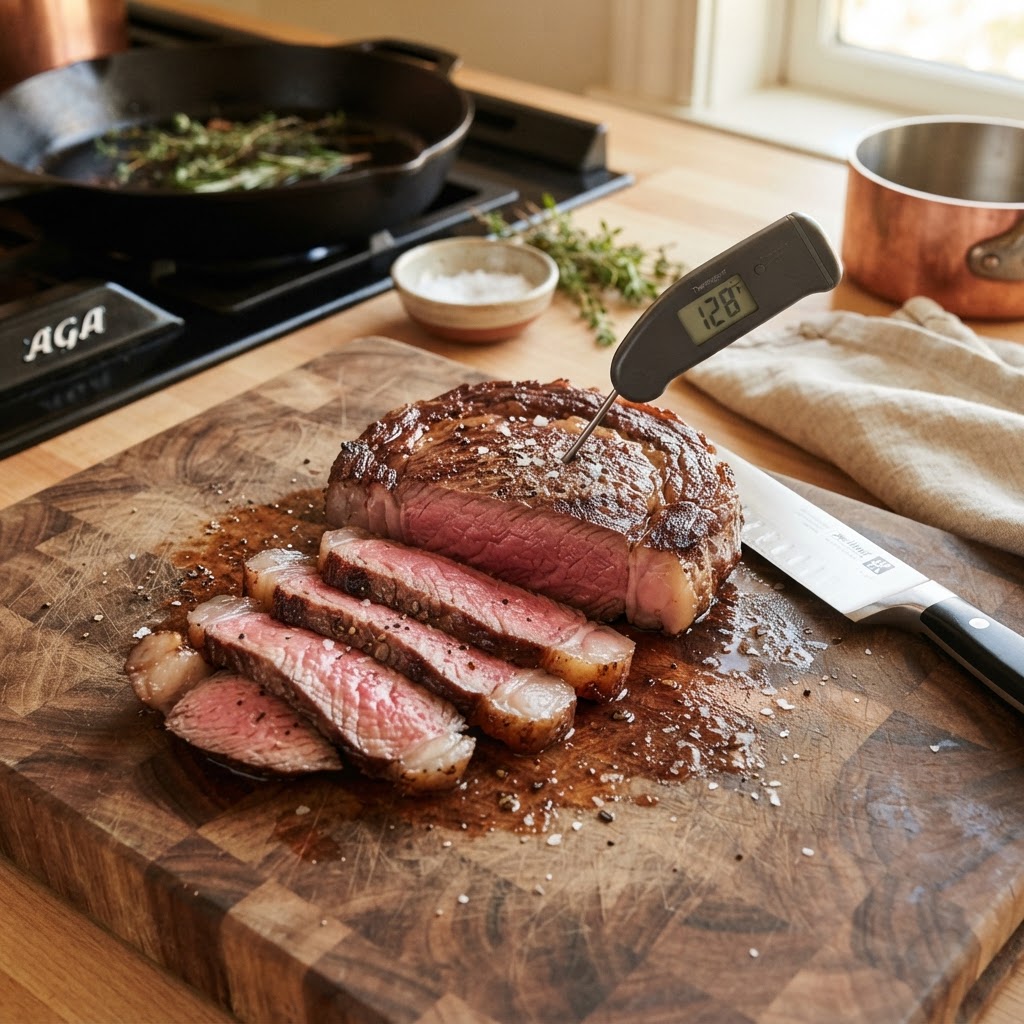
For most beef steaks, a medium-rare finish is ideal at 130°F. If you are searing in a very hot pan, you should look to pull that steak at roughly 120°F to 123°F. As it rests, the ambient heat will carry it up to that final 130°F. If you pull it at 130°F, you are destined for a final temperature near 140°F, pushing you into medium territory. Understanding this allows you to manipulate the outcome with surgical precision.
Factors That Influence Rise
Surface Area:* The higher the surface-to-volume ratio, the faster the heat dissipates, leading to less carryover.
Cooking Method:* Frying or high-heat searing creates high carryover; baking or roasting creates moderate carryover.
Environmental Temperature:* A warm room will keep the exterior of the meat warmer for longer, allowing for more heat transfer inward.
The Resting Surface:* A cold cutting board acts as a heat sink, stripping energy from the bottom of the meat, while a warm plate keeps the carryover process going more consistently.
The Importance of the Resting Period
Resting is not just a suggestion found in cookbooks to annoy hungry diners; it is a fundamental step in the structural integrity of the protein. During the cooking process, the muscle fibers contract and tighten, pushing juices toward the center of the meat. If you slice into the meat immediately upon removing it from the heat, these pressurized juices have nowhere to go but out onto your cutting board, leaving you with dry, flavorless meat.
The Science of Fiber Relaxation
As the protein cools slightly during the resting phase, the muscle fibers relax and lose some of their tension. This relaxation allows the juices to be reabsorbed back into the fibers, ensuring that each bite is as succulent as the first. This is where carryover cooking and structural resting work in tandem. You are using the resting time both to finish the cooking process and to allow the meat to reach a state of equilibrium where it is tender, juicy, and perfectly cooked.
Resting Guidelines for Success
"Resting is the final step in the cooking process, not the pause between cooking and serving. It is the moment where the texture of the meat is finalized, and the flavor is distributed. Treat it with the same urgency as the searing."
Tailoring Techniques for Specific Proteins
Not all proteins behave the same way under the influence of residual heat. A delicate fish fillet has very little fat and connective tissue, meaning it is incredibly sensitive to temperature spikes. A thick, well-marbled piece of beef, however, is more forgiving and can withstand a longer resting period. Knowing the specific requirements of the animal you are preparing is vital for success.
Poultry and The Risk of Overcooking
Chicken is notorious for becoming dry because of its lean nature. Many home cooks fear undercooking it, so they blast it in the oven until it reaches 175°F. In reality, chicken breast is safe and juicy at 160°F. If you pull it at 155°F and let it carry over to 160°F, you will experience a dramatic increase in moisture. The key here is to rely entirely on your thermometer, as color is an unreliable indicator of safety or doneness in poultry.
Working with Delicate Seafood
For fish, the carryover effect is rapid and profound. Because fish flesh is composed of smaller, more delicate muscle fibers, it reaches its final temperature almost instantly. When poaching or pan-searing fish, pull the protein when it is just slightly translucent in the center. By the time it hits the plate, the residual heat will turn it opaque and perfectly flaky. If it looks "done" in the pan, you have already overcooked it.
Red Meat and Game
Beef, lamb, and venison provide the best examples of carryover cooking in action. Because these proteins are often served at varying levels of doneness, you have a wider margin of error. However, the difference between a perfect medium-rare and a disappointing medium is often just three degrees. Always aim for the lower end of the spectrum, as you can always return a piece of meat to the pan if it is underdone, but you cannot reverse the process if it has gone too far.
Troubleshooting Common Carryover Pitfalls
Even with the best intentions, things can go wrong. Perhaps you were distracted by a ringing phone or a boiling pot of pasta, and the residual heat worked faster than you anticipated. It is important to know how to diagnose the issue and adjust your next attempt. The most common pitfall is failing to account for the "heat capacity" of your cookware. A heavy cast-iron skillet retains heat for much longer than a stainless steel or aluminum pan.
When the Meat Overcooks
If your protein hits the table and it is overcooked, don't throw it out. You can salvage the meal by using high-quality sauces or herb-infused compound butters. These add moisture back into the protein and mask the dryness. More importantly, take a note of the time and the temperature you pulled the meat at. Use this as your new baseline and adjust your pull temperature downward by three to five degrees for the next cook.
The "Soggy Crust" Problem
One of the most common complaints regarding resting is the loss of a crispy sear. When you set a hot, seared steak on a plate, the steam escaping from the bottom of the meat has nowhere to go, which condenses and creates a soggy crust. To avoid this, use a wire rack set over a rimmed baking sheet. This allows air to circulate around the entire piece of meat, ensuring that your crust stays crisp while the interior finishes cooking through carryover.
* Avoid stacking pieces of meat during the rest.
* Do not leave the meat in the pan it was cooked in unless you are deliberately finishing it in a low-temperature oven.
* Always use a digital probe thermometer rather than the built-in dial on your oven or an old-fashioned analog meat thermometer.
The Professional Chef’s Workflow
In a professional kitchen, the workflow is built around the inevitability of carryover cooking. Chefs organize their station to account for the "drop time." A steak is fired, seared, and then moved to a holding area or a low-temperature warming oven. The timing is calculated down to the second so that by the time the garnish is plated and the sauce is drizzled, the meat is at the perfect temperature for the diner.
Time Management for the Home Cook
You can mimic this professional efficiency by organizing your prep work. Have your sides ready to go before you start your main protein. If your vegetables are roasted and waiting, and your sauce is thickened and ready to pour, you won't feel the need to rush the resting of your meat. The more chaotic your kitchen, the less likely you are to pay attention to the critical resting period.
Using the "Hold" Technique
If you are cooking a large roast, consider using a holding technique. By wrapping your rested roast in heavy-duty foil and placing it in a cooler (without ice), you can keep it at the perfect serving temperature for up to an hour. This stabilizes the internal temperature and ensures that every single slice is perfectly uniform. It is a trick that caterers use to ensure large groups receive high-quality, perfectly cooked meat regardless of serving time.
"Professional kitchens are not magic; they are just systems designed to minimize error. When you adopt a system for your own cooking—accounting for resting, carryover, and temperature—you stop playing the role of the stressed-out cook and start playing the role of the kitchen manager."
Final Thoughts
The mastery of carryover cooking is the mark of a cook who has moved beyond the recipe and into the realm of understanding the ingredient. It is a quiet, unassuming skill that provides some of the most noticeable improvements in flavor and texture you will ever achieve. By embracing the physics of residual heat, you reclaim control over your kitchen. You stop being a victim of the flame and start being the architect of your own dinner.
Remember that perfection is not a static point; it is a moving target. Some days, your carryover will be faster, and some days it will be slower, depending on the humidity of your home, the thickness of your protein, and the temperature of your pans. Embrace the variability. Keep a journal of your successes and your lessons. Note the weight of your steaks, the thickness of your chops, and the pull temperatures that worked best for you.
Ultimately, cooking is meant to be a joyful, sensory experience. Do not let the science distract you from the pleasure of the craft. Use these techniques as a foundation, not a set of rigid rules that limit your creativity. Once you understand how to control the internal temperature of your proteins, you will find that the stress of the "perfect cook" melts away, leaving you with nothing but confidence. So, the next time you hear that sizzle, remember: the cooking isn't over just because the heat is off—your work is just moving into its final, most important phase. Happy cooking.
When you master the art of the residual rise, you gain the ability to cook proteins that were once intimidating. A thick rack of lamb, a hefty bone-in pork chop, or a crown roast of pork—these become approachable, manageable dishes rather than potential disasters. This confidence allows you to experiment with different seasoning profiles and cooking techniques, knowing that your foundational grasp of heat management will carry you through to a successful finish.
Do not be discouraged if your first attempt at timing the carryover isn't perfect. Even in the highest-rated restaurants, chefs are constantly adjusting their techniques based on the specific cut of meat or the environmental conditions of the kitchen. Every piece of meat is an individual; they do not all behave the same way under the same heat. Your role as the home chef is to remain observant and responsive. When you see the temperature hit that "sweet spot" before the target, don't panic—trust your preparation.
Lastly, share this knowledge. The biggest obstacle to better home cooking is the myth that culinary excellence is a gift you are born with. It is not; it is a body of knowledge that is accessible to anyone willing to observe, measure, and refine. By sharing these principles of thermal management with your friends and family, you help elevate the quality of home cooking in your community. Let's make "Blame The Chef" a thing of the past, replaced by "How did you get this so perfect?"
As you move forward, keep these core principles at the forefront of your process:
As you look back on your culinary journey, you will realize that the most impactful changes were the ones that seemed the smallest at the time. Focusing on the quiet, internal temperature shifts of a resting piece of beef might not seem as exciting as mastering a complex French sauce, but it is the difference between a dry, tough piece of meat and one that practically melts on the tongue. Focus on the basics, master the science, and never stop questioning why things happen in the pan.
Enjoy the process, trust your tools, and always keep an eye on that probe. You have the power to transform every ingredient you touch into something remarkable. The kitchen is your laboratory, and the result is your masterpiece. May your steaks always be perfectly medium-rare, your poultry consistently succulent, and your carryover perfectly timed.
If you are cooking for a large group, remember that the carryover effect is multiplied by the sheer volume of protein being cooked. A single steak is one thing, but a massive brisket or a tray of twenty chicken thighs is a different ball game entirely. The center of that tray will hold heat significantly longer than a single piece. Be conservative with your pull temperatures when cooking in batches, and you will find that your results remain consistent across every plate you serve.
We have covered a lot of ground in this guide, from the basic thermodynamics of heat transfer to the practical realities of managing a meal. Keep this as a reference as you grow, and don't be afraid to revisit these sections when you are attempting a new or challenging cut of meat. The more you practice, the more intuitive this process will become, until you no longer need the thermometer as much as you need your own experience.
It is time to light the burners and put these principles into practice. You have the knowledge, you have the strategy, and you have the tools. The only thing left to do is cook. We look forward to hearing about your successes in the kitchen, and remember, with these techniques, there is no need to blame the chef—everything is under control. Happy resting, and even happier eating.
Your journey into the world of precision cooking doesn't end here; it is merely the beginning of a life-long pursuit of culinary excellence. Stay curious, stay sharp, and always keep your thermometer handy. The secret to professional-grade results is often simpler than you think—it's just a matter of respecting the heat, even when it's supposedly "off." Whether you are hosting a dinner party or simply making a Tuesday night meal for your family, these techniques will change the way you interact with food, creating a more relaxed and rewarding cooking experience for years to come.
Let this guide serve as a constant reminder that you are in charge of your kitchen environment. When you understand the forces at play, the fear of "messing up" vanishes. You are no longer cooking with anxiety, wondering if you've overcooked the center; you are cooking with intention, carefully guiding your protein to its perfect, delicious peak. That is the true essence of a home chef who has mastered their craft.
As you conclude your next meal, pay attention to the texture and the juiciness. If it's perfect, take a moment to acknowledge the carryover process that helped you get there. If there's room for improvement, adjust your next pull temperature by a degree or two. This constant, incremental improvement is the key to becoming a master of your own domain. The kitchen is a place of endless learning, and we are thrilled to be on this journey with you.
Everything you need to know about the final stage of cooking is now in your hands. Trust in the science, trust in your tools, and most importantly, trust in yourself. The perfect meal is within your grasp, hidden just a few degrees of residual heat away. Go forth, cook with confidence, and enjoy the delicious results of your hard-earned culinary expertise. Your best meal is always your next one, and we can't wait to see what you create.

Get the Next Recipe
Weekly recipes, techniques, and gear picks — straight to your inbox.
