The Home Cook’s Guide to Carryover Cooking: Mastering Residual Heat Ratios for Perfectly Succulent Roasts and Proteins
Every home cook has experienced the sinking feeling of pulling a gorgeous, golden-brown roast from the oven, only to slice into it ten minutes later and find a dry, lackluster center. We tend to focus so intently on the heat of the oven or the intensity of the pan-sear that we forget the process doesn't actually end when the flame goes out. The truth is that cooking is a kinetic process, not a static one, and the period immediately following direct heat is just as vital as the sear itself. Mastering the nuances of residual energy—what professionals call carryover cooking—is the single most important skill to elevate your kitchen game from amateur to seasoned expert.
At its core, carryover cooking is the phenomenon where the internal temperature of a protein continues to climb after it has been removed from a heat source. This happens because the exterior of the meat is significantly hotter than the interior, and thermal energy naturally moves from high-temperature zones to low-temperature zones. As the center absorbs this excess energy, the proteins continue to denature and coagulate, effectively finishing the job you started in the oven or on the stovetop. Understanding this movement of heat is not just about avoiding overcooked meat; it is about achieving that perfect, edge-to-edge consistency that makes restaurant meals feel so luxurious.
When you learn to account for this rise, you stop fighting against the physics of your food and start working with them. Most home recipes fail because they instruct you to cook to a "final" temperature, which inevitably leads to the meat hitting that temperature while still on the heat, only to climb five to ten degrees higher on the cutting board. By adjusting your pull-off temperature and respecting the resting phase, you ensure that every slice of beef, pork, or poultry remains juicy, tender, and perfectly prepared. This guide will walk you through the math, the mechanics, and the patience required to make carryover cooking a fundamental part of your culinary repertoire.
The Science Behind Residual Heat Transfer
The movement of heat within a protein is dictated by the principles of thermal conductivity. Even after you pull a thick-cut ribeye or a whole roasted chicken out of the oven, the exterior surface layers are saturated with heat energy. These outer layers act as a thermal reservoir, slowly pushing that heat inward as the surface begins to lose energy to the surrounding air. If you do not factor this in, the meat will continue to cook beyond your desired doneness level, leading to the dreaded "gray band" of overcooked protein surrounding an otherwise medium-rare center.
Thermal Equilibrium and Protein Structure
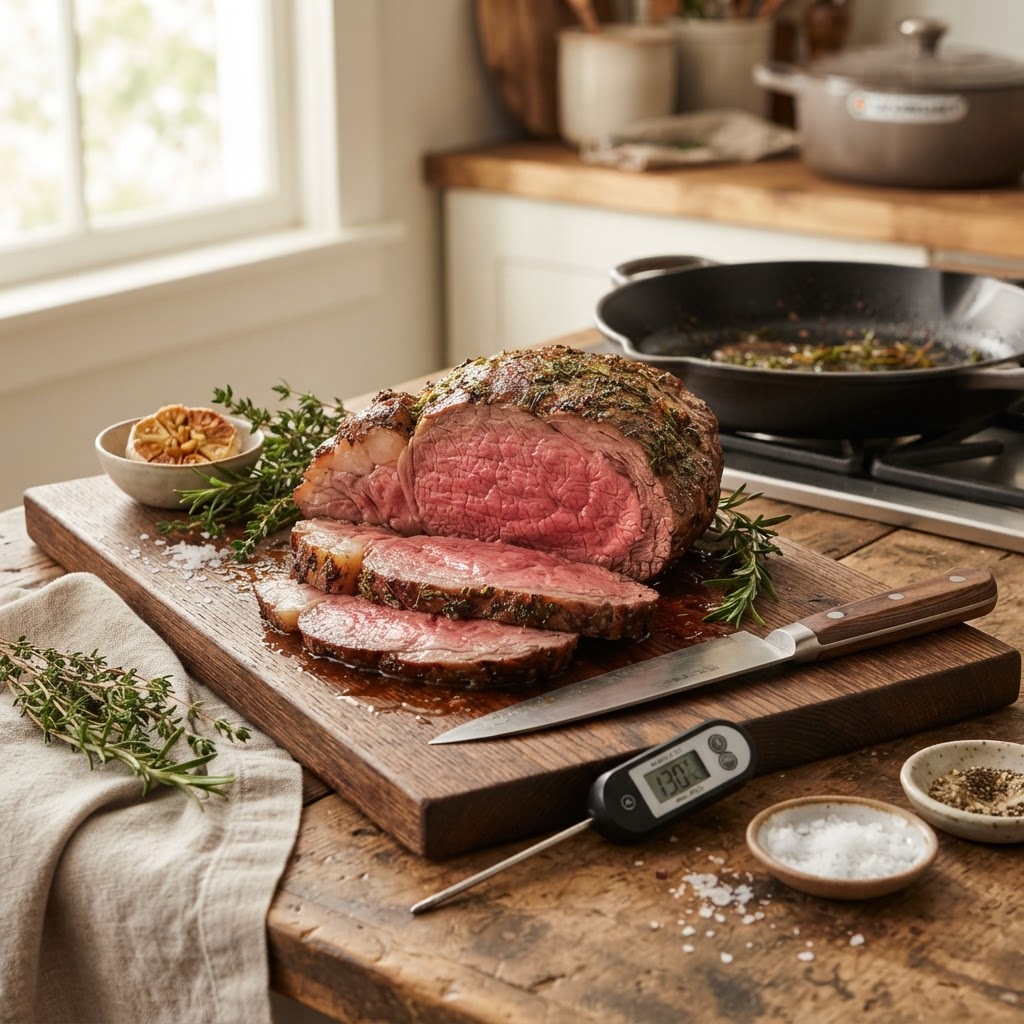
As the heat migrates inward, the muscle fibers begin to finalize their transformation. At specific temperature thresholds, proteins begin to tighten and squeeze out moisture. If you allow the meat to sit on the heat until it hits your target temp—say 130°F for medium-rare beef—the residual heat will inevitably drive that temperature upward, potentially reaching 135°F or 140°F while it rests. This is where the difference between a succulent meal and a tough, dry one is born. We want the meat to reach its perfect state of doneness at the exact moment the resting period ends.
Factors Affecting Heat Migration
Not all proteins behave the same way when removed from the heat. The size of the roast, the density of the muscle, and the temperature of your resting environment all play a massive role. A large, dense cut like a prime rib will hold much more residual heat than a thin, delicate pork chop. Similarly, if you rest a piece of meat on a cold plate in a drafty room, you will lose heat to the environment faster, potentially shortening the duration of the carryover. Conversely, a warm plate or a light covering of foil can trap heat, extending the cooking time slightly.
"The resting phase is not merely a waiting game; it is the final, essential stage of the cooking process where the internal juices redistribute and the heat performs its last, most delicate alchemy."
Mastering the Pull-Off Temperature
The golden rule of professional cooking is to pull your protein off the heat before it reaches the final target. But how do you know exactly when to pull it? This is where the Carryover Factor comes into play. For smaller cuts of meat, like individual steaks or chicken breasts, you can generally expect a rise of about 3 to 5 degrees Fahrenheit after removing them from the heat. For larger roasts, such as a whole turkey, a leg of lamb, or a beef tenderloin, the carryover can cause the temperature to climb by 10 to 15 degrees.
Creating Your Personal Cheat Sheet
I recommend keeping a small notebook in your kitchen to track your successes and failures. When cooking a specific cut, note the weight, the cooking temperature, the pull-off temperature, and the final temperature after a 15-minute rest. Over time, you will develop an intuitive sense of how your specific oven and your specific cooking style influence these numbers. Remember that the higher the oven temperature you use for the initial roast, the more extreme the carryover will be, as you have effectively "super-charged" the outer layers of the protein.
The Importance of Instant-Read Thermometers
You simply cannot master carryover cooking by guessing. A high-quality digital instant-read thermometer is not an optional accessory; it is your best friend. Relying on "minutes per pound" is an outdated technique that fails to account for the thickness, shape, and initial temperature of your meat. By checking the internal temperature at the thickest part of the protein, you move from cooking based on hope to cooking based on precise, repeatable data.
The Resting Protocol: Why Patience Pays Off
Once you have pulled your roast, the resting period is where the magic happens. This is not just about waiting for the heat to stabilize; it is about juice redistribution. When meat is subjected to high heat, the moisture is pushed toward the center, where the fibers are the most constricted. If you slice into a hot steak immediately, those juices will simply run out onto the board, leaving you with dry, flavorless meat. Resting allows the internal temperature to plateau and the muscle fibers to relax, effectively reabsorbing those precious juices throughout the entire cut.
To Cover or Not to Cover?
A common debate in culinary circles is whether to wrap resting meat in aluminum foil. If you wrap it tightly, you trap steam, which can ruin the crispy crust or "bark" you worked so hard to create. If you don't cover it at all, the meat might get too cold too quickly. The best approach is a "loose tent." Lay a piece of foil over the top without sealing it to the edges. This keeps the ambient heat around the protein without steaming the exterior. If you have a large roast, a clean kitchen towel placed over the foil can provide extra insulation without sacrificing that hard-earned crust.
The Math of Resting Times
As a general guideline, the resting time should be proportional to the cooking time and the size of the protein. For individual steaks, five to ten minutes is usually sufficient. For a medium-sized roast or whole chicken, fifteen to twenty minutes is the sweet spot. For large, holiday-sized roasts like a bone-in prime rib or a whole brisket, you may need to rest the meat for forty-five minutes to an hour. Never feel like you are "wasting time" by resting; this is the most productive part of the entire cooking process.
Techniques for Different Proteins
While the science of carryover cooking applies universally, the application varies significantly across different animal proteins. Beef, being a dense, red muscle, is the most forgiving but also the most sensitive to temperature gradients. Pork, due to its leaner nature in modern cuts, requires even more careful monitoring to prevent it from crossing the line into dry, chewy territory. Poultry, with its delicate skin and potential for uneven thickness, requires a slightly different approach involving structural manipulation.
Beef and Lamb: Precision and Patience
For red meats, your goal is to pull the protein when it is roughly 5 to 10 degrees below your target. For a perfect medium-rare (130°F), pull your beef at 120°F to 125°F. Because beef has a high connective tissue density and rich fat marbling, it retains heat exceptionally well. If you are searing a steak in a cast-iron skillet, remember that the high surface temperature of the iron will continue to sear the bottom of the meat for several seconds even after you flip or remove it. Always use a wire rack for resting to allow air to circulate underneath, preventing the bottom from becoming soggy.
Poultry: The Humidity Factor
Poultry is a different beast entirely. Because you are dealing with both white and dark meat, which have different internal structure requirements, you are often aiming for a range rather than a single point. Pulling a whole chicken at 155°F in the breast will allow the residual heat to push the temperature to the food-safe 165°F mark, while ensuring the breast meat remains moist. If you pull it at 165°F, it will continue to rise to 175°F or higher, at which point the breast will have become chalky and fibrous.
"The difference between a dry chicken and a succulent one often comes down to a five-minute window and a thermometer that works faster than your impatience."
Pork: Understanding Leaner Cuts
Modern pork is much leaner than the pork of decades past, which means it requires much less cooking time than many home cooks assume. Whether it is a loin or a tenderloin, you should treat it similarly to poultry. Pulling a pork loin at 140°F and letting it rise to a final 145°F-150°F will yield a beautiful, juicy result. Overcooking pork is the primary reason many people think they don't like it; it’s not the meat, it’s the lack of carryover management.
Equipment That Enhances Your Technique
To truly master this, you need the right tools. While a basic analog dial thermometer can give you a ballpark figure, they are notoriously inaccurate and slow to react. A professional-grade, fast-reading digital thermometer is a non-negotiable investment. Look for models that can provide a reading in under three seconds with an accuracy range of +/- 1 degree. This allows you to probe the meat, adjust your fire, or remove the protein from the oven at the exact millisecond required.
The Role of Pans and Roasting Racks
The material of your pan matters. Cast iron holds heat far longer than thin stainless steel or aluminum. If you use a heavy cast-iron pan, assume the carryover effect will be about 20% higher than if you used a lighter-weight pan. Similarly, utilizing a wire rack inside your roasting pan is essential. When you place a roast directly on the bottom of a pan, the surface in contact with the hot metal continues to cook rapidly, creating an uneven ring of heat. A rack allows consistent airflow, which leads to a more uniform temperature distribution and a more predictable carryover effect.
Ambient Temperature Considerations
Always pull your meat out of the refrigerator at least 30 to 45 minutes before cooking. A cold piece of meat takes longer for the heat to penetrate the center, which means the outside will be blasted with high heat for longer, leading to a more exaggerated carryover effect. By bringing your protein to room temperature, you ensure a more even cooking profile from the start, which makes predicting the residual rise much easier once you take it off the flame.
Common Pitfalls and How to Avoid Them
The most common mistake is panic. Many cooks see the temperature reading on their thermometer, see that it hasn't reached the target, and decide to leave it in the oven for "just five more minutes." That extra time is almost always where the disaster happens. Trust your thermometer. If it says 120°F and you are aiming for 130°F, have faith that the physics of the oven and the residual heat will carry you the rest of the way. If you aren't sure, remove the meat, wait two minutes, and check it again.
The Danger of "Checking" Too Often
Another frequent error is piercing the meat repeatedly to check the temperature. Every time you insert a thermometer probe, you create a pathway for juices to escape. While a single hole is not a problem, a "pincushion" effect will significantly impact the moisture retention of your roast. Insert the probe once, leave it for a few seconds to get an accurate reading, and then pull it. If you are worried about the reading, use a probe thermometer that stays inside the meat, allowing you to monitor the temperature continuously without opening the oven door.
Ignoring the Resting Environment
Don't place your resting meat near a heat source like the stove top you just turned off. While it might seem like a good idea to keep it "warm," you are effectively stopping the cooling process and potentially continuing the cooking process. Move your cutting board or platter to a neutral, slightly cool area of the kitchen. This helps the meat reach its peak rest state where the fibers have relaxed and the temperature has settled into the perfect serving range.
Developing Your Culinary Intuition
Beyond the numbers and the thermometers, there is a certain "feel" to perfectly cooked meat. As you become more confident with carryover cooking, you will start to notice the way the exterior of a roast feels when you poke it. A piece of beef that is properly rested will have a certain "give"—a slight bounce back that indicates the fibers have relaxed. A piece of meat that has been overcooked and rushed to the table will feel tight, rigid, and unyielding. This physical feedback, combined with your data, is how you graduate from a home cook to a true artisan.
Embracing the Process
Do not be discouraged if your first few attempts at calculating carryover aren't perfect. Even in professional kitchens, even the best chefs have the occasional roast that rests a little too long or a steak that needed one more minute. The key is to pay attention to the outcome. If your steak was slightly over, document it and pull it two degrees earlier next time. If it was slightly under, you now know you have a little more room to push the temperature before resting. Culinary mastery is a cycle of refinement.
Sharing Your Results
Cooking is fundamentally an act of service. When you apply these techniques—when you present a roast that is perfectly pink from edge to edge or a bird that stays succulent down to the last slice—you are giving your guests the best possible version of the meal. You are removing the guesswork and replacing it with intention. Carryover cooking isn't just about saving your meat from the oven; it's about respecting the ingredients you've chosen and the time you've spent preparing them.
Final Thoughts
The art of the home cook is often defined by those quiet moments behind the scenes. While the sear gets all the glory on social media, the true test of a chef is how they handle the final moments of the heat. By embracing carryover cooking, you are taking control of the entire process, ensuring that your roasts, steaks, and chops reach their full potential. It requires a bit of discipline and a healthy respect for the physics of heat, but the payoff is a kitchen full of perfectly prepared food and the confidence to take on any cut of meat.
Remember that temperature is a destination, but carryover cooking is the map that gets you there. Don't be afraid to pull your food early. Don't be afraid to let it rest longer than you think it needs. Trust your thermometer, trust the science, and most importantly, trust yourself. When you master these residual heat ratios, you aren't just following a recipe; you are understanding the very essence of how protein transforms under heat. That is where the joy of cooking really begins. Happy roasting, and remember, when it comes to heat management, you are the final authority in your kitchen.

Get the Next Recipe
Weekly recipes, techniques, and gear picks — straight to your inbox.
