The Home Cook’s Guide to Clarification: Mastering Protein-Coagulation Techniques for Crystal-Clear Consommés and Stocks
There is a lingering myth in the culinary world that the art of the perfect, crystal-clear consommé is a dark magic reserved exclusively for white-tablecloth restaurants and classically trained professionals. Home cooks often stare at their bubbling stockpots, watching as cloudy, murky liquid swirls with bits of sediment, resigned to the idea that transparency is an impossible standard for their own kitchens. However, the truth is that achieving that legendary, jewel-toned clarity is less about magic and more about a fundamental understanding of protein coagulation. When you learn to manipulate the delicate proteins found in egg whites and lean ground meats, you gain the ability to turn a humble, hazy stock into a refined, high-end masterpiece that commands respect at any dinner table.
The secret behind this transformation lies in the raft, a structured mass of protein and aromatic vegetables that acts as a physical filter for your liquid. As the stock slowly heats, these proteins reach their denaturation point, rising to the surface and capturing microscopic impurities, fats, and debris along the way. It is a process of scientific precision that rewards patience, temperature control, and a steady hand. Once you grasp the mechanics of this culinary alchemy, you will find yourself no longer blaming the ingredients or the heat of your stove, but instead mastering the physics of the kitchen to produce results that are nothing short of professional.
We are going to dismantle the intimidation factor of clarification, breaking it down into actionable, repeatable steps that any home cook can execute with confidence. This is not a task to be rushed; it is a ritual of refinement that elevates cooking from a chore to a craft. Throughout this guide, we will explore the precise ratios of egg whites to stock, the importance of maintaining a gentle simmer, and the troubleshooting steps for when the raft begins to crack. By the time you finish reading, your freezer will be stocked with portions of liquid gold, and you will understand exactly why clear, flavorful stock is the ultimate foundational tool for any serious home cook.
The Science of the Raft: Understanding Protein Coagulation
At its core, the clarification process is a systematic method of trapping particles. We rely on the high protein content of egg whites—specifically albumin—and lean protein like ground beef, chicken, or fish to do the heavy lifting. When these ingredients are whisked into a cold stock and brought to a heat, the proteins begin to unwind and expand, creating a mesh-like structure. As this structure hardens, it acts as a molecular sieve, drawing suspended solids out of the liquid through a combination of physical trapping and electrical attraction.
To build an effective raft, you must ensure your ingredients are perfectly cold when introduced to the stock. The denaturation process must happen gradually; if you heat the stock too quickly, the proteins will coagulate prematurely and unevenly, resulting in a fractured raft that fails to clear the liquid. By starting with a cold foundation, you allow the proteins to distribute evenly throughout the pot before the thermal energy forces them to aggregate into that singular, solid mass at the surface.
The Role of Acid and Aromatics
Incorporating an acidic element, such as a splash of dry sherry, tomato paste, or a squeeze of lemon juice, is crucial for the structure of the raft. The acidity helps to tighten the protein bonds, making the mesh finer and more effective at capturing tiny particles. Furthermore, the mirepoix (onions, carrots, and celery) added to the raft mixture is not just for flavor; it provides additional surface area and structure that helps the raft hold its shape, preventing it from collapsing under the agitation of a boil.
"The raft is the ultimate kitchen filter; treat it with the same respect you would a fine-tuned piece of machinery, for if it breaks, the clarity vanishes along with it."
Preparing Your Base: The Foundation of Clarity
Before you even think about clarification, you must ensure that your starting stock is as flavorful as possible. Clarity is a visual goal, but depth of flavor is the non-negotiable objective. A consommé is essentially a concentrated stock that has been refined, meaning that every flavor note—from the sweetness of roasted bones to the earthiness of herbs—will be amplified by the concentration process. If your initial stock lacks complexity, your final consommé will taste thin and uninspired, regardless of how transparent it looks.
Start by roasting your bones until they are deeply caramelized but not charred. Any burnt bits will introduce bitter, dark flavors that cannot be removed through clarification. Once roasted, simmer your stock for several hours with high-collagen components like trotters or necks to build viscosity and body. Once the stock is finished, it must be completely chilled. Skimming the solid fat off the surface after refrigeration is the first step toward a successful clarification; if fat remains in the pot, it will emulsify into the consommé, making it look dull and greasy.
Key Rules for Success
* Always use cold stock as your starting point.
* Ensure all fat has been removed from the chilled base.
* Use a wide-bottomed pot to allow for a large surface area for the raft to form.
* Avoid over-salting your base, as the clarification process concentrates flavors significantly.
Constructing the Clarification Mixture
The clarification mixture consists of three primary components: egg whites, lean ground protein, and finely minced mirepoix. For every liter of stock, you should use approximately two egg whites and 200 grams of lean ground meat. Whisk these ingredients together in a chilled bowl until the mixture is frothy and uniform. The goal is to distribute the protein evenly so that when it meets the hot stock, it forms a cohesive, uniform layer rather than a collection of scattered clumps.
When choosing your lean ground meat, consider the final flavor profile. Beef consommé requires lean ground beef or venison; chicken consommé benefits from ground chicken breast; and a clear fish broth can be clarified using finely minced white fish fillets or scallops. The leaner the meat, the better, as excess fat will fight against the clarification process and leave a sheen on your final product. Some chefs also choose to add tomato paste to the mixture, which not only aids in coagulation but also provides a deep, reddish-golden hue to the final consommé.
The Secret to the Ratio
The ratio of egg whites to stock is not just a suggestion; it is the mathematical backbone of your technique. If you have too few whites, the raft will be porous and fail to catch the sediment. If you have too many, the raft may become too dense and seal the surface, causing the stock to boil over or forcing impurities to stay trapped underneath. Stick to the 2 whites per liter rule, and adjust only once you have mastered the fundamental technique.
The Gentle Heat: Managing the Simmer
Once your clarification mixture is incorporated into the cold stock, place the pot over medium heat. This is the moment where most home cooks stumble, as the urge to crank the heat is strong. You must resist. Use a whisk to stir the mixture constantly until it reaches exactly 140°F (60°C). This temperature is the sweet spot where the proteins begin to denature and rise to the surface. As you stir, you will see the liquid begin to change, moving from a cloudy, disorganized mix to a clear, shimmering broth underneath the forming raft.
As the temperature rises, the mixture will begin to "bloom." You will see small, white protein clouds floating to the top, and eventually, these will knit together to form a solid, bubbling mass. Once the raft has completely formed and you have punched a small hole—the vent—in the center to allow steam to escape, stop stirring entirely. The most common mistake in this stage is agitation. If you stir the pot while the raft is cooking, you will physically break the filter you just spent an hour building, and your effort will be wasted.
Troubleshooting the Temperature
Straining and Finishing: The Final Reveal
The moment of truth arrives when you are ready to strain the finished consommé. The raft should be firm and the liquid beneath it should look like polished glass. Prepare a fine-mesh sieve lined with several layers of cheesecloth or a dedicated chinois. Place this over a clean, warm pot. With a deep ladle, carefully spoon the consommé from the center vent, pouring it gently through the filter. Do not rush this process; let the liquid pass through the cloth naturally. If you force it, you risk pushing through the very sediment you worked so hard to trap.
The final liquid should have a deep, vibrant color—amber for beef, pale gold for chicken—and a clarity that allows you to see the bottom of the ladle clearly. Before serving, taste the consommé for seasoning. You will likely find that the concentration process has intensified the flavors, so a very small adjustment of salt or perhaps a drop of high-quality sherry is all that is required to bring the dish to life. Some chefs choose to "clear" the consommé a second time, though this is rarely necessary if your technique was precise.
"True refinement is not about adding complexity, but about removing the unnecessary until only the essence of the ingredient remains, shimmering in the light of your soup bowl."
Culinary Applications: How to Serve Consommé
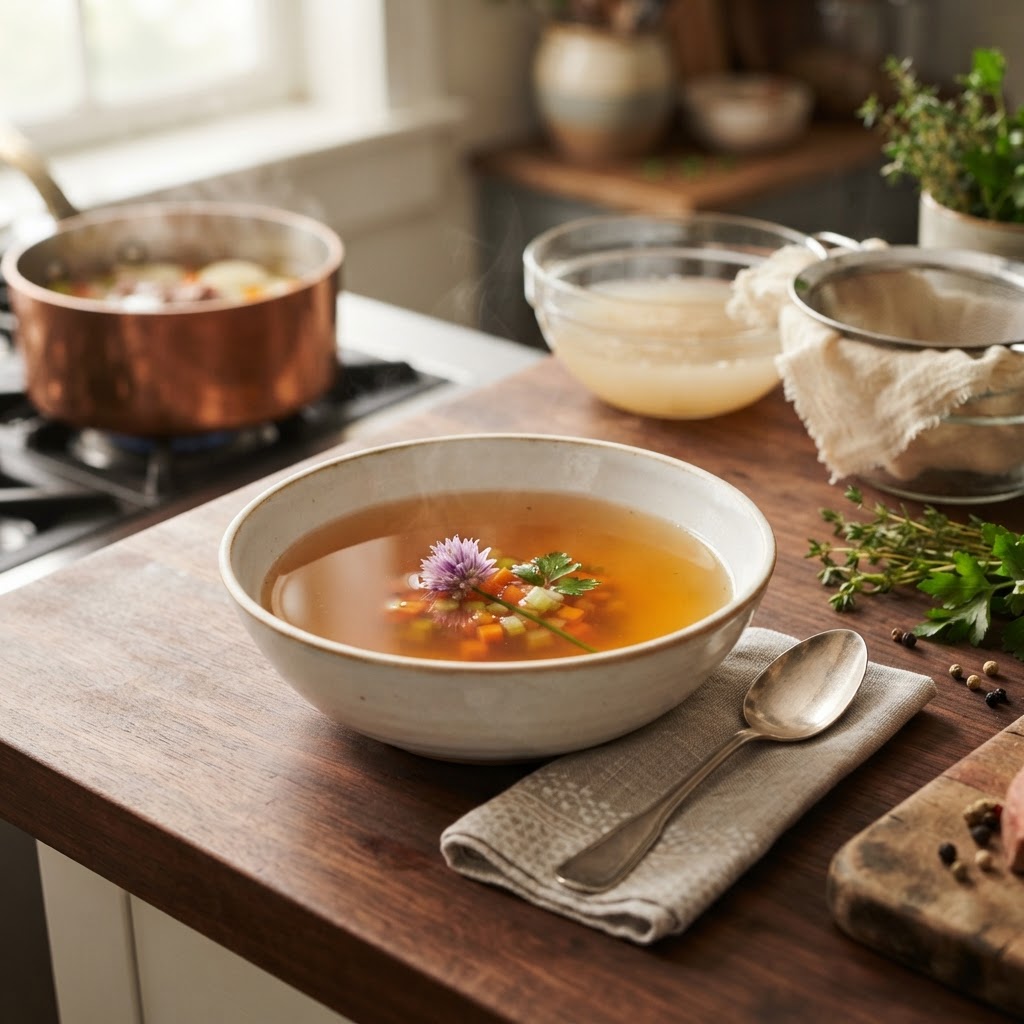
Consommé is the ultimate showcase for a home cook’s skill, but it is also a versatile component. Served hot, it should be garnished with precision—perhaps a few perfectly turned vegetable brunoises, a single chervil sprig, or a tiny, delicate dumpling. Because the liquid is so transparent, any garnish you add must be of the highest quality and visually appealing, as it will be magnified by the liquid. Avoid dark-colored herbs that might bleed into the crystal-clear broth.
Beyond serving it as a standalone soup, consommé can be used to elevate sauces, braises, and risottos. A beef consommé can be reduced to create a glace de viande with unparalleled intensity, or it can be chilled into an aspic—a savory jelly that adds both flavor and texture to terrines and pâtés. Because the protein-coagulation process essentially strips the stock of its emulsified fats, the flavor is cleaner and more direct, making it a perfect base for delicate reductions that don't need the heavy mouthfeel of a standard demi-glace.
Garnishing Ideas
Brunoise:* Tiny, perfect cubes of carrot, leek, and celery, blanched for thirty seconds.
Royal Royale:* A thin, firm egg custard sliced into decorative shapes and dropped into the broth.
Herb Essence:* A single, pristine leaf of parsley, chervil, or tarragon floated on the surface.
Truffle Shavings:* A few paper-thin slices of fresh black truffle for an earthy, luxurious aroma.
Final Thoughts
Mastering the clarification of stocks is a rite of passage for any cook who wishes to move beyond simple recipes and into the realm of true culinary artistry. It teaches you that flavor is only half of the experience; the visual presentation, the texture, and the purity of a dish are what elevate a meal into a memory. Do not be discouraged if your first attempt is not perfectly transparent. Even a "slightly cloudy" consommé is still a nutritious and delicious accomplishment that will outperform any commercial store-bought broth.
Take your time with the raft, respect the temperature of the simmer, and keep your kitchen clean and organized throughout the process. The beauty of this technique lies in its honesty—it shows you exactly how much care you have invested in your cooking. Whether you are preparing a centerpiece for a holiday dinner or simply practicing for the sake of honing your craft, remember that the most complex dishes are often built upon the simplest of principles. Stay curious, stay precise, and never settle for cloudy soup when you possess the knowledge to create liquid diamonds.
When you finally pull that ladle out of the pot and see the steam rising from a bowl of pure, clear consommé, you will realize that you have moved past the need to blame the chef. You are the chef, and you have mastered the elements of your craft. Continue to practice these coagulation techniques with different stocks and different aromatic profiles. Experiment with adding toasted spices to your raft mixture or using different types of lean proteins to see how they impact the final clarity and flavor depth. Every time you perform this process, you learn more about the interaction of heat, protein, and liquid, refining your instincts and building a repertoire that will impress for a lifetime.
Ultimately, this guide is about the pursuit of excellence in the home kitchen. It is about proving to yourself that the boundaries between a home kitchen and a professional brigade are not as wide as they seem. All it takes is the right information, a bit of focused effort, and the willingness to learn from the process. Take your stock, gather your eggs, and begin the clarification. The result is not just a soup; it is a testament to your growth as a cook and a celebration of the wonderful, scientific, and deeply satisfying world of professional-grade culinary techniques. Keep cooking, keep clarifying, and enjoy the exquisite results of your labor.
The journey toward the perfect consommé is one that never truly ends, as there is always a new aromatic combination to test or a different base stock to refine. Perhaps next time, you will try a double-clarified consommé, where the already clarified broth is clarified a second time with a fresh raft, creating an intensity of flavor that is almost ethereal. Or, you might experiment with cold-clarification techniques using centrifugal force or specialized filters, though those are tales for another day. For now, take pride in the foundation you have built. You have turned the chaotic into the coherent and the cloudy into the clear.
The kitchen is a place of constant evolution. Your stockpot is a vessel for transformation, and each time you stand at the stove, you are adding to your library of culinary wisdom. Do not let the complexity of the task intimidate you. Instead, look at the raft as your partner in the process, a structure that is working with you to achieve a common goal. Once you see the liquid turn clear, the sense of accomplishment is profound. It is a quiet, singular moment of victory that makes all the preparation and patience worthwhile.
Continue to explore the nuances of the mirepoix, the quality of the egg whites, and the subtle shifts in temperature that dictate the success of the raft. Share your successes with friends and family, and don't be afraid to share the story of how you learned to master the protein-coagulation process. After all, the best part of any culinary technique is the joy it brings to those who sit down to eat. Your crystal-clear consommé is a reflection of your dedication, your precision, and your passion for the culinary arts. May it always be as clear as your ambition, and as flavorful as your experiences in the kitchen.
As you step away from the stove and look at your final creation, remember the key takeaways that have guided you through this process: the importance of the cold start, the necessity of the lean protein, the gentle heat of the simmer, and the patient process of straining. These are the pillars of the technique, and they will serve you well in all your future endeavors. Keep these lessons in your mind, and you will never have to worry about a cloudy soup again. You have the tools, you have the knowledge, and you have the passion. The kitchen is yours to conquer.
In closing, remember that culinary excellence is not an end point, but a continuous path of learning and discovery. Each batch of stock is an opportunity to improve, to refine your technique, and to deepen your understanding of how ingredients interact under the influence of heat. Whether you are crafting a simple chicken stock or a complex game-meat consommé, the principles remain the same. Stick to the fundamentals, pay attention to the details, and trust the process. You are doing great work, and your culinary journey is just beginning. Keep refining, keep experimenting, and most importantly, keep enjoying the process of creating something beautiful and delicious from scratch.
When you look back on your progression from your first attempt to your fiftieth, you will see how far you have come. You will remember the day you finally understood the raft, the day you stopped worrying about the heat, and the day you achieved that perfect, shimmering clarity. These moments are the milestones of a true home cook, and they are the foundation of a lifetime of culinary joy. Stay dedicated, stay humble, and keep striving for that perfect, crystalline bowl of consommé. You have earned every drop, and your kitchen will always be the better for it.
The final piece of advice for the aspiring master of clarification is simple: don't let a mistake keep you from trying again. If a batch doesn't turn out as clear as you had hoped, analyze what went wrong, adjust your technique, and try again. Every "failed" batch is actually a lesson in disguise, providing insights that a perfect batch simply cannot offer. Embrace the challenge, enjoy the process, and take pride in your role as the architect of your own culinary success. You have the guide, you have the techniques, and you have the drive. Go forth and clarify, and enjoy the remarkable results of your hard work and dedication.
It is rare to find a technique as rewarding as this. The act of clarification is meditative, requiring a level of focus that silences the rest of the world. In the hustle and bustle of modern life, these moments of intentional cooking are precious. They remind us of the value of slow work and the satisfaction of craftsmanship. When you serve your consommé, you aren't just serving food; you are serving an experience, a piece of art that you have crafted with your own hands. That is the true power of the home cook, and it is something to be celebrated.
As you move forward into your next kitchen project, bring with you the confidence that you have mastered one of the most respected techniques in the culinary repertoire. Whether you are using these skills to impress guests, to challenge yourself, or simply to feed your family with the best food possible, know that your commitment to quality is evident in every bite. Keep exploring, keep questioning, and keep cooking. The world of culinary technique is vast, and you have only scratched the surface. The journey continues, and I am excited to see where your curiosity leads you next.
Thank you for trusting me to guide you through this process. It has been a pleasure to break down the complexities of protein coagulation and share the joy of the perfect consommé. Remember that the "Blame The Chef" philosophy is all about taking ownership of your kitchen and finding joy in the precision of the craft. You are the master of your stockpot now, and I have no doubt that your future dishes will be nothing short of magnificent. Happy cooking, and may your stocks always be as clear as the pride you feel in your work.
Get the Next Recipe
Weekly recipes, techniques, and gear picks — straight to your inbox.
