The Home Cook’s Guide to Degreasing: Mastering Fat-Skimming and Clarification Ratios for Cleaner, More Balanced Sauces and Soups
There is an undeniable allure to the perfect bowl of consommé or a velvety, refined demi-glace, yet many home cooks find themselves intimidated by the presence of excess fat. We often start with the best intentions, sourcing high-quality bones and aromatic mirepoix, only to be left with a greasy film that dulls the brightness of our hard work. Understanding how to manage, skim, and clarify this fat is the difference between a heavy, cloying liquid and a crystalline, professional-grade sauce. It is not about banishing fat entirely, as fat is a vital carrier of flavor, but rather about achieving a harmonious balance where the richness supports the dish rather than overwhelming the palate. Mastering these techniques will elevate your repertoire and grant you the confidence to tackle stocks and stews that truly sing.
When we speak of degreasing, we are discussing the physical separation of lipids from a water-based liquid, a process rooted in basic thermodynamics and chemistry. Fat has a lower density than water, which means that given enough time and the right temperature, it will naturally migrate to the surface. However, the true art lies in how we capture and remove that surface layer without disturbing the precious, flavor-packed liquid beneath. Whether you are using the traditional ladle-skimming method or the more modern approach of chilled stratification, the goals remain identical: achieving a clean mouthfeel and preventing the off-putting oily sheen that often plagues poorly handled stocks. This guide will walk you through the professional-grade nuances of fat management, ensuring that your home kitchen produces results that rival your favorite bistro.
The path to a refined sauce is rarely a straight line; it involves patience, observation, and a willingness to embrace the quiet, technical aspects of cooking. You will learn the importance of resting periods, the subtle science of clarification, and why certain fats provide depth while others are best discarded. We will explore the critical ratios that separate a muddy, chaotic broth from a clarified masterpiece. By the time you finish reading, you will possess a toolkit of techniques that will transform your soups and sauces from "good enough" to absolutely unforgettable. Let us peel back the curtain on these foundational methods and start your journey toward mastering the essential, yet often overlooked, craft of degreasing.
The Science of Surface Tension and Fat Migration
At the heart of any successful stock or soup is the understanding of how fat behaves when subjected to heat. As bones and connective tissues break down, they release their collagen and stored lipids into the simmering liquid. Because fat is hydrophobic and lighter than water, it floats to the top, forming an emulsion-like layer that can trap impurities. If you boil a stock too vigorously, you risk creating an emulsion, where the fat is broken into tiny droplets and dispersed throughout the liquid, making it cloudy and difficult to skim. Maintaining a gentle simmer—at roughly 185°F to 195°F—is the first defense against unwanted greasiness.
Why Gentle Simmering Matters
By keeping the temperature steady and avoiding a rolling boil, you allow the fat globules to coalesce into larger, more manageable pools on the surface. When the surface remains relatively still, the fat can easily be pulled away. If you find your stock is too turbulent, you are effectively "beating" the fat into the water, which necessitates much more labor-intensive clarification methods later. Temperature control is the silent partner to every great chef; it dictates the structure of your liquid before you even reach for the ladle.
The Role of Resting and Cooling
The most effective way to degrease a large batch of liquid is the refrigeration method. Once your stock has finished cooking, it should be strained and chilled as quickly as possible. As the liquid reaches temperatures below 40°F, the fat solidifies into a firm, opaque disk on the surface. This creates a physical barrier that is incredibly easy to remove in one motion. Always store your stock in wide-mouthed containers to increase the surface area, which makes the subsequent skimming process far more efficient for the home cook.
"A stock that is rushed is a stock that is clouded. To achieve clarity, one must respect the slow transition of temperature; fat is a patient creature, and you must be even more patient to outsmart it."
Mastering the Art of Skimming Techniques
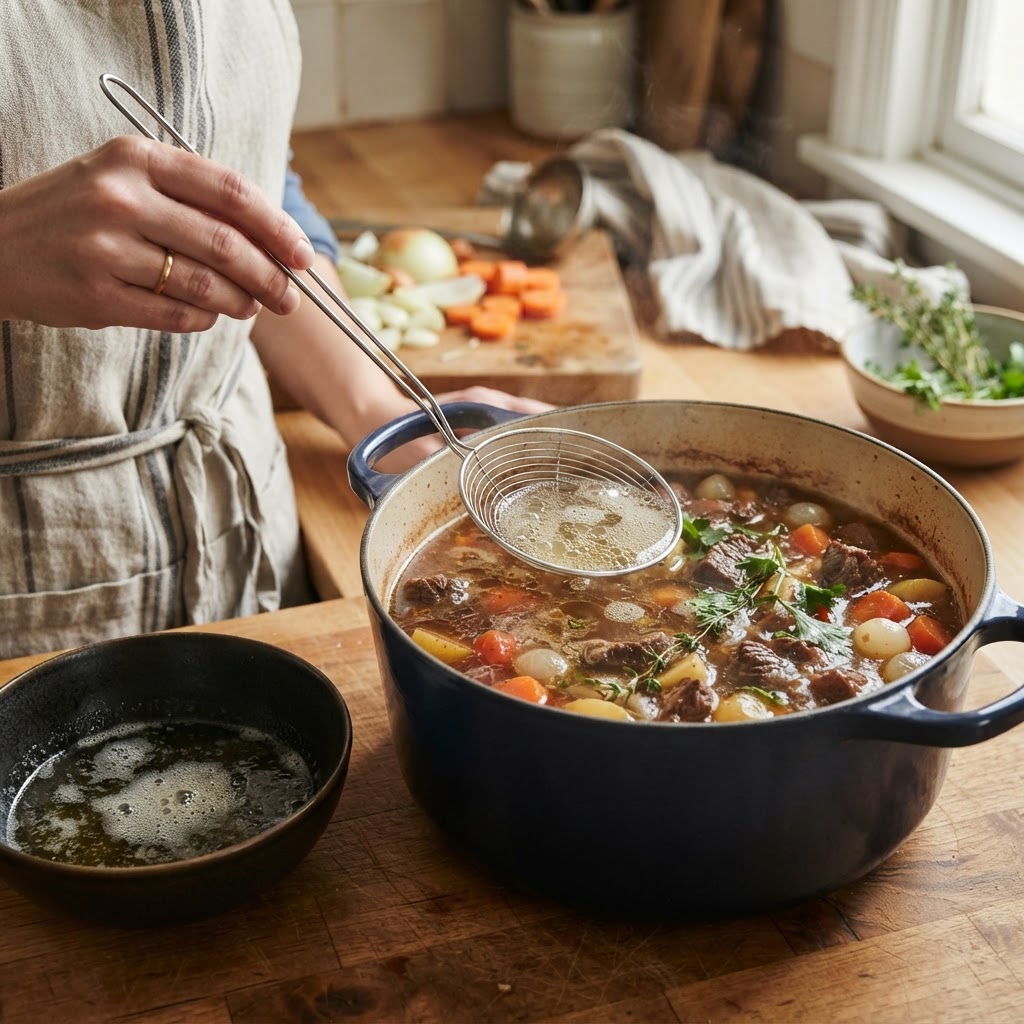
When refrigeration is not an option, or when you are working with a reduction that must be finished immediately, manual skimming becomes a critical skill. The key to successful manual skimming is having the right tools and a steady hand. I always recommend using a wide, shallow ladle or a specialized fine-mesh skimmer. The goal is to work systematically, starting from one edge of the pot and moving slowly across the surface, pulling the fat toward the side where it can be lifted out without disturbing the clearer liquid below.
The Paper Towel Trick
For home cooks struggling with those last few stubborn droplets of fat, there is a professional secret: parchment paper or a clean paper towel. By gently laying a sheet of parchment across the surface of the simmering liquid and pulling it off immediately, the fat adheres to the paper while the liquid stays in the pot. You can repeat this process three or four times to achieve a nearly mirror-like surface. This is particularly effective when working with sauces that have been reduced to a glaze, where a ladle might remove too much precious volume.
Tips for Efficiency
* Use a wide-bottomed stockpot to maximize surface area.
* Keep a bowl of warm water nearby to rinse your ladle, preventing a cold ladle from congealing fat as you work.
* Never try to skim while the pot is at a rolling boil; move the pot to a back burner or take it off the heat entirely for a moment.
* Tilt the pot slightly to encourage the fat to pool in one corner, making it easier to capture.
Clarification: Achieving Crystalline Clarity
When we talk about clarification, we are entering the realm of the consommé. This is the process of using a raft—a mixture of egg whites, lean ground meat, and mirepoix—to capture every stray impurity and fat molecule. The proteins in the egg whites coagulate as they heat up, creating a literal filter that pulls suspended particles out of the stock. The resulting liquid is not only degreased but also intensified in flavor, as the raft ingredients infuse their essence into the final product.
The Mechanics of the Raft
To build a successful raft, you must start with a cold, clear stock. Whisk your egg whites and aromatics together, then slowly add the cold stock to the mix. As you place the pot over medium heat, the mixture will begin to rise to the surface. It is vital that you do not stir once the raft begins to form, or you will break the filtration process. Once a "chimney" forms in the center of the raft and you see the clear liquid bubbling through, you know the clarification is working.
Ratios for Success
For every liter of stock, you should use approximately two large egg whites and a small amount of finely minced lean meat (usually chicken or beef, depending on the stock). The meat provides additional protein and flavor, while the egg whites act as the mechanical filter. If the ratio is off—specifically, if you use too many whites—the consommé can become overly thin or lose body. Mastering these ratios is the hallmark of a refined kitchen, ensuring you get the perfect balance of mouthfeel and clarity.
"Clarity is the ultimate expression of control in the kitchen. When you serve a consommé so clear it reflects the light, you are not just serving a soup; you are serving evidence of your technical mastery."
Troubleshooting Common Greasiness Issues
Even the most experienced chefs occasionally find themselves with an oily sauce. Perhaps the heat was too high, or a piece of fat was missed during the initial trimming of the bones. Do not panic; there are several ways to rescue a dish without starting over. The most common mistake is attempting to add thickeners to an oily sauce. Flour, cornstarch, or arrowroot will only bind to the fat, creating a heavy, paste-like texture that is worse than the original problem. Always address the grease before you attempt to thicken or mount the sauce with butter.
The Ice Cube Method
If you are in a pinch and need to degrease a sauce immediately, try wrapping a few ice cubes in a clean, lint-free cheesecloth or a paper towel. Gently drag this cold bundle across the surface of the sauce. The intense cold will cause the fat to harden instantly and cling to the fabric. This is a fast, effective technique for finishing a sauce at the last second, though it requires a bit of dexterity to ensure no moisture from the melting ice enters your reduction.
Adjusting the Emulsion
If you find your sauce has broken—meaning the fat has separated from the wine or stock base—you can often re-emulsify it by whisking in a tablespoon of cold liquid (like water or broth) or a small amount of heavy cream. However, if the sauce is simply too greasy, you must resort to the skimming techniques previously discussed. Remember: the best way to avoid a greasy sauce is to properly trim your fats before they enter the pot. Always trim the silver skin and excess exterior fat from proteins before roasting your bones for stock.
The Role of Fat in Flavor Architecture
While this guide focuses on removing fat, it is important to acknowledge that fat is flavor. If you remove 100% of the fat from a stock, you will likely find the result a bit hollow or thin on the palate. A small amount of fat acts as a delivery system for aromatic compounds, carrying the taste of herbs and vegetables across your tongue. In professional kitchens, we often "mount" a sauce with a small knob of cold butter at the very end. This adds a velvety texture and a richness that is distinct from the greasy, rendered fat of a stock.
Understanding Fat Profiles
Different fats have different melting points and flavor profiles. Rendered chicken fat (schmaltz) is delicious in soups, adding a clean, savory note. Beef fat (tallow) is heavier and better suited for rich, dark reductions. When you are degreasing, you are essentially curating the flavor profile of the dish. By removing the murky, cloudy fats and leaving behind a subtle sheen, you are ensuring that the flavor of your stock remains pure and focused, rather than muddled by the heavy, metallic taste of over-rendered tissue.
Balancing Richness
When designing a menu, consider the fat content of each component. If you are serving a fatty protein like duck breast or pork belly, your sauce should be on the lighter, more acidic side to cut through that richness. If you are serving a lean white fish or a vegetable-based soup, a slightly richer, more emulsified sauce might be appropriate. The goal is always balance—the trinity of acid, fat, and salt must remain in equilibrium for a dish to be truly balanced.
"The professional kitchen is a laboratory of balance. We remove what is excessive so that what remains can truly shine. Fat is a tool; use it with intention, or be prepared to lose the clarity of your vision."
Advanced Fat Management: From Stock to Reduction
As you progress in your culinary journey, you will find that degreasing happens at every stage of the cooking process. It begins with the initial stock, continues as you strain it, and carries through to the final reduction. A demi-glace is the perfect example of a product that requires constant vigilance. As the liquid reduces, the concentration of fat increases. If you do not skim throughout the reduction process, you will end up with a sauce that is overly heavy and lacks the glossy, glass-like finish that defines a properly made reduction.
The Importance of the "Fat Cap"
In traditional French cooking, a small amount of fat is sometimes left on the surface of a finished stock to act as a seal. This fat cap prevents air from interacting with the stock, which can extend its shelf life in the refrigerator for a few extra days. However, you must be careful: if the fat cap is not completely pristine, it can harbor bacteria. If you choose to use this method, ensure your stock is brought to a boil once before using it, and always store it in a clean, sanitized container.
Clarifying Butter: The Ultimate Degreased Fat
While we have spent most of this time discussing stock, we cannot overlook the importance of clarified butter (or ghee). This is the purest form of fat, with all the milk solids and water removed. Learning to clarify butter is a rite of passage. By slowly melting butter and separating the clear, golden fat from the cloudy, burnt-prone milk solids, you create a cooking medium that can handle much higher heat. This is a fundamental skill for searing proteins and finishing sauces with a clean, nutty flavor.
* Melt butter slowly over low heat without stirring.
* Skim the white foam (the water) from the top.
* Carefully pour off the clear, golden fat into a jar, leaving the milk solids at the bottom.
* Store the resulting clarified butter in a cool, dark place.
Final Thoughts
The journey toward mastery in the kitchen is paved with these small, technical details. Degreasing might seem like a chore—a tedious part of the process that stands between you and the enjoyment of your meal—but it is actually a moment of connection. When you stand over the pot, skimming carefully, you are engaging in a dialogue with your ingredients. You are learning the language of heat, the behavior of emulsions, and the importance of patience. By embracing these techniques, you move beyond following a recipe and toward true culinary intuition.
Remember that perfection is not about never making a mistake; it is about knowing how to fix the ones that occur. If your sauce is greasy, don't despair. Use the ice cube method, reach for the parchment paper, or simply take the time to chill the stock and start fresh. Every error is a lesson in thermodynamics, and every successful degreasing is a step closer to the restaurant-quality meals you deserve to serve at your own table. The clarity of your soup reflects the clarity of your process, and there is no greater reward than a clean, balanced, and flavorful dish that speaks for itself.
As you continue to "Blame the Chef" for the challenges of your kitchen adventures, keep in mind that the chef is merely a guide. The real magic happens when you take these principles and apply them to your own unique palate. Keep your stocks clear, your temperatures controlled, and your kitchen orderly. Whether you are aiming for a classic brown veal stock or a delicate vegetable broth, the principles remain the same. Mastery is a slow simmer, not a flash in the pan. Now, go put your ladle to work and find the beauty in the clarity you create. Your culinary repertoire is waiting to be refined, one skim at a time.


Get the Next Recipe
Weekly recipes, techniques, and gear picks — straight to your inbox.
