The Home Cook’s Guide to Degreasing: Mastering Skimming and Clarification Techniques for Perfectly Clear Stocks and Sauces
There is a specific, quiet moment in the kitchen that separates the hurried home cook from the true student of culinary arts. It occurs when a stockpot has been simmering for hours, filling the house with an intoxicating aroma, yet the liquid remains clouded by a shimmering, oily veil on the surface. We have all stood there, ladle in hand, wondering if the murky broth is simply the cost of doing business or a sign of a fundamental error in our process. Mastering the art of degreasing is not merely about aesthetics; it is about refining the flavor profile of your dishes to reach a level of clarity that carries the true essence of your ingredients. When we remove excess fats and impurities, we allow the complex notes of roasted bones, mirepoix, and aromatics to shine through without the heavy, cloying film that often masks them.
Learning to control the clarity of your stocks, consommés, and pan sauces is a rite of passage for any cook who aspires to move beyond the recipe and into the realm of intuition. The presence of fat, while essential for flavor in many contexts, acts as a barrier that dulls the palate’s ability to discern subtle nuances. By implementing proper skimming techniques and learning the science behind clarification, you elevate a humble liquid from a heavy base to a sophisticated, crystalline elixir. This process requires patience, a keen eye, and a willingness to embrace the slower pace of traditional kitchen craft. It is a meditative practice that forces us to pay attention to the gentle alchemy happening within the pot, rewarding us with a product that looks as professional as it tastes.
Throughout this guide, we will peel back the layers of these essential techniques, starting from the basic physical removal of fat to the delicate chemistry of protein-based clarification. Whether you are a beginner looking to improve your first chicken stock or a seasoned enthusiast attempting a classic consommé double, these methods are the bedrock of fine cooking. We will discuss the importance of temperature control, the tools you absolutely must have in your arsenal, and the common pitfalls that often lead to cloudy liquids. By the end of this journey, you will no longer view a murky pot as a failure, but as a project waiting to be refined through the gentle application of technique and care. Let us transform your kitchen repertoire, one ladle at a time, and ensure that your sauces and stocks are always perfectly clear.
The Science of Fat and Impurities in Stocks
To understand how to clean a stock, we must first understand what we are actually removing. When you begin a stock, you are boiling or simmering proteins, collagen, and fats from bones and vegetables into water. As the temperature rises, proteins denature and coagulate, often rising to the surface as a gray, foamy scum. This is not necessarily dirt, but rather a collection of blood, marrow, and soluble proteins. If left to boil, these proteins break down into microscopic particles that emulsify with the fat, creating that undesirable cloudy appearance. Controlling this from the very beginning is the first step in successful degreasing.
Understanding Emulsification
When fat and water-based proteins collide in a boiling pot, they create an emulsion. This is the same science behind a vinaigrette, but in your stockpot, it is working against you. The fat droplets become trapped by the coagulated proteins, effectively locking them into the liquid. To keep a stock clear, you must maintain a gentle simmer rather than a vigorous boil. A boil creates convection currents that forcefully agitate these components together. By keeping the pot at a soft bubble, usually around 190°F to 200°F, you allow the impurities to rise to the surface gently where they can be captured.
The Role of Collagen and Gelatin
While fat is the primary target of degreasing, collagen is your best friend. It breaks down into gelatin, which provides the luxurious mouthfeel we associate with high-quality stocks. If you boil your stock too hard, you risk extracting too much fat and clouding the liquid with impurities. High-quality stocks are characterized by their clarity when hot and their wobble when chilled. By managing your heat, you ensure that the gelatin remains in suspension while the fats and impurities are easily skimmed away at the surface.
"Clarity in a stock is not just a visual achievement; it is a manifestation of the cook's patience. When you stop rushing the boil, you allow the ingredients to express their true character, unburdened by the heavy, muddled flavors of burnt impurities."
Manual Skimming Techniques for Daily Cooking
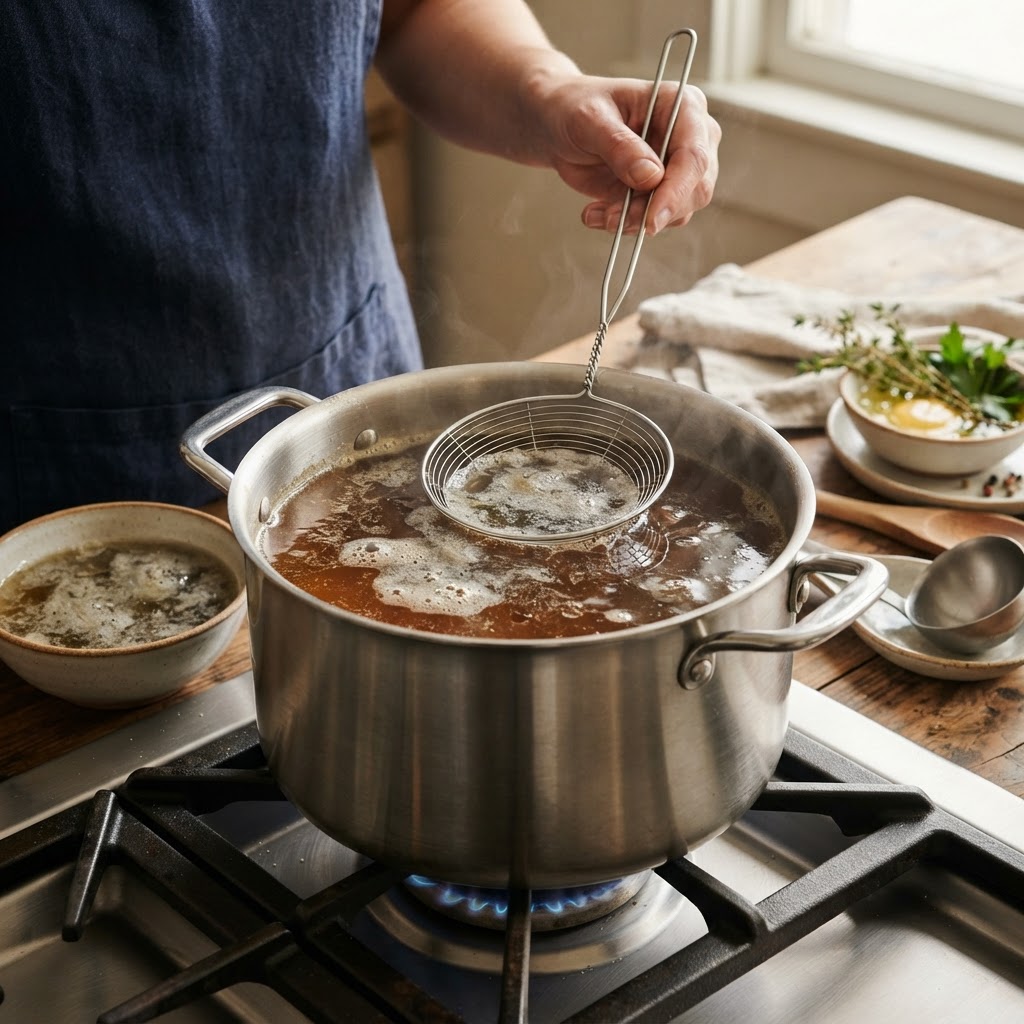
Manual skimming is a skill that is practiced, not taught in a single sitting. For everyday stocks—whether chicken, beef, or vegetable—the process begins well before the pot reaches a simmer. As your stock pot heats up, keep a bowl of cold water and a high-quality, fine-mesh ladle nearby. You will notice that as the liquid nears the boiling point, the "scum" begins to rise. This is the time to act. Do not wait for it to boil over or incorporate into the rest of the liquid.
The Gentle Surface Sweep
Use your ladle to gently skim the surface of the liquid, starting from the sides and working your way toward the center. Because the surface of the liquid is the point where the temperature is slightly lower and the convection cycle turns, the foam and impurities will naturally congregate here. Professional skimming requires a light touch; avoid plunging the ladle deep into the pot, as this will disturb the sediment that has already settled at the bottom. By removing these early-stage impurities, you drastically reduce the amount of fat that will emulsify later.
Skimming Mid-Simmer
Once the stock is at a simmer, you will continue to see small pearls of fat rise to the top. This is a continuous process. You do not need to stand over the pot for six hours, but you should aim to skim at least once every 45 to 60 minutes. Use a skimmer or a small fine-mesh chinois to lift these fat globules out. If you find the fat is too dispersed to ladle easily, move the pot slightly so that it hangs off the edge of the burner. This creates a "dead zone" on one side of the pot where the liquid is cooler, causing the fat to pool in that one corner for easy removal.
Utilizing Temperature to Your Advantage
One of the most effective tools for degreasing is the refrigerator. Many home cooks feel compelled to skim everything while the stock is hot, but the physics of fat makes this inherently difficult. Fat is lighter than water, which is why it floats, but at high temperatures, some of the fat remains melted and integrated into the broth. By cooling your stock down completely, you change the state of the fat from a liquid to a solid, making it infinitely easier to manage.
The Overnight Chill
After your stock has finished cooking, strain it through a fine-mesh chinois or cheesecloth to remove the bones and aromatics. Once strained, transfer the stock into a wide, shallow container. The more surface area the container has, the faster it will cool and the easier the fat will be to remove. Let the stock sit in the refrigerator overnight. The next morning, you will find a solid, waxy layer of white or yellow fat sitting on top of a gelatinous, clear stock.
The "Disc" Removal
Because the fat has solidified, you can simply run a knife around the edge of the container and lift the entire disc of fat off in one piece. This is the most effective way to degrease a stock, as it leaves almost zero residual fat behind. If you are worried about small fragments remaining, you can take a warm spoon and gently wipe the surface of the chilled stock to pick up any stray bits. This method is the secret behind those restaurant-quality demi-glaces that have a deep, clean flavor without a hint of greasiness.
Advanced Clarification: Creating a Consommé
When you need a liquid that is perfectly transparent—like a classic consommé—skimming and chilling are not enough. You must employ a raft. A raft is a mixture of ground meat, aromatics, and egg whites that is added to a cold, clarified stock. As the mixture heats up, the proteins in the egg whites and meat denature and rise to the surface, creating a porous layer that acts as a filter. As the stock bubbles through this raft, the proteins trap the microscopic particles that make the stock cloudy.
The Mechanics of the Raft
To build a raft, combine lean, ground protein (such as chicken or beef), finely minced mirepoix, herbs, and slightly beaten egg whites in a cold pot. Pour your cold, strained stock over this mixture. Turn the heat to medium and stir gently until the liquid reaches a gentle simmer. At this point, stop stirring completely. The proteins will begin to coagulate and rise to the surface, forming a thick, solid mass.
The Clarification Process
Once the raft has formed, use a large spoon to gently poke a small hole in the center—often called a "chimney"—to allow the steam to escape and the stock to continue simmering without breaking the raft. As the liquid bubbles up through the chimney, it is filtered through the proteins of the raft. After about 45 to 60 minutes of this, you will have a liquid that is as clear as tea. Gently ladle the consommé out from the chimney, being careful not to disturb the integrity of the raft itself.
"A consommé is the ultimate test of a chef's discipline. It is a dish that refuses to hide behind fats or thickeners, demanding that the stock be handled with absolute, unwavering technical precision."
Troubleshooting Common Cloudiness
Even with the best intentions, stocks can sometimes turn cloudy. It is important to know why this happens so you can avoid it in the future. The most common culprit is a rolling boil. When a stock boils vigorously, the proteins and fats are whipped into an emulsion that is nearly impossible to separate without extensive clarification. If you find your stock is cloudy, do not panic; it is still perfectly safe to eat, though it may lack the polished aesthetic you were aiming for.
The "Paper Towel" Trick
If you are in a pinch and need to degrease a warm sauce or stock quickly without the benefit of refrigeration, a piece of parchment paper or a clean paper towel can work wonders. Simply lay a piece of parchment paper flat on the surface of the hot liquid. The fat will cling to the paper instantly. Lift the paper carefully and discard. Repeat this process two or three times, and you will see a dramatic reduction in the amount of fat floating on top.
When to Use a Clarifier
If your stock is truly muddled, the only way to restore it is through a chemical or physical clarifier. Beyond the traditional protein raft, some chefs use a small amount of acid (like a splash of lemon juice or wine) during the skimming process. Acid can help slightly in coagulating proteins, but it must be used sparingly to avoid altering the flavor profile. Ultimately, the best way to "fix" a cloudy stock is to serve it in a way that disguises the color, such as using it as a base for a blended soup or a rich, dark gravy.
Professional Tools for the Home Kitchen
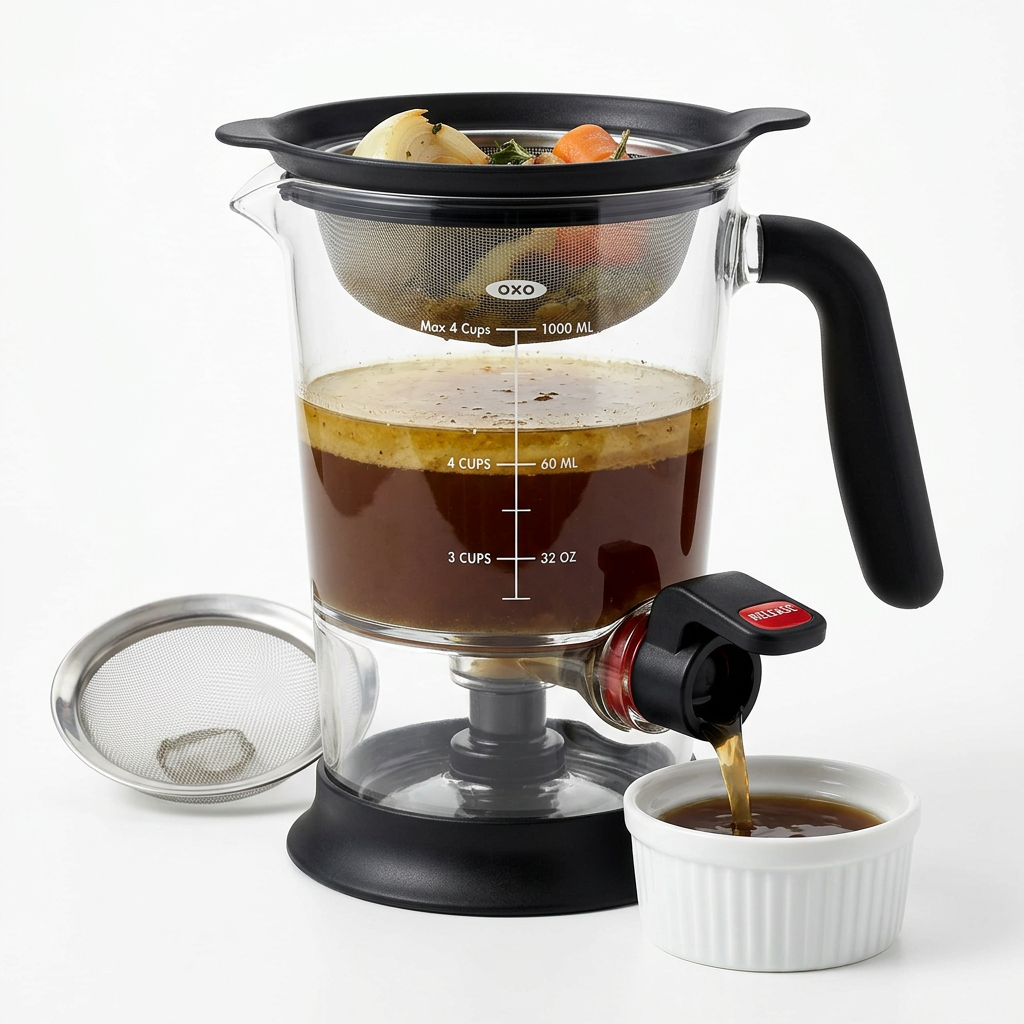
You do not need a commercial kitchen to achieve professional results, but you do need the right tools. A high-quality chinois (a conical sieve with a very fine mesh) is perhaps the most important investment you can make. It catches the small particulates that a standard colander lets through. Pair this with a ladle that has a slightly flared lip, which makes it easier to skim the surface without pouring the liquid over the side of the pot.
The Importance of Pot Choice
The shape of your pot matters. For stocks, use a pot that is taller than it is wide. This reduces the surface area, which actually makes skimming easier because the impurities are concentrated in a smaller space at the top. Conversely, if you are making a pan sauce that needs to reduce quickly, a wide, shallow pan is better to allow for evaporation. Choosing the right tool for the job is half the battle in maintaining the clarity of your liquid.
Maintaining Your Equipment
Always ensure your pots are scrubbed clean. Any leftover residue or burned bits from a previous cooking session can compromise the clarity of a new stock. Use a copper or stainless steel pot for the best results, as non-stick coatings are unnecessary for stock-making and can occasionally flake if you are stirring heavily. Treat your tools with respect, and they will ensure your stocks remain pristine every time you step into the kitchen.
Final Thoughts
Mastering the art of degreasing and clarification is a journey that changes how you cook. It teaches you to look past the ingredients and focus on the chemistry of the pot. You learn that heat is not just a mechanism for cooking, but a tool for texture and visual refinement. As you practice these techniques—from the patient, rhythmic skimming of a rising stock to the silent, slow-motion filtration of a consommé—you will find that your cooking becomes more intentional.
Do not be discouraged if your first attempt at a perfectly clear stock has a few stray bubbles or a bit of sediment at the bottom. The true measure of a home cook is not perfection, but progress. Each time you skim a pot, you are refining your technique and learning the unique behaviors of your ingredients. Over time, you will find that these steps become second nature, a part of your culinary workflow that you no longer have to think about.
By removing the excess, you are creating space for the essential flavors to speak. When your sauces come out silky, clear, and rich, you will understand exactly why the extra hour of simmering or the overnight chill in the fridge was worth the effort. Keep your heat low, your patience high, and your gaze fixed on the clarity you are working to achieve. Your kitchen is your laboratory, and with these techniques, you are well on your way to becoming the master of your own culinary world. Happy cooking, and may your stocks always be as clear as your passion for the craft.
As you move forward, consider documenting your process. Note the time it took to clarify, the temperature of your simmer, and the final result. Understanding the relationship between these variables is what differentiates a home cook from a master. You now possess the knowledge required to take a simple chicken carcass or a handful of aromatic vegetables and turn them into a liquid gold that serves as the foundation for countless meals. It is a quiet, noble work, and it is entirely within your reach. Keep pushing, keep refining, and above all, keep blaming the chef when things get too delicious to handle.
Finalizing your technique requires more than just reading; it requires repetition. Take this guide into the kitchen this weekend. Start a batch of chicken stock. Watch the proteins rise, perform your skimming, and observe the difference that temperature control makes. When you finally strain that liquid and see the amber, translucent body of your work, you will realize that the time spent was not wasted. It was an investment in the quality of every meal that follows. The art of the clear stock is a gift you give to yourself and to those who sit at your table. It is the hallmark of someone who cares about the integrity of every single drop. Enjoy the process, and may your future stocks be the envy of every home cook in your circle.
When we talk about culinary foundations, we are talking about the building blocks of flavor. Degreasing is the act of refining those blocks. It is about removing the noise so that the signal—the deep, savory, complex flavor of a well-made stock—can come through with perfect fidelity. Do not let the simplicity of the technique fool you; it is this attention to detail that elevates a home-cooked meal to a restaurant-level experience. Every time you lift the ladle, you are making a choice to create something better. Keep making that choice, and your culinary journey will be one of constant, delicious discovery. Keep experimenting, keep tasting, and always keep that stockpot simmering low and slow. The results, as you will find, are always worth the patience.
The beauty of the kitchen is that it is an ever-evolving project. You will find that as your skills grow, so too will your desire to challenge yourself with even more complex techniques. Perhaps you will move from a basic chicken stock to a rich, dark beef bone broth, or perhaps you will attempt a vegetable consommé that relies on the natural clarity of garden-fresh produce. Whatever path you take, remember that the principles of degreasing remain the same. The science does not change, but your ability to manipulate it will. Stay curious, stay diligent, and remember that in the world of fine cooking, it is the smallest details that create the biggest impact. Your commitment to these techniques is what will distinguish your kitchen, turning it into a space where true culinary magic is crafted every single day.
Remember that every chef, even those with stars behind their names, started exactly where you are now. They stood in front of a pot, watched the scum rise, and wondered if they were doing it right. The difference is that they kept showing up to the stove. They kept skimming, they kept cooling, and they kept refining. You are now part of that tradition. With every batch of stock you clear, you are contributing to a legacy of craftsmanship that has sustained kitchens for centuries. It is a wonderful thing to be a part of. May your kitchen be a place of joy, experimentation, and, of course, perfectly clear, delicious results. Your family and friends are in for a treat, and that, ultimately, is the greatest reward of all. Keep cooking, keep learning, and don't stop until you have perfected the art of the clear stock.

Get the Next Recipe
Weekly recipes, techniques, and gear picks — straight to your inbox.
