The Home Cook’s Guide to Degreasing: Pro Techniques for Achieving Crystal-Clear Stocks and Sauces
Every home cook reaches that moment of culinary reckoning where they stand over a simmering pot, ladle in hand, staring down a sheen of liquid gold that—while flavorful— threatens to turn their sophisticated sauce into a greasy, heavy mess. We have all been there, laboring over a complex reduction for hours only to find that the final product sits like a lead weight on the palate. Achieving that elusive, restaurant-quality clarity in your stocks and sauces is not a matter of sorcery or expensive equipment; it is a fundamental skill rooted in chemistry and patience. Understanding how to manage fat content is the bridge between a home-cooked meal that feels heavy and one that sings with clean, defined flavors.
The process of degreasing is often misunderstood as a simple act of skimming, but it is actually a vital architectural step in building a balanced dish. When you learn to control the emulsion and separation of fats during the cooking process, you gain total command over the mouthfeel of your culinary creations. Whether you are crafting a deep, dark veal demi-glace or a simple, rustic chicken velouté, the removal of excess lipids allows the volatile aromatic compounds in your ingredients to shine through without being masked by a film of animal fat. This guide will walk you through the professional techniques used in commercial kitchens to strip away the excess without sacrificing the soul of the sauce.
Welcome to the inner sanctum of kitchen fundamentals, where we believe that "blaming the chef" is only acceptable when the chef has failed to master the basics of fat management. As we dive into the technical nuances of temperature control, cold-shocking, and mechanical separation, remember that consistency is your greatest ally. By the end of this guide, you will have moved beyond the guesswork and into the realm of precise, professional technique. Prepare to transform your kitchen repertoire as we strip back the layers of your sauces and reveal the crystal-clear, intense flavors hiding just beneath the surface.
The Science of Fat Separation in Stocks
At its core, the reason we degrease is to provide a cleaner canvas for the palate. Animal fats—whether from beef, chicken, or pork—have a distinct melting point and a coating quality that can dull the taste buds, making it harder to detect the nuanced notes of herbs, mirepoix, and wine. When we boil a stock, the agitation of the liquid causes fat droplets to rise to the surface due to their lower density compared to water. By managing the convection currents within your stockpot, you can manipulate how and where these fats congregate, making the physical act of removal significantly easier.
Understanding the Physics of the Boil
The most common mistake amateur cooks make is a "rolling boil." While a vigorous boil is necessary for certain blanching tasks, it is the enemy of a clear stock. A hard boil creates turbulence that shatters large fat globules into smaller, microscopic droplets. This process, known as emulsification, keeps the fat suspended throughout the liquid, turning your beautiful, golden stock into a cloudy, opaque broth. To ensure the fat rises to the surface effectively, you must maintain a gentle, consistent simmer, where small bubbles rise steadily from the bottom, encouraging larger fat droplets to coalesce on the top.
The Role of Temperature and Density
Temperature is your primary tool in the separation process. Fats solidify at specific temperatures, usually below 65°F (18°C) for most animal fats. By leveraging this property, we can induce a state of "super-separation." If you ever feel like your sauce is just too greasy to skim, the most professional move is to stop fighting the physics of the heat. Instead, embrace the cooling process, which allows the lipids to migrate toward the cooler pockets of the vessel, forming a solid "cap" that can be lifted away with ease, leaving the clarified liquid beneath perfectly intact.
"A sauce is not merely a topping; it is a structural element of the plate. When you fail to degrease, you are layering heaviness over your hard work. Clarity is the hallmark of a disciplined chef."
Strategic Skimming Techniques
Skimming is a rhythmic, meditative process that requires a delicate touch. Many cooks attack their stockpot like they are scraping grime off a sidewalk, but this is a mistake. When you skim, you are not just removing surface oil; you are also removing impurities and scum—the proteins that have coagulated and risen to the top. If these are not removed early, they will be stirred back into the liquid, permanently clouding your stock.
The Tools of the Trade
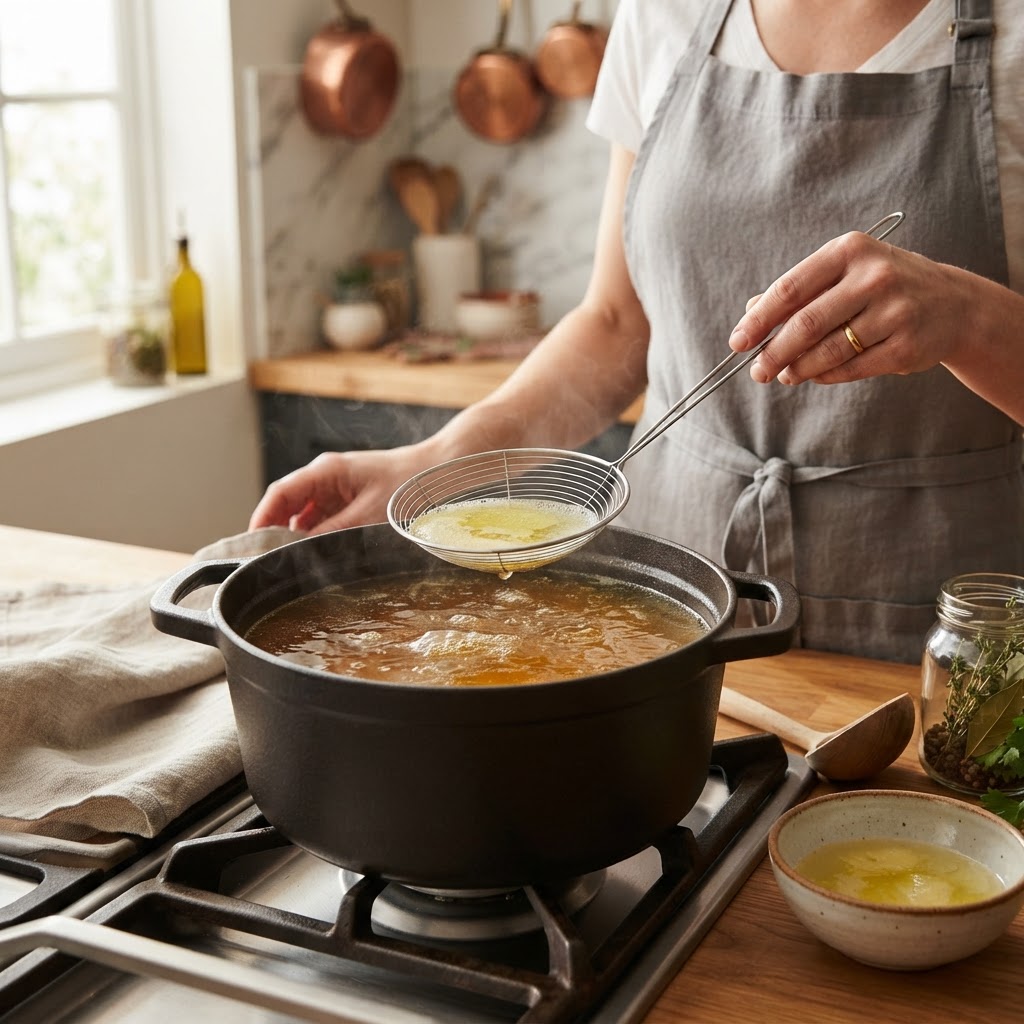
While a standard metal spoon can get the job done, a dedicated fine-mesh skimmer (often called a spider or a bouillon strainer) is worth its weight in gold. A wider, flatter ladle is also essential for skimming oils from the surface without disturbing the lower layers of the stock. Ensure your tools are clean and kept in a bowl of hot water; this prevents the fat from clinging to the spoon, which would only spread the oil back into the pot as you move from side to side.
The Technique of the "Corner Skim"
To skim like a pro, shift your pot slightly off-center on your burner. This creates a "dead zone" on one side of the pot where the liquid is barely moving. The convection currents will naturally push the fat and impurities toward this stagnant corner. By focusing your attention on this localized area, you can efficiently remove the grease without constantly chasing it across the entire surface of the pot, allowing you to save time while achieving a much more thorough result.
The Cold-Shock Method for Perfect Clarity
Sometimes, skimming just isn't enough, especially if you have been a bit too aggressive with the heat early in the process. When a stock has become clouded, or when you are dealing with a particularly fatty cut of meat, the cold-shock method is your secret weapon. This involves rapidly lowering the temperature of your liquid to force the fats to solidify immediately. It is a technique favored in fine-dining kitchens for producing stocks so clear you can read a newspaper through them.
Implementing the Ice Bath
Once your stock has finished its simmer, remove it from the heat and move the pot into a large basin filled with ice water. This creates an accelerated cooling cycle. As the temperature drops, the fat will rise to the surface in a thick, semi-solid layer. While this might seem like it takes extra time, it is far faster than attempting to skim a hot, shimmering surface for an hour. Once the fat has solidified into a white, waxy cap, you can simply lift it out with a spatula or your hands, leaving behind a pristine, clarified liquid.
Dealing with Residual Emulsions
If your stock remains slightly cloudy even after removing the fat, it is likely due to tiny protein particles. The professional solution is to clarify the stock using an egg white raft. By whisking egg whites with a bit of lean ground meat and mirepoix, then adding it to your cold stock and slowly bringing it to a simmer, the egg whites will coagulate and attract every single impurity in the pot. The result is a sparkling, translucent liquid that acts as the perfect base for your most delicate sauces.
"Degreasing isn't about eliminating fat entirely; it's about curating the texture. You want the silkiness of the fat without the greasy coating that dulls the soul of the ingredients."
Choosing the Right Fats for Your Sauce
Not all fats are created equal, and knowing which ones to keep and which to remove is a critical part of the chef's craft. In many cases, the fat you are skimming away is actually "spent"—it has been oxidized by long cooking times and no longer carries the fresh, clean flavor of the original ingredient. However, in some preparations, you may want to retain a small portion of the rendered fat to build flavor, especially when creating a pan sauce.
The Anatomy of Rendered Fat
Consider the difference between the fat rendered from a high-quality dry-aged steak and the fat from a commercial chicken carcass. Beef tallow has a distinct, nutty profile that can be used to add depth to a bordelaise sauce. In this instance, you wouldn't want to strip away every trace. Instead, you might skim off 80% of the surface fat to ensure the sauce doesn't coat the mouth, while leaving a small amount to provide the necessary richness that carries the flavor of the wine and aromatics.
Filtering and Clarification Steps
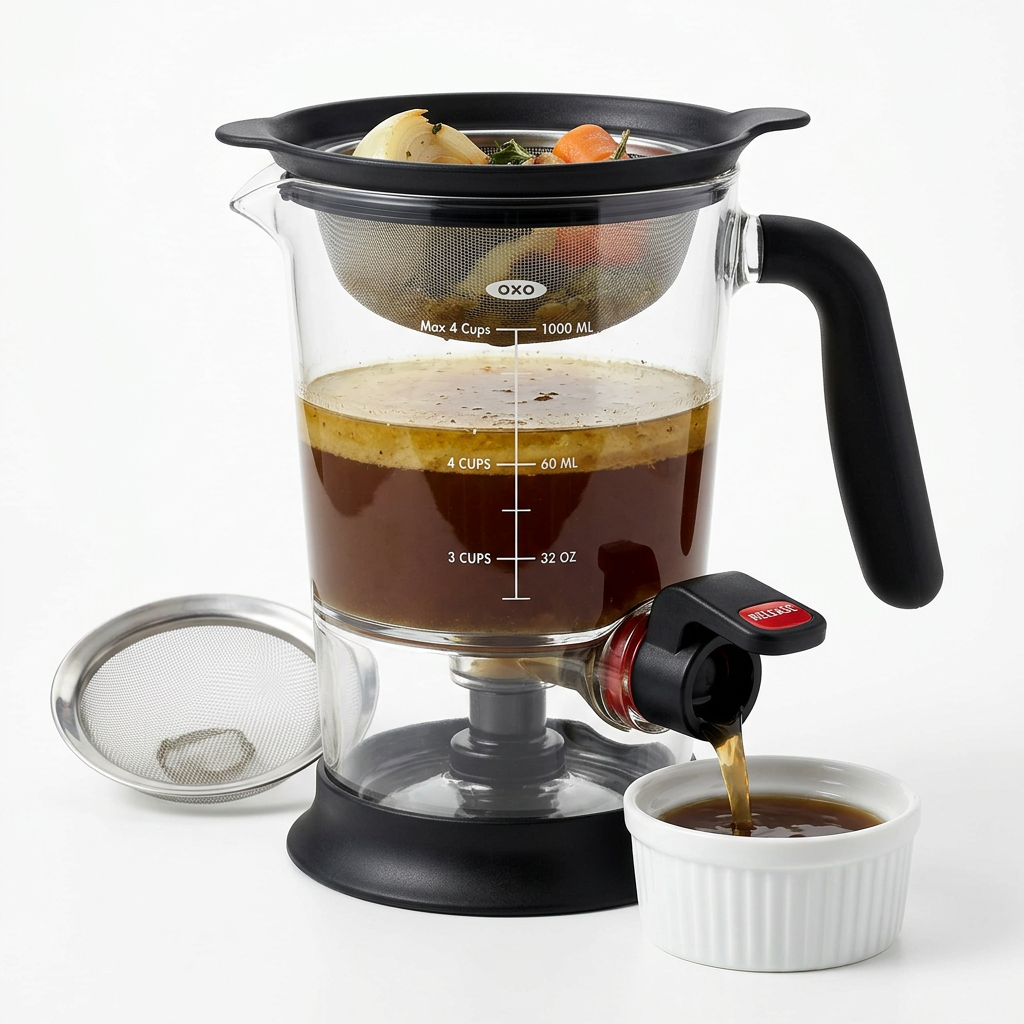
If you decide to save some of your rendered fat, it must be properly filtered. Use a cheesecloth or a fine-mesh conical strainer (a chinois) to ensure that no burnt bits or protein sediment make it into your storage container. A clean, rendered fat is a versatile ingredient that can be used for roasting vegetables or searing meats, but it must be stored in the refrigerator and treated as a perishable item. Never leave your rendered fats at room temperature for extended periods, as they will turn rancid.
Degreasing in the Context of Pan Sauces
A pan sauce is the ultimate test of a home cook's speed and technique. Unlike a long-simmered stock, a pan sauce is built in minutes, often using the residual fat from the searing process. Achieving the perfect balance in a pan sauce requires a "pour-off and replace" strategy. If you have too much fat in the pan after searing your proteins, you must remove it before adding your aromatics or deglazing, or your sauce will end up with a greasy, separated appearance.
Mastering the Pour-Off
When degreasing a pan, the most efficient method is to tilt the pan and use a small spoon to remove the excess oil. Aim for a ratio where only about a tablespoon of fat remains for every pound of meat being cooked. This remaining fat is essential for sweating your shallots or garlic, as it serves as a conductive medium for heat. If you remove all of it, your aromatics will burn instead of soften; if you leave too much, your final wine-based reduction will not properly emulsify with the butter or stock you add later.
The Emulsion Finish (Montez au Beurre)
The final step in many professional sauces is montez au beurre, or "mounting with butter." This is the point where you take cold, cubed butter and whisk it into your hot, degreased reduction. Because you have already done the hard work of removing the heavy, oxidized animal fats, the butter introduces a clean, creamy, and stable emulsion that coats the back of a spoon. This is the difference between a greasy, separated sauce and a velvety, glossy coating that makes your dish look like it belongs on the cover of a magazine.
Professional Tips for Sauce Stability
Even with the best technique, sauces can sometimes "break." A broken sauce is one where the fat has separated from the liquid, resulting in a pool of oil floating on top of a watery broth. While this is often a result of adding too much fat or not enough stabilizer, it is usually fixable. Understanding how to rescue a broken sauce is just as important as knowing how to degrease in the first place, as it saves hours of effort and prevents food waste.
The "Slight" Rescue
If you notice your sauce beginning to separate, the immediate reaction should be to stop the heat. The most common cause of a break is excessive heat, which causes the fat molecules to move too quickly to maintain an emulsion. Take the pan off the burner immediately and whisk in a small amount of cold liquid—this can be a splash of cold stock, cold wine, or even a single ice cube. This rapid drop in temperature can often pull the emulsion back together before it fully separates.
Using Natural Stabilizers
To prevent breaking in the first place, many professional kitchens rely on natural stabilizers. Reducing the sauce sufficiently is the most important step; as the water evaporates and the collagen from the bones concentrates, the liquid naturally becomes more viscous, making it better at holding onto fat. Furthermore, starting with a cold emulsification—adding cold butter at the end—rather than trying to emulsify fats at the beginning of the process, ensures a more stable and professional result.
Patience is Key:* Never rush the skimming process.
Temperature Control:* Keep your simmer low to avoid shattering fat droplets.
Strain, Strain, Strain:* Use a chinois to catch the smallest impurities.
The Cold-Shock:* Use an ice bath when you need 100% clarity.
Finish with Butter:* Always mount with cold butter to ensure a glossy, emulsified finish.
Final Thoughts
Mastering the art of degreasing is a journey that elevates your cooking from "tasty" to "technically precise." By understanding the physical and chemical interactions between fat, heat, and liquid, you strip away the unnecessary components of your dishes and reveal the pure, concentrated flavors of your ingredients. Whether you are working on a batch of Sunday-afternoon beef stock or a quick, elegant pan sauce for a Tuesday dinner, these techniques are the secret language of the professional kitchen.
Remember that "Blame the Chef" is not about finding fault, but about taking responsibility for the craft. Every time you skim, every time you choose to discard that excess oil, and every time you monitor the temperature of your simmering pot, you are making a deliberate choice to improve the quality of your output. Embrace the process, don't fear the cold-shock, and always finish your sauces with the care and attention they deserve. The difference between an average home meal and a professional-grade dish is rarely found in the cost of the ingredients; it is found in the discipline of the chef.
Continue to practice these methods, and soon, you will find that clear, beautiful, and perfectly emulsified sauces become second nature. You will start to notice the fat rising to the surface of your soups and stews almost instinctively, and you will understand exactly when to act to keep your flavors clean and your palate satisfied. The kitchen is a place of constant learning, and by dedicating yourself to these fundamental basics, you ensure that every dish you serve is a testament to your growing skill, precision, and passion for the culinary arts. Keep cooking, keep testing, and never stop refining your technique.

Get the Next Recipe
Weekly recipes, techniques, and gear picks — straight to your inbox.
