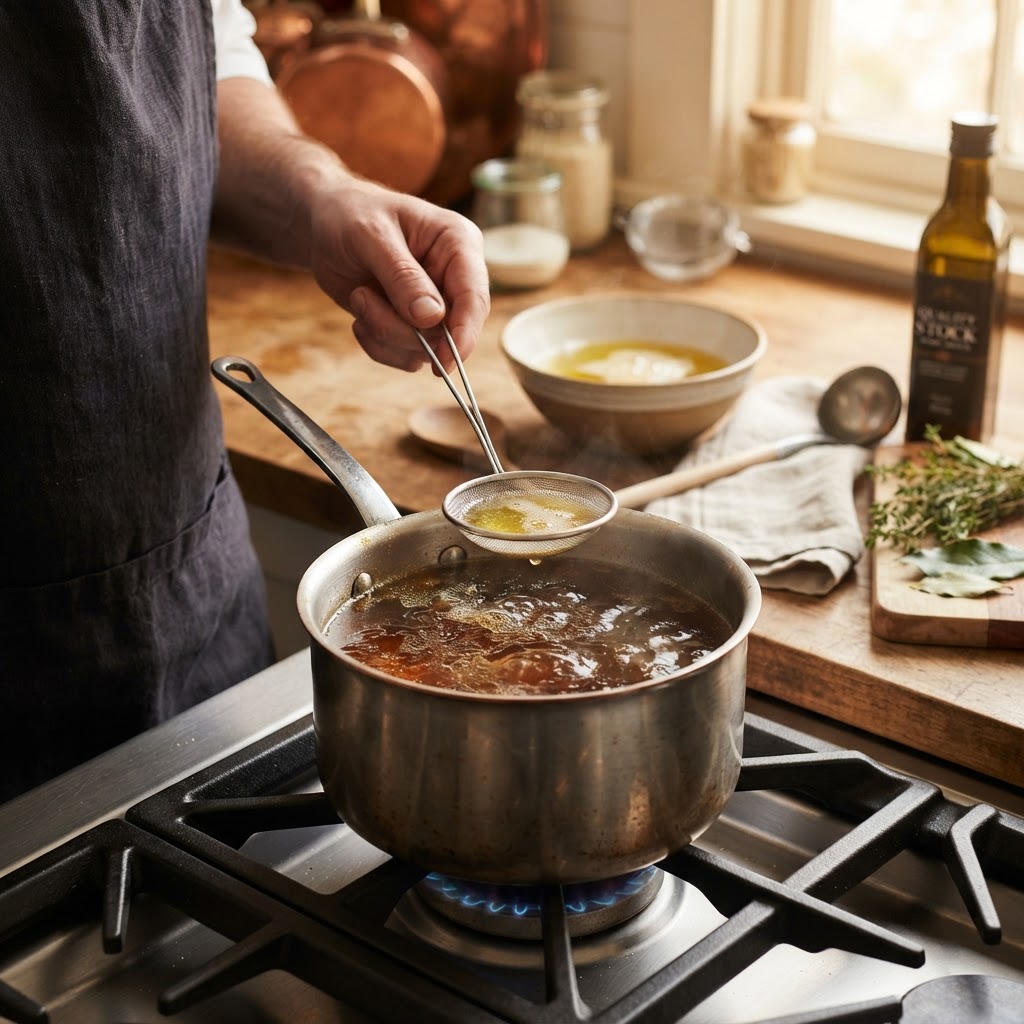
The Home Cook’s Guide to Degreasing Stocks and Sauces: Pro Techniques for Achieving a Crystal-Clear Finish
There is a particular kind of heartbreak that settles into the chest of a home cook when they spend six hours simmering a golden, aromatic stock, only to watch it cool into a cloudy, grease-slicked puddle. We have all been there, peering into the stockpot with a sense of betrayal, wondering where the elegance of a restaurant-quality consommé went wrong. Achieving that elusive, mirror-like clarity is often treated like a dark art, whispered about in the back hallways of professional kitchens by chefs who act as if they are guarding the secret to alchemy. In reality, the science of degreasing is a fundamental skill rooted in thermal dynamics and patience, rather than professional sorcery. By understanding how fats behave at different temperatures and how emulsions interact with your liquids, you can elevate your sauces from heavy, oily coatings to refined, translucent masterpieces.
The truth is that fat is flavor, but uncontrolled fat is a structural failure. When we talk about degreasing, we aren’t talking about stripping the soul out of your hard work; we are talking about curating the texture of the final experience. A thick, opaque layer of tallow or schmaltz resting on top of a sauce does more than just ruin the visual appeal; it coats the palate in a way that prevents the complex aromatics of your mirepoix and herbs from actually hitting your taste buds. When you master the techniques of controlled fat separation, you aren't just cleaning up a mess; you are actively engaging in the process of refinement. It is the difference between a rustic, home-style stew and a professional-grade reduction that clings to the back of a spoon with glistening, velvet-like precision.
Throughout this guide, we are going to break down the barrier between the amateur kitchen and the professional line. You will learn the importance of temperature gradients, the physics of refrigeration, and the manual dexterity required to skim a surface without disturbing the sediment below. We will explore the tools that make this easier—from the humble ladle to the sophisticated fat-separator—and discuss the chemistry of why your stock turns cloudy in the first place. You are about to turn the page on a new chapter of your culinary journey where the grease is no longer the enemy, but a controlled element that you can manipulate at will. Grab your apron and your finest fine-mesh strainer, because we are going to achieve that crystal-clear finish you’ve been chasing for years.
The Science of Fat Separation: Understanding the Float
At its core, degreasing is a study of density and polarity. Animal fats are lipids, and in the world of liquids, they are naturally hydrophobic—they do not want to mix with the water-based proteins and minerals in your stock. This is why, when you remove a pot from the heat, the fat molecules immediately begin to rise to the surface. They are lighter than water, and given enough stillness and time, they will form a distinct layer. Understanding this movement is the first step toward reclaiming your sauce.
Temperature and Viscosity
The temperature gradient is the primary driver of fat movement. When your stock is at a rolling boil, the turbulence forces fat particles to emulsify temporarily, creating that muddy, opaque look we associate with a "dirty" stock. To degrease effectively, you must eliminate movement. By allowing the liquid to drop in temperature, you increase the viscosity of the fats. As they cool, they begin to coalesce into larger, more manageable droplets rather than remaining suspended in the liquid.
"Clarity is not achieved by force; it is achieved by silence. If you move too fast, you only agitate the impurities back into the suspension you are trying to purge."
Why Stocks Turn Cloudy
Cloudiness often occurs when your stock is allowed to boil too vigorously for too long. This creates an emulsion of fat and water that is notoriously difficult to break. Furthermore, the presence of too many suspended solids—bits of bone, marrow, or soft tissue—acts as an anchor for fat molecules. Achieving clarity requires a gentle simmer—often referred to as a "smile"—where small bubbles rise to the surface at infrequent intervals, ensuring the stock stays clean and the fat separates naturally without being churned back into the liquid.
The Refrigeration Technique: The Gold Standard
If you have the luxury of time, the refrigerator is your greatest ally in the quest for a crystal-clear stock. This is the professional’s preferred method for a reason. By chilling your stock, you fundamentally change the state of the lipids, allowing them to harden into a solid disk that can be lifted away with zero effort. This is the most efficient way to ensure that 100% of the rendered fat is removed from the surface, leaving you with a base that is as pure as glass.
The Chilling Process
Lifting the Fat Disk
Once the stock is thoroughly chilled, you will notice a solid, whitish or yellow layer sitting on top. This is the rendered fat. Gently run a thin, flexible spatula around the edge of the container to break the vacuum seal between the fat and the walls of the bowl. Carefully peel back the edge of the fat disk. If it is firm enough, you can often lift the entire layer off in one single piece. If it breaks, simply use a spoon to lift the shards away. Any small remnants that remain can be wiped away with a dry paper towel by gently dragging it across the surface of the chilled, gelatinous stock.
Manual Skimming: The Active Technique
When you are in the middle of a dinner service or simply don't have the time for an overnight chill, you must rely on manual skimming. This requires a steady hand and an eye for detail. The goal here is to remove the fat while it is still in a liquid or semi-liquid state, which is significantly more challenging than working with a solidified disk. You are essentially mining for gold in a river; you want the surface material without disturbing the silt on the bottom.
Tools of the Trade
You don't need a drawer full of gadgets to succeed, but you do need the right two:
A Shallow Ladle:* A wide, shallow ladle is better than a deep, narrow one. It allows you to scoop from the very top surface without plunging into the deeper, nutrient-dense liquid.
Absorbent Paper Towels:* These are your insurance policy. If you have fine droplets of oil, a quick drag of a folded paper towel across the surface will soak up the grease while leaving the stock behind.
The Technique of the Tilt
To make manual skimming easier, tilt your stockpot slightly. Place a folded kitchen towel or a small heat-proof trivet under one side of the pot. By tilting the vessel, you force the fat to pool at the lower edge of the surface. This concentrated "pool" of fat is much easier to isolate and remove with a spoon or a turkey baster. Work slowly, moving from the edge toward the center, taking care not to submerge your ladle deeper than a quarter-inch below the surface.
Using Commercial and DIY Fat Separators
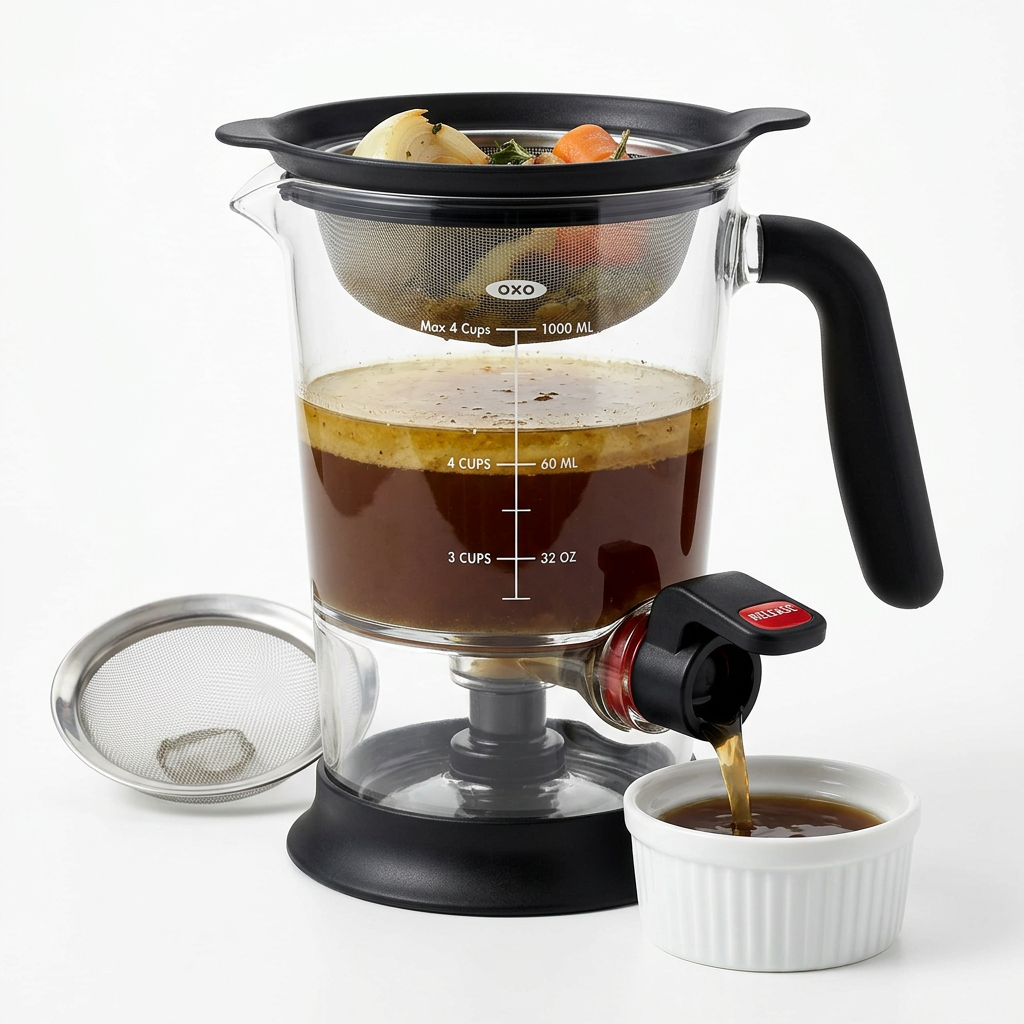
If you are a home cook who frequently makes sauces, a fat separator is a tool that pays for itself in just a few uses. These devices operate on the principle of gravity and the fact that fat floats. By pouring your stock into a separator, the fat rises to the top while the cleaner, leaner liquid sits at the bottom. The pour spout is attached to the bottom of the vessel, meaning only the clean stock flows out, leaving the fat behind.
Proper Use of a Separator
Pour slowly:* When pouring hot stock into the separator, do it in a steady, controlled stream to avoid turbulence that keeps the fat mixed in.
Wait for the line:* Let the liquid sit for a few minutes until you see a sharp, distinct line forming between the darker, clear stock and the yellow, oily top layer.
Control the flow:* As you begin to pour the stock back into your sauce-pot, watch the spout closely. The moment you see the golden fat layer enter the neck of the pour spout, stop immediately.
Why Not Just Strain It?
Many cooks make the mistake of thinking a fine-mesh strainer will remove the fat. While a strainer is essential for catching solids, it is largely ineffective against liquid fat. If the fat is melted, it will simply pass through the mesh alongside your stock. A strainer is for clarity of particles; a separator or skimming technique is for clarity of lipids. Always use both in sequence to achieve the desired result.
"A sauce is not just a flavor profile; it is a texture. If the sauce leaves a film on the roof of your mouth, you haven't degreased enough. The goal is a clean, bright finish that sparkles on the tongue."
Degreasing Emulsified Sauces: The Pro-Level Challenge
Sometimes, despite your best efforts, you end up with a sauce that looks like it has "broken." This happens when the fats and liquids refuse to stay together, or conversely, when the fat is so thoroughly emulsified that you cannot separate it. Fixing a broken or overly greasy sauce is a skill that separates a home cook from a saucier. You are essentially working to re-stabilize the emulsion or, in the case of too much fat, force the excess out of the solution.
The "Ice Cube" Trick
If you have a sauce that seems greasy but you cannot effectively skim it, drop two or three ice cubes into the pot. The sudden drop in temperature will cause the fat to solidify instantly in small, marble-sized chunks. You can then quickly skim these out with a slotted spoon before they have a chance to melt back into the sauce. This is a brilliant, last-minute rescue technique for a dinner party that is going south.
The Paper Towel "Floating" Method
For sauces that are nearly finished, take a large sheet of paper towel and lay it flat across the surface of the sauce for just a second, then lift it straight up. The surface tension of the paper will pull up the microscopic beads of fat that are too small to skim with a ladle. You may need to repeat this three or four times, using a fresh towel each time. It is a humble, low-tech solution, but it produces a remarkably clean finish that looks incredibly professional.
Troubleshooting Common Issues
Even with the best intentions, things go wrong. Perhaps your stock is cloudy even after skimming, or maybe you find that your sauce lacks body after you remove the fat. These are common issues that every chef encounters. The key is knowing how to course-correct without sacrificing the integrity of the dish.
Dealing with Persistent Cloudiness
If your stock remains cloudy after degreasing, you may have "boiled the particles." This happens when proteins have been shredded into such tiny pieces that they stay suspended in the liquid. You can clarify this by using a raft of egg whites and ground meat, effectively performing a consommé clarification. Simply whip egg whites with some cold lean ground meat and aromatics, add it to your simmering stock, and let it coagulate. The proteins will act as a filter, trapping the cloudy sediment as they rise to the top.
Maintaining Body After Degreasing
Some home cooks fear that removing the fat will make their sauces feel "thin" or "watery." This is a valid concern, as fat provides mouthfeel. If you find your sauce lacks that luxurious, coating quality after it has been properly degreased, you can compensate in several ways:
Advanced Tips for the Home Chef
Once you have mastered the basics, you can start incorporating advanced habits into your routine. Degreasing shouldn't be a chore you dread; it should be a meditative part of the process. Professionals treat the skim as a way to check in on the health of their sauce, observing the color and the consistency as they work.
The Power of the "Sediment Bed"
Always leave the very bottom of your stockpot alone. Even when you are pouring the stock through a strainer, the last bit of liquid at the bottom of the pot often contains the fine, chalky sediment of the bones. It is better to waste a quarter-cup of stock than to ruin a whole gallon with the bitter, dusty taste of over-extracted mineral sediment. Be comfortable leaving the last little bit behind.
The Role of Collagen
Remember that fat and collagen are two different things. Collagen provides the "lip-smacking" stickiness that we want in a good demi-glace. If you skim too aggressively and try to get rid of every single speck of fat, you might accidentally pull out some of the gelatin-rich liquid that gives the sauce its structure. When you see tiny, clear bubbles that don't look like they have a yellow sheen, that is likely your collagen, and you should keep it in the pot.
"The most important tool in your kitchen is not your knife or your blender; it is your patience. If you rush the cooling, you lose the clarity. If you rush the skim, you lose the texture. Slow down, and the sauce will reward you."
Storing and Reusing Fat
Don't throw away that beautiful, golden fat you’ve skimmed off. If you are roasting vegetables or searing a steak, that rendered duck fat or chicken schmaltz is culinary gold. Store it in a small, airtight container in the fridge. Use it to roast potatoes, sauté mushrooms, or even as the fat component for a savory crust. Degreasing isn't just about making a clean sauce; it’s about harvesting the pure essence of the animal to use as a high-quality cooking medium later.
Final Thoughts
Achieving a crystal-clear stock or sauce is one of the most rewarding milestones for a home cook. It signifies that you have moved past the "dump and stir" method of cooking and into the realm of intentional, controlled craftsmanship. By mastering the separation of fat from your liquids, you are taking control of the final sensory experience—the way the sauce looks on the plate, the way it coats the palate, and the way it highlights the flavors of your carefully chosen ingredients.
Remember that perfection is not a destination; it is a series of small, consistent decisions. Whether you are chilling your stock overnight to achieve that perfect fat disk or carefully tilting your pot to skim away the impurities during a busy afternoon, you are engaging in the same traditions that have guided chefs for centuries. Do not be discouraged if your first attempts at a perfectly clear sauce aren't quite restaurant-ready. The beauty of cooking lies in the repetition. Each time you skim, you learn more about the liquid you are working with.
As you move forward in your culinary journey, continue to prioritize these foundational techniques. It is easy to be distracted by flashy new gadgets or complex recipes, but the heart of great cooking will always be the fundamentals. A crystal-clear sauce is the hallmark of a cook who cares about the details, who understands the ingredients, and who respects the time it takes to build real, honest flavor. Keep refining your technique, stay patient with your simmering, and never be afraid to blame the chef—but only if the chef is you, and you know exactly how to fix the problem next time. Happy cooking, and may your sauces always be as clear as a mountain stream.

Get the Next Recipe
Weekly recipes, techniques, and gear picks — straight to your inbox.
