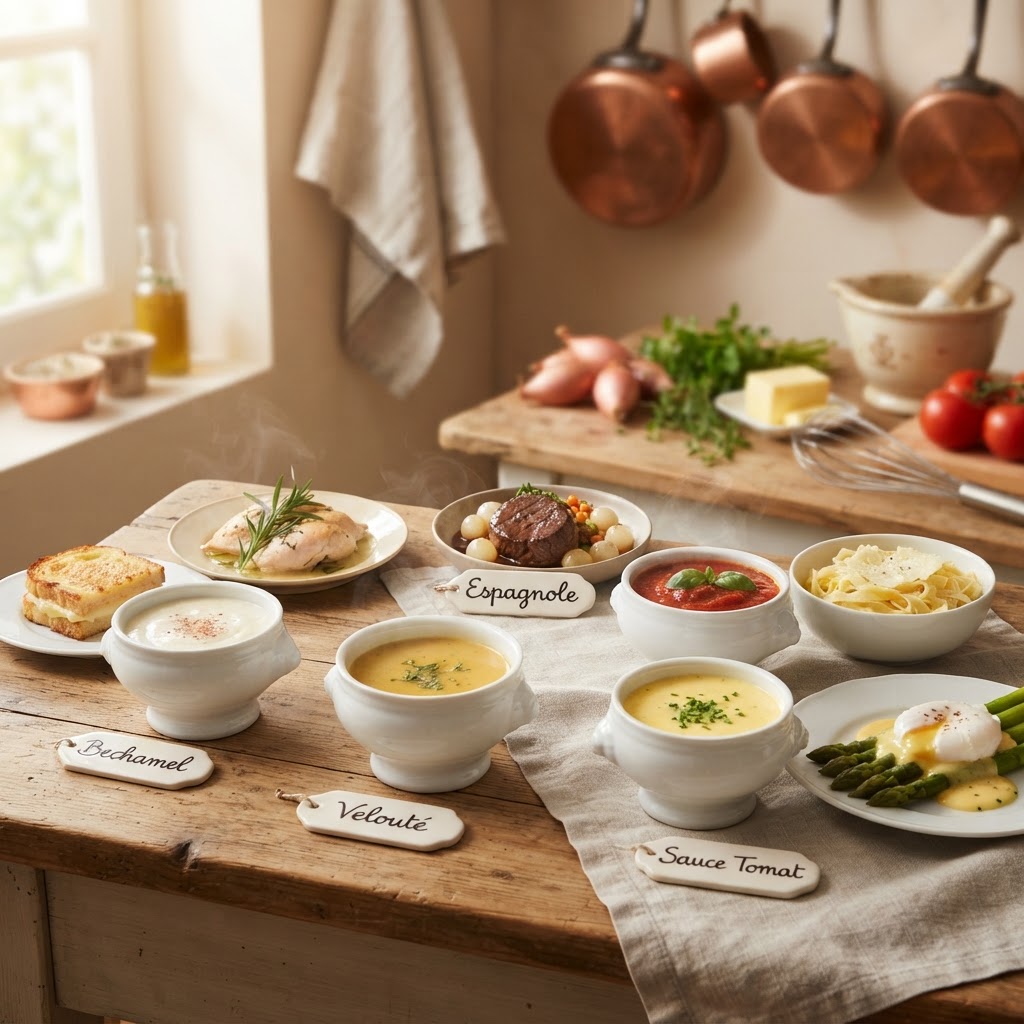
The Home Cook’s Guide to French Mother Sauces: Mastering the Foundation of Classic Culinary Technique
There is a pervasive myth among amateur home cooks that French cuisine is an insurmountable fortress, guarded by impenetrable techniques and an elitist vocabulary that demands years of formal training to decode. I have spent a significant portion of my professional life watching talented home cooks shy away from a classic Bechamel or a Hollandaise simply because they were intimidated by the prospect of a split emulsion or a lumpy roux. The truth is far less daunting: French cooking is not about rigid perfection, but rather about understanding the fundamental physics of flavor and texture. By mastering the five Mother Sauces, you are not just learning five recipes; you are acquiring a structural toolkit that allows you to improvise, correct, and elevate every single dish that leaves your kitchen. When you understand how heat interacts with fat and flour, or how acid stabilizes an emulsion, the "magic" of the restaurant kitchen becomes a reproducible, everyday reality.
The concept of the Mother Sauces—codified by the legendary Auguste Escoffier—is essentially a lesson in culinary architecture. Think of these sauces as the scaffolding for a vast array of derivative sauces; once you understand the base, you can branch out into hundreds of variations simply by adjusting aromatics, herbs, or fortifying liquids. This is the secret language of the professional kitchen, where efficiency meets elegance. It is not about memorizing complex chemical formulas, but about developing an intuitive sense of timing, temperature, and visual cues. Whether you are searing a simple chicken breast or hosting an elaborate dinner party, having these sauces in your repertoire transforms a standard meal into an expression of intentional, thoughtful cookery.
Welcome to "Blame The Chef," where we believe that every mistake is just a delicious learning opportunity. We are going to strip away the pretense and dive into the mechanics of these sauces, focusing on the tactile feedback—the way a sauce coats the back of a spoon, the specific color of a cooked-out roux, and the precise moment of emulsification. Forget the intimidating white tablecloths of Paris; we are bringing the soul of the French kitchen into your home. Grab your whisk, sharpen your knives, and prepare to stop following recipes blindly and start cooking with the confidence of a seasoned chef. By the time we reach the end of this guide, you will find that the barrier between "home cook" and "master of the kitchen" is thinner than you ever imagined.
The Foundation of All Things: The Roux and Its Science
The Roux is the heartbeat of most French sauces, serving as the primary thickening agent for three of the five mother sauces. At its core, a roux is a simple mixture of equal parts fat and flour, cooked together to remove the raw, starchy taste of the wheat. The ratio is usually 1:1 by weight, meaning if you use 50 grams of butter, you use 50 grams of all-purpose flour. The secret to a perfect roux lies in patience and temperature control; you are looking to cook the mixture until it reaches the desired level of toastiness without scorching the flour.
Mastering the Levels of Toast
There are three primary stages of a roux, each serving a different purpose in your sauce making. The White Roux is cooked just long enough to remove the raw flour taste, usually about 2-3 minutes, maintaining a pale, ivory color. This is the standard for Bechamel or white veloutés. A Blond Roux is cooked slightly longer until it takes on a golden, nut-like aroma, usually around 5-7 minutes. This adds a subtle layer of depth to your base. Finally, the Brown Roux is cooked until it is deep, dark, and toasted, requiring careful heat management to prevent the flour from burning. The brown roux provides a robust, nutty flavor that is essential for dark sauces and gravies, though it loses some of its thickening power the longer it is cooked.
The Technique of Incorporation
When adding your liquid (whether it is milk, stock, or water) to your roux, the temperature contrast is your greatest enemy. Professional chefs often swear by the rule: cold liquid to a hot roux, or hot liquid to a cold roux. If you add hot liquid to a hot roux, the starch molecules hydrate too rapidly, resulting in immediate, stubborn clumps that are notoriously difficult to whisk out. By controlling this temperature differential, you ensure a smooth, velvety consistency. Always add your liquid in a slow, steady stream while whisking constantly. This constant motion is what breaks down the flour particles and creates a cohesive, silky emulsion that will coat a spoon perfectly.
"A roux is the bridge between a thin, watery liquid and a decadent, clinging sauce. Treat your roux with respect, watch the color, and never rush the cooking process, for a raw-tasting sauce can never be saved."
Béchamel: The White Sauce of Elegance
Béchamel is arguably the most recognizable of the mother sauces, forming the creamy, comforting backbone of dishes like Croque Monsieur, lasagna, and macaroni and cheese. It begins with a White Roux and is whisked with milk. It is a deceptively simple sauce, yet it requires precise attention to aromatics. The inclusion of an onion pique—a small onion studded with a bay leaf and a clove—steeped in the milk is a traditional technique that imparts a subtle, aromatic complexity that elevates the sauce from a basic white paste to a sophisticated base.
Achieving the Perfect Silkiness
To achieve the ideal consistency, you want your Béchamel to reach a nappe consistency, meaning it coats the back of a spoon. When you run a finger through the sauce on the back of the spoon, the line should stay clean and distinct without the sauce running back into the gap. To achieve this, maintain a gentle simmer rather than a rolling boil. If the sauce becomes too thick, whisk in a splash of warm milk. If it is too thin, remember that the sauce will continue to thicken as it cools, so err on the side of slightly thinner than you think you need.
Seasoning and Finishing
Because Béchamel is inherently neutral, seasoning is everything. A pinch of nutmeg is the classic finishing touch, adding a whisper of warmth that cuts through the richness of the milk and butter. Salt and white pepper are essential, but remember to use white pepper so you don't end up with visible black flecks in your pristine white sauce. If you want to transform your Béchamel into a Mornay, simply fold in grated Gruyère or Emmental cheese at the very end, off the heat, to prevent the proteins from breaking and the sauce from becoming grainy.
Velouté: The Stock-Based Masterpiece
If Béchamel is the queen of creaminess, the Velouté is the king of stock-based depth. Unlike the dairy-heavy Béchamel, a Velouté is made by thickening a clear, light stock—chicken, fish, or vegetable—with a Blond Roux. The name itself, which translates to "velvety," suggests the intended texture: smooth, refined, and deeply savory. This is the sauce that rewards you for making your own stocks, as the quality of your finished Velouté is entirely dependent on the quality of the stock you begin with.
The Importance of Stock Quality
There is no "fixing" a weak stock in a Velouté. If your chicken stock tastes like dishwater, your sauce will taste like thickened dishwater. Use a high-quality, gelatin-rich stock. Gelatin provides the "mouthfeel" that makes a sauce feel luxurious rather than oily. If you are using store-bought stock, try to find a low-sodium, roasted version, and feel free to fortify it with extra herbs, carrot peels, and onion ends before reducing it slightly. The reduction process concentrates the flavors, ensuring that the base of your Velouté is packed with umami.
Derivative Sauces: The Power of Extension
The Velouté is a gateway to a massive family of derivative sauces. By adding heavy cream and egg yolks, you create a Sauce Allemande. If you add white wine and mushrooms, you are on your way to a Sauce Suprême. The key is to start with a perfectly executed Velouté and then treat the secondary ingredients as a way to "build" upon the architecture. Because a Velouté is so neutral, it acts as a perfect blank canvas for whatever protein you are serving. It is the sauce that bridges the gap between the earthiness of root vegetables and the lean, delicate nature of white-fleshed fish or poultry.
"A Velouté is not merely a sauce; it is the essence of the animal or vegetable from which it was derived. It is the ultimate exercise in extraction and refinement."
Espagnole: The Mother of Deep Flavors
Espagnole is the darkest and most complex of the mother sauces. It is a hearty, brown sauce made from a Brown Roux, a rich beef or veal stock, and a mirepoix (carrots, onions, and celery) that has been caramelized to perfection. This is not a sauce you whip up in ten minutes on a Tuesday; this is a sauce that demands time, reduction, and attention. It is the precursor to the famous Demi-Glace, which is simply an Espagnole that has been reduced with more stock until it achieves a syrupy, intense, and glossy consistency.
The Art of Caramelization
The secret to a great Espagnole is the depth of color you achieve during the caramelization of the mirepoix and the roux. You aren't just sautéing the vegetables; you are coaxing out sugars and developing a deep, mahogany hue. Do not be afraid of the fond—the brown bits that form on the bottom of the pot. These are pure flavor, and by deglazing the pan with a bit of red wine, you incorporate all those browned, concentrated notes into your base. This process requires a heavy-bottomed pot to ensure even heat distribution and prevent localized burning.
Refinement and Skimming
Because this sauce is simmered for a long period, you must be diligent about skimming. Throughout the process, impurities, fat, and proteins will rise to the surface. Use a ladle or a fine-mesh skimmer to remove these foam deposits periodically. If you leave them in, they can impart a bitter, cloudy quality to the sauce. Once finished, straining the sauce through a fine-mesh sieve (a chinois is the professional choice) is mandatory. You want a smooth, dark, glossy finish that clings to the back of a spoon with the intensity of an ink-like glaze.
Hollandaise: The Emulsion of Light and Acid
Hollandaise is the high-wire act of the culinary world. Unlike the previous sauces, it does not rely on a roux; instead, it is an emulsion of egg yolks and clarified butter, stabilized by a touch of acid, typically lemon juice or a white wine reduction. It is rich, bright, and intensely decadent, most famous for its role in Eggs Benedict. Because it is an emulsion, it is fragile—too much heat, and the eggs scramble; too little fat, and the sauce breaks. This is where your thermometer and your whisking hand become your most valuable tools.
The Physics of Emulsification
The goal in a Hollandaise is to suspend tiny droplets of fat within the water-based yolk mixture. This is achieved through vigorous agitation. Begin by whisking your egg yolks with a small amount of liquid until they are pale and slightly thickened. Place the bowl over a pot of barely simmering water (a bain-marie). It is critical that the water does not touch the bottom of the bowl; you want gentle, indirect steam. Whisk constantly, adding your clarified butter in a very thin, slow stream. If you add the fat too quickly, the emulsion will fail, and you will be left with a greasy mess of separated butter and curdled eggs.
Troubleshooting a Broken Sauce
Even professional chefs see a Hollandaise break from time to time—do not panic. If the sauce looks grainy or oily, it has "split." You can usually rescue it by placing a fresh egg yolk in a clean bowl and slowly whisking the broken sauce into that new yolk, drop by drop, just like you were starting over. The fresh yolk acts as an emulsifier, binding the broken components back into a cohesive, creamy state. Keep the sauce warm until serving, but never hot. If you need to hold it, a small thermos or a warm spot on the back of the stove is ideal. Keep it away from direct heat to prevent the proteins from setting.
Tomato Sauce: The Mediterranean Foundation
While the classical French Tomato Sauce (or Sauce Tomate) is a distant cousin to the bright, basil-heavy sauces of Southern Italy, the French version is fundamentally different because it is traditionally thickened with a roux and fortified with pork fat. It is rich, savory, and deep. Unlike the quick-cooked pasta sauces we are used to, the classical French tomato sauce is a slow-simmered, stew-like preparation that relies on time to break down the tomatoes and meld the flavors into a single, cohesive entity.
Ingredients and Techniques
Start with high-quality canned plum tomatoes, as they offer the most consistent sweetness and acidity throughout the year. The addition of salt pork or bacon at the beginning of the process provides a foundational smokiness and saltiness that defines the profile. The use of a roux here—usually a light roux—gives the sauce a velvety, coating consistency that allows it to hold up to meats and heavier vegetables. Ensure you are removing the seeds and stems, as they can add an unwanted bitterness to a long-simmered sauce.
The Balance of Acidity and Sweetness
The challenge with any tomato-based sauce is balancing the natural acidity of the fruit. Use a small amount of sugar or, better yet, a finely diced carrot, to mellow the sharp edge of the tomatoes. The goal is to cook the sauce down until the water has evaporated and the oil has begun to separate from the solids. This "shimmering" effect, where the fat rests on top of the thickened tomato base, is a sign that the sauce has achieved its optimal concentration. Always taste as you go; a perfect tomato sauce should be balanced, bright, and deeply satisfying, lacking that metallic "tinny" taste of improperly cooked canned products.
Final Thoughts
Mastering the mother sauces is not about performing a chore; it is about liberating yourself from the tyranny of the recipe book. When you understand the roux-to-liquid ratio, the necessity of skimming, and the delicate art of emulsification, you stop cooking to survive and start cooking to create. You will find that these sauces appear in nearly every cuisine, wearing different masks but following the same fundamental laws of chemistry and technique. Do not be discouraged by a broken Hollandaise or a lumpy Béchamel; those moments are where the real learning happens. Pick up the whisk, adjust your heat, and try again.
The professional kitchen is a place of repetition, where these techniques are burned into your muscle memory until they become second nature. As a home cook, you have the luxury of time and the freedom to experiment. Use these five foundations as your compass, but don't be afraid to take detours. Add fresh herbs to your Velouté, experiment with different stocks in your Espagnole, or find the perfect ratio of butter to yolk that fits your palate.
At the end of the day, cooking is an act of generosity. When you present a plate with a sauce that has been crafted with care, you are sharing a tradition that spans centuries. You are honoring the ingredients, the time, and the technique. So, keep your knives sharp, keep your whisk ready, and always, always taste as you go. You are the architect of your own culinary world, and these sauces are the bricks and mortar that will hold your creations together. Welcome to the craft, and enjoy every single drop of the process.
To recap our journey, keep these foundational ratios in mind whenever you step into the kitchen:
By keeping these five pillars in your mental toolkit, you will find that the complexity of high-end French cooking is actually a series of logical, manageable steps. Practice each one until you don't have to look at the measurements. Learn to feel the thickness of the sauce as it hits the spoon, hear the way the liquid bubbles when the roux is fully incorporated, and smell the deep caramelization of a proper brown sauce. The path to becoming a better cook is paved with the efforts of those who came before us, and by learning these techniques, you are keeping the flame of classical culinary education alive in your own home. Happy cooking, and remember—blame the chef if it doesn't work, but celebrate yourself when it does.
As you move forward, consider documenting your progress. Keep a small notebook of your sauces, noting the color of your roux, the type of stock used, and any adjustments you made to the seasoning. Culinary intuition is built on the foundation of experience, and there is no better way to gain that experience than by refining these five sauces over and over again. You will find that your Béchamel becomes lighter, your Espagnole deeper, and your Hollandaise more stable with every attempt. It is a lifelong journey of refinement, and you have officially taken the first major step toward mastery. Stay curious, stay hungry, and keep the tradition of the mother sauces alive in your kitchen. Whether you are cooking for one or for a crowd, the principles remain the same: quality ingredients, precise technique, and a genuine love for the craft. Go forth and cook with confidence.
Get the Next Recipe
Weekly recipes, techniques, and gear picks — straight to your inbox.
