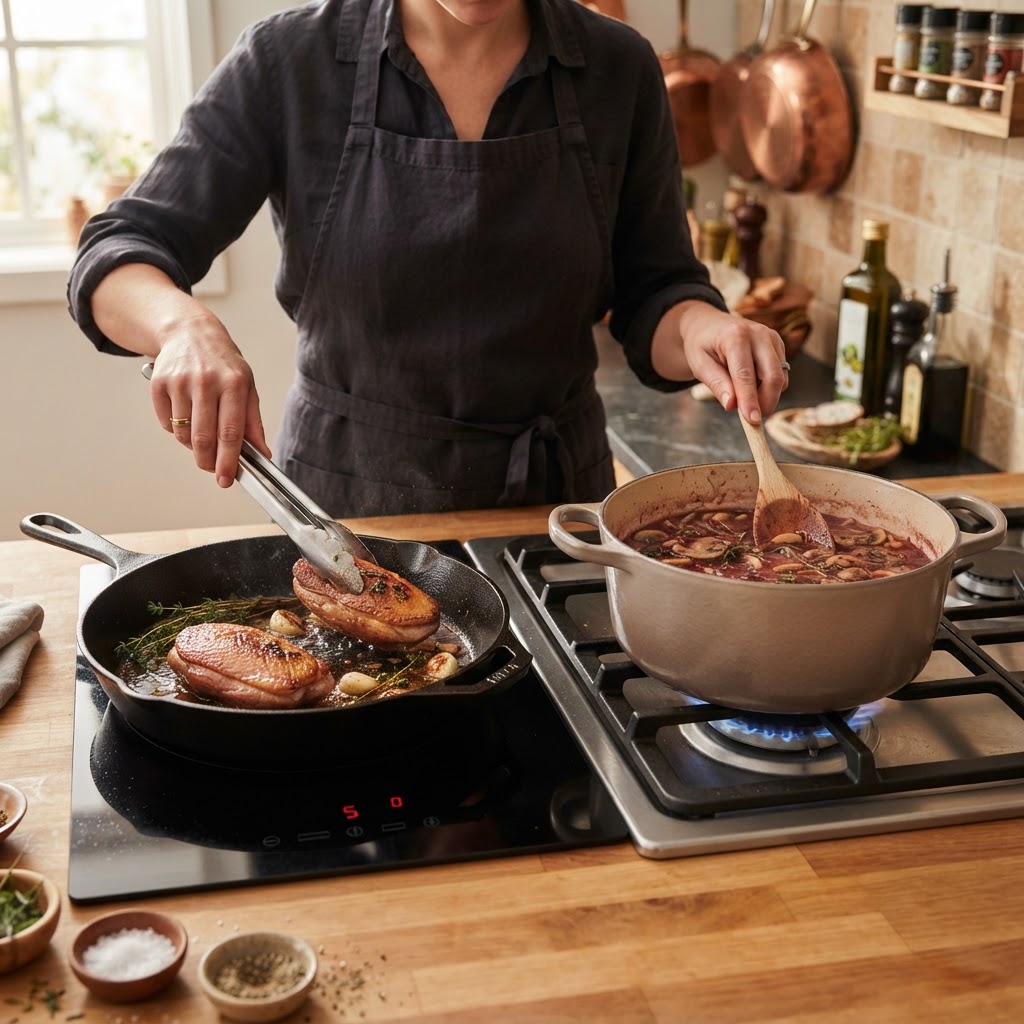
The Home Cook’s Guide to Induction and Gas: Mastering Heat Response and Control for Consistent Searing and Simmering
The journey of a home cook is often defined by the tools they choose to command, and perhaps no decision is as foundational or as debated as the choice between induction and gas. For years, the professional kitchen was the exclusive domain of roaring blue flames and heavy-duty gas ranges, creating an aura of culinary romanticism that suggested only fire could produce a true sear. Yet, as technology advances, the precision of electromagnetic induction has begun to challenge that long-standing hegemony, offering speed and control that can sometimes feel like sorcery. Understanding the nuances of these two power sources is not merely about gear acquisition; it is about learning how to manipulate energy to coax the best flavors from your ingredients. Whether you are chasing the perfect Maillard reaction on a ribeye or attempting a delicate, temperamental hollandaise, the source of your heat is the silent partner in every success and every mishap.
The transition from a standard electric coil or a temperamental gas burner to a high-performance system is often where the amateur truly begins to evolve into a confident home chef. You might find yourself frustrated by uneven hot spots or the sluggishness of a burner that refuses to dial down fast enough, leading to burnt garlic or broken sauces. This guide is designed to demystify the mechanics of heat transfer, providing you with the technical vocabulary and the sensory awareness needed to master your stove. We will explore the thermodynamics of induction, the kinetic dance of gas flame control, and the specific culinary applications where each truly shines. By the end of this guide, you will no longer blame the equipment for inconsistent results; instead, you will understand how to orchestrate your range to suit the specific needs of every recipe you tackle.
Ultimately, "Blame the Chef" is about taking full responsibility for the process, from the initial sizzle of a protein hitting the pan to the final, gentle simmer of a reduction. Consistent cooking is not an accident; it is the result of deliberate choices regarding surface area, pan material, and the precise application of BTUs. While the debate between gas and induction is often colored by personal preference, there is objective science behind how heat is delivered to your food. We invite you to look past the marketing and the nostalgia to embrace a more analytical approach to your kitchen. Let’s dive deep into the mechanics of heat, so you can stop guessing and start cooking with the authority of a professional.
The Physics of Heat: Induction vs. Gas
At its core, induction cooking is an exercise in electromagnetism, where a copper coil under the glass surface creates a magnetic field that induces an electric current directly into the base of your cookware. This means the pan itself becomes the heating element, resulting in an incredibly efficient transfer of energy that leaves the surrounding air cool and the stovetop surface significantly safer than traditional options. For the home cook, this manifests as near-instantaneous changes in temperature, allowing you to move from a rolling boil to a gentle simmer in a matter of seconds. It is a system built for speed, precision, and efficiency, effectively eliminating the lag time found in older cooking methods.
Gas cooking, by contrast, relies on the combustion of fuel to create a thermal plume that heats the cookware through convection and radiation. The flame provides a visual cue that allows the cook to estimate the heat intensity before the pan even makes contact. While gas lacks the sheer speed of induction, it offers a tangible connection to the fire, allowing for unique techniques like charring peppers directly over the flame or using a wok with a traditional rounded bottom. The primary challenge with gas is thermal lag, as the heat must travel through the air to the metal, and the stove’s response to a dial adjustment is not as immediate as an electromagnetic switch.
"The true mastery of a kitchen isn't found in the most expensive stove, but in the cook's ability to listen to the sounds of the pan and the smell of the ingredients, adjusting the heat source with intuition honed by practice."
Understanding BTU and Wattage
When evaluating your heat source, you are dealing with two different units of measurement: British Thermal Units (BTU) for gas and Watts (W) for induction. A standard home gas range usually offers burners between 5,000 and 15,000 BTUs; professional-grade ranges can exceed 20,000 BTUs. Induction, however, is measured by the power draw of its coils, typically ranging from 1,200 to 3,700 watts for a large "power boost" element. Knowing these numbers is vital for searing; you need high, consistent energy to prevent the pan temperature from dropping when a cold steak is introduced.
The Material Requirement
One major caveat with induction is the requirement for ferrous cookware. If a magnet does not stick to the bottom of your pan, it will not work on an induction cooktop. For the home cook, this means investing in high-quality cast iron, carbon steel, or induction-ready stainless steel. Gas is far more forgiving, accepting everything from thin aluminum pans to heavy copper pots, though copper often requires a heat diffuser on gas stoves to prevent scorched handles and uneven heating.
Achieving the Perfect Sear: Heat Management
The Maillard reaction—that complex chemical transformation between amino acids and reducing sugars that gives browned food its distinctive flavor—requires high, consistent heat. When searing a protein, the surface temperature of your pan needs to hover between 300°F and 400°F. If your heat source is too weak, the moisture released by the food will not evaporate quickly enough, effectively steaming the meat rather than searing it. This leads to grey, rubbery results that lack the depth of flavor a proper crust provides.
Whether you are using gas or induction, the technique remains the same: preheating is non-negotiable. A cold pan will almost always guarantee a lack of browning. On gas, you must ensure the flame is large enough to touch the base of the pan without licking up the sides, which can cause burning of the oils. On induction, you can often reach the necessary temperature much faster, but you must be careful not to overheat thin pans, which can warp under the intense, focused energy of the electromagnetic field.
Oil Smoke Points and Pan Velocity
To sear effectively, choose an oil with a high smoke point, such as avocado oil (520°F), grapeseed oil (420°F), or refined coconut oil. Avoid extra virgin olive oil for high-heat searing, as it will break down and impart a bitter, burnt taste. When searing, remember the rule of pan velocity: don’t crowd the pan. If you put too much cold food into the pan at once, the temperature will plummet, and your hard-earned sear will vanish.
Simmering and Reduction: The Art of Gentle Heat
When moving from searing to delicate tasks like reducing a sauce or cooking a custard, the challenge shifts from power to thermal stability. A simmer should be a slow, rhythmic movement—barely bubbling. If your burner cannot hold a low enough temperature, your sauce will break, or your dairy-based components will scramble. Gas stoves are often praised here because you can visually verify the size of the flame, ensuring it is just a tiny blue crown, though some gas burners can still be too aggressive even on their lowest setting.
Induction excels at the lower end of the spectrum because it can cycle on and off at very high frequencies, maintaining a precise temperature without the risk of a flame flickering out. Many modern induction units have a "melt" or "keep warm" setting that is perfect for delicate tasks like melting chocolate or keeping a delicate Beurre Blanc at the edge of separation. If you find your gas stove runs too hot on the lowest setting, invest in a flame tamer or a thick-gauge heat diffuser to dissipate the intensity.
Controlling the Reduction
To create a perfect glaze or reduction, you are looking to evaporate water while concentrating flavors. This requires a stable, steady heat. If you use too much heat, the sugars in the wine or stock will caramelize and eventually burn, creating an acrid taste. On induction, set your power level to a low setting—usually 2 or 3 out of 10—and allow the liquid to gently bubble away. On gas, you must monitor the flame height constantly, as air currents in the kitchen can cause the flame to fluctuate, changing the rate of evaporation.
"A great reduction is not a race; it is a slow transformation where flavors move from being disparate elements to a cohesive, intense velvet that coats the back of a spoon."
Troubleshooting a Broken Sauce
Even the best chefs occasionally face a broken sauce. If your emulsified butter sauce breaks, it is almost always due to heat. Immediately pull the pan off the burner. Whisk in a tablespoon of cold water or a single ice cube, and vigorously incorporate it to bring the emulsion back together. If you are using induction, the immediate loss of heat upon moving the pan makes this a much safer procedure than on a gas range, where the heat lingers in the cast-iron grates.
Mastering Heat Response: The Home Chef’s Secret Weapon
The ability to control the rate of heat change is perhaps the most defining skill of a professional. In a restaurant, the chef is constantly moving the pan on and off the flame. This is known as "flame management," and it is used to regulate the cooking process without having to turn the dial up or down constantly. On an induction range, you don't necessarily have to move the pan physically, but you must be adept at adjusting the electronic interface to get the same result.
Professional chefs often talk about "reading the pan." This means watching how the fat reacts to the heat—how it shimmers, how it bubbles, and how it changes viscosity. When you are sautéing aromatics like onions and garlic, you are looking for a translucent, golden quality. If the butter browns too quickly, you’ve lost the window for subtle sweetness. Learning to adjust your heat based on these visual queues, rather than waiting for a digital thermometer, will elevate your cooking immediately.
The Role of Pan Geometry
Your choice of pan is an extension of your heat source. A thin, cheap pan will respond to heat changes instantly, but it will also cool down instantly when you add ingredients. A heavy, thick-bottomed pan acts as a thermal battery, storing heat and releasing it slowly. For searing, you want the heavy battery. For stir-frying or tasks that require rapid cooling, you want a thinner, responsive pan.
Cast Iron:* Excellent heat retention, perfect for induction and gas.
Tri-ply Stainless Steel:* Great versatility and heat distribution, ideal for sauces.
Carbon Steel:* The professional’s choice for searing, lighter than cast iron but with similar performance.
Clad Copper:* The gold standard for heat control, though it requires specific maintenance.
Understanding the Thermal Lag of Different Ranges
One of the most significant frustrations for home cooks is the delay between a dial adjustment and the actual change in temperature. In a gas range, you are relying on the iron grates to hold heat. If you turn the burner down, those heavy grates remain hot, continuing to transfer heat to the pan for several minutes. This is why you should always have a cool-down burner—a second burner that is turned off—so you can quickly slide your pan over to stop the cooking process when necessary.
Induction virtually eliminates this lag. When you tap the button to reduce power, the energy field collapses, and the transfer of heat stops instantly. This is a game-changer for dishes like scrambled eggs, where the difference between creamy, soft curds and dry, rubbery ones is a matter of ten seconds. Understanding the "thermal inertia" of your specific stove will allow you to plan your cooking steps with more precision, ensuring you are never caught off guard by a pan that is too hot.
Practice Exercises for Heat Control
Advanced Techniques: Beyond the Basics
Once you are comfortable with the basics, you can begin exploring techniques that push the boundaries of your heat source. For gas users, this means utilizing the "sear-and-slide" technique, where you keep the pan in constant motion over the flame to ensure even distribution and prevent localized burning. For induction users, this means taking advantage of the power boost settings to perform high-heat stir-fries that would typically require an industrial-grade wok burner.
Another advanced technique is tempering. Whether you are working with chocolate or eggs, the ability to introduce heat in a controlled, tiered manner is essential. On gas, this is often done by using a "double boiler" setup to insulate the ingredients from the direct flame. On induction, you can achieve this by using the lowest possible power setting, which simulates the gentle, consistent heat of a bain-marie without the need for additional equipment.
"True consistency is the hallmark of a chef who understands the limitations and the strengths of their environment. Whether it's the roar of a gas flame or the silent hum of induction, the goal remains the same: the perfect expression of the ingredient."
Incorporating Professional Habits
Mise en place:* Have every ingredient chopped and measured before the flame is lit. With induction’s speed, there is no time to chop while the pan is heating.
Pan maintenance:* Keep your pans clean. Carbonized food on the bottom of a pan acts as an insulator, preventing efficient heat transfer regardless of the source.
Sensory awareness:* Listen to the sizzle. A high-pitched, fast sizzle indicates moisture loss and searing. A low, soft bubbling indicates braising or simmering. Your ears are as important as your eyes.
Final Thoughts
The debate between induction and gas is, in many ways, a false dichotomy. Both systems, when mastered, are capable of producing world-class cuisine. The "blame" we often cast upon our equipment is almost always a reflection of our own lack of understanding of its mechanics. Gas offers a tactile, visible connection to fire that satisfies our primal need to cook, while induction offers a modern, efficient precision that satisfies our need for control and repeatability. The home cook who learns to harness the heat of their specific range—understanding the lag of their gas grates or the intensity of their induction coils—is the one who finds true consistency in the kitchen.
As you move forward, focus not on the stove you wish you had, but on the stove you occupy. Experiment with different pan materials, pay attention to the sounds of your ingredients, and practice the art of thermal management in every dish you prepare. Remember that searing is about volume and temperature, while simmering is about patience and stability. By breaking down these complex physical processes into manageable techniques, you move from being a home cook who follows recipes to a chef who commands the kitchen.
Ultimately, cooking is a dialogue between you and your ingredients, mediated by the heat you choose to provide. Whether you are searing a thick ribeye or whisking a delicate lemon curd, the heat is the bridge between raw potential and finished masterpiece. Take your time, stay curious, and never be afraid to adjust your approach. When you finally stop blaming the chef—or the stove—and start embracing the science of the kitchen, you will find that consistency follows you in every meal you serve. Keep practicing, keep tasting, and above all, enjoy the process of turning energy into flavor. You have all the tools you need to succeed; now, it is simply a matter of applying the heat with intention.
As a final piece of advice for the home kitchen, maintain a logbook if you find yourself struggling with specific dishes. Write down the power settings you used, the type of pan, and the results you achieved. Over time, you will develop a "map" of your stove’s performance, a secret guide that turns every cooking session into an informed, successful endeavor. The mastery of heat is a lifelong pursuit, and there is no better time to refine your craft than tonight’s dinner. Happy cooking, and may your sears always be golden and your sauces always silky smooth.
The evolution of a home cook is a journey without a final destination, for there is always a new technique to master or a new variable to control. As you become more attuned to your stove, you will notice your reliance on timers and rigid instructions fading, replaced by a confidence that comes from genuine understanding. You are the architect of your kitchen’s environment; use your range with purpose, respect the physics of your cookware, and never underestimate the power of a perfectly controlled flame—or a perfectly modulated electromagnetic field. The difference between good and great cooking is often found in the subtle decisions made between the moment the stove is turned on and the moment the food is plated. By mastering your equipment, you secure your role as the true authority at the hearth.
Get the Next Recipe
Weekly recipes, techniques, and gear picks — straight to your inbox.
