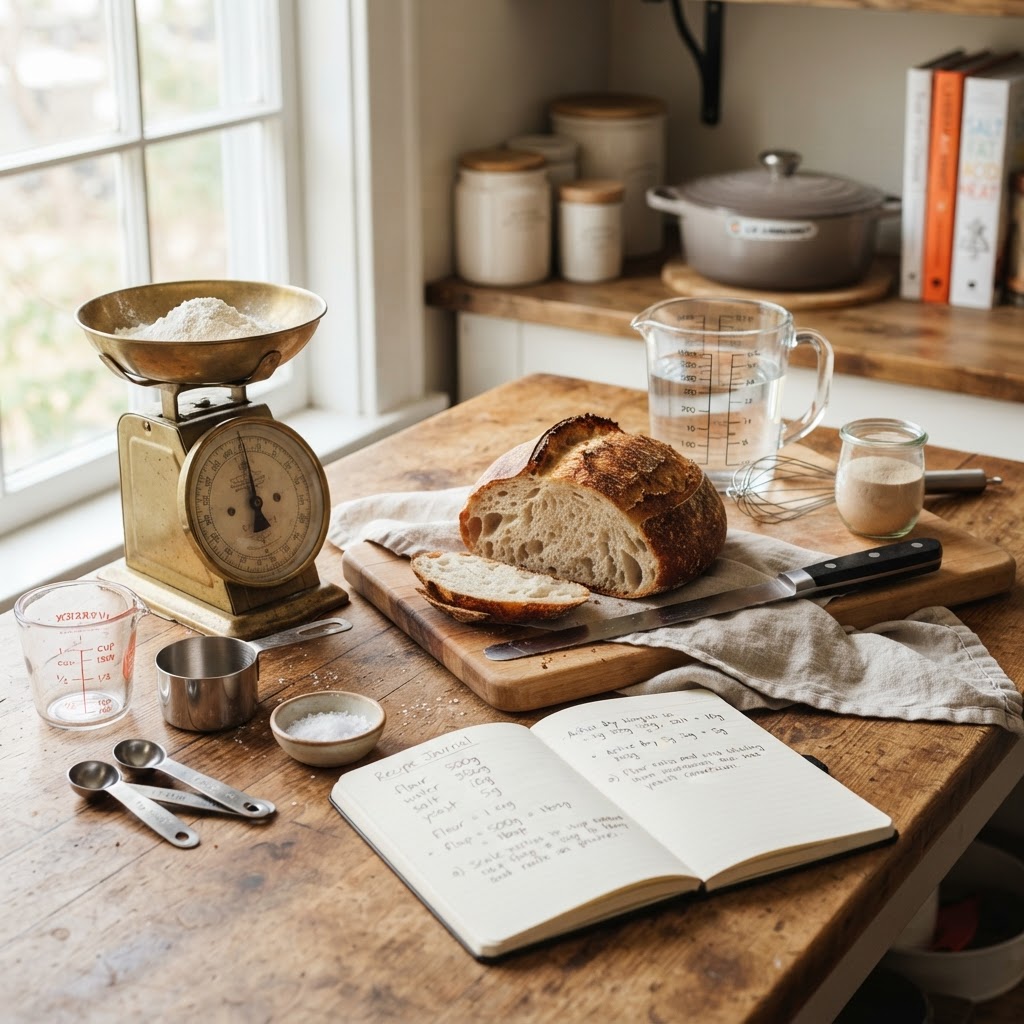
The Home Cook’s Guide to Kitchen Math: Mastering Conversions, Ratios, and Scaling for Consistent Results
Cooking is often romanticized as a purely intuitive art form, a dance of intuition and flavor that happens in the quiet hum of the kitchen. While that artistic flair is certainly part of the magic, the foundation of every truly great meal is built upon something much more concrete: math. Whether you are adjusting a recipe to feed a crowd of twenty or simply trying to figure out why your sourdough starter isn't bubbling with its usual vigor, understanding the underlying numbers is what separates a lucky guess from a repeatable success. At "Blame The Chef," we believe that once you master the logic behind the heat and the volume, you stop chasing recipes and start creating them.
The transition from a home cook to a culinary strategist begins the moment you stop relying on "a pinch" or "a splash" and start looking at the ratios that define the dish. Baking, in particular, is a science of precise chemistry where a minor miscalculation can lead to a collapsed soufflé or a leaden loaf of bread. By learning to convert measurements, scale ingredients, and balance your liquids against your fats, you reclaim control over your kitchen. This guide is designed to strip away the anxiety of high-stakes cooking and replace it with the cool, calculated confidence of a professional chef, ensuring your results are consistent, delicious, and entirely your own.
Precision is not about turning your kitchen into a sterile laboratory, but rather about respecting the variables you can control to compensate for the ones you cannot. Room temperature, humidity, the quality of your flour, and even the calibration of your oven can change the outcome of a dish, but if you have a baseline of mathematical competence, you can adjust on the fly. We are going to dive deep into the essential ratios, the logic behind conversion, and the professional techniques that make scaling a recipe for a dinner party feel like second nature. It is time to sharpen your pencils, grab your scale, and turn your kitchen into the most efficient, high-performance space in your home.
The Foundation of Precision: Why Weighing Matters
The most important tool in any kitchen is not a sharp knife or a heavy-duty mixer; it is a reliable digital kitchen scale. In the culinary world, volume is a deceptive metric. A cup of all-purpose flour, depending on how it is scooped or settled, can vary in weight by up to 20 percent. If you are baking a delicate sponge cake, that 20 percent difference is the difference between a light, airy crumb and a dense, chewy mistake. By shifting your mindset to weigh ingredients in grams, you eliminate the variance introduced by the density of the ingredient or the method of measurement.
When you weigh your ingredients, you enter the language of professional pastry chefs and bakers globally. This allows you to follow international recipes without having to grapple with the ambiguity of fluid ounces versus dry ounces or the differences between imperial and metric systems. Consistency is the primary goal of any cook, and consistency is impossible when your foundation is built on the loose interpretation of a "cup." A gram is a gram, regardless of who is measuring it, which makes your kitchen a place of absolute, verifiable reliability.
Understanding the Metric Transition
Transitioning to the metric system is the single greatest upgrade you can make to your culinary process. Most professional scales offer a toggle between ounces and grams; choosing grams is the superior path because the math is cleaner and more precise. For example, dividing a recipe that calls for 450 grams of flour is simple; dividing a recipe that calls for 3 ¾ cups is a logistical headache. By standardizing your measurements in grams, you make scaling up or down a matter of simple arithmetic rather than complex fractions that often lead to errors.
"The scale is the silent auditor of the kitchen; it reveals the truths that volume measurements try to hide, ensuring your craft is built on precision rather than guesswork."
Calibration and Maintenance
Your scale needs to be reliable, which means it requires a level surface and fresh batteries. Invest in a scale that has a "tare" function, which allows you to reset the display to zero after placing a bowl on the platform, enabling you to add ingredients sequentially without needing multiple containers. Regularly calibrate your scale using a known weight—many professional-grade models come with a calibration weight, but you can also use a sealed package of a known quantity to verify that your scale is reading accurately. A scale that is off by even a few grams can throw off a delicate emulsion or a fermentation-based dough.
The Architecture of Flavor: Essential Culinary Ratios
Every classic dish is built on a ratio that provides the blueprint for its texture and flavor profile. In the professional kitchen, we often think in ratios—parts of one ingredient relative to others—rather than specific weights, because ratios remain constant whether you are cooking for one or one hundred. A perfect vinaigrette, for instance, relies on a 3:1 ratio of oil to acid. If you keep this golden rule in your head, you never need to look up a recipe again; you simply scale the oil and acid to match the volume of greens you have on hand.
Understanding ratios gives you the freedom to improvise within a framework that is guaranteed to work. If you know the ratio for a standard custard (eggs, milk, sugar), you can easily manipulate it to create an ice cream base, a crème brûlée, or a pastry cream just by adjusting the concentration of your fats and proteins. This is the difference between a cook who follows a recipe and a chef who understands the underlying structure of food.
The Holy Trinity of Ratios
Vinaigrette:* 3 parts oil to 1 part acid.
Pâte à Choux:* 2 parts water/milk, 1 part butter, 1 part flour, 2 parts eggs.
Simple Syrup:* 1 part water to 1 part sugar (by weight).
Pasta Dough:* 100 grams of flour per 1 large egg (approx. 50g).
Adapting Ratios to Your Palate
While the 3:1 ratio for vinaigrette is the industry standard, culinary math allows for personal preference. If you enjoy a sharper dressing, you can shift the ratio to 2:1. The key is that once you understand the base ratio, you can move away from it intentionally, knowing exactly how the structural integrity of the sauce will change. When you deviate from a ratio, you are making a creative choice rather than a blind guess, and that is where your unique culinary voice begins to emerge.
Mastering Conversions and Scaling
Scaling a recipe for a dinner party is a task that intimidates many, but it is entirely a matter of calculating the "scaling factor." To scale any recipe, you must first determine how many servings or how much volume the original recipe yields, and then divide your target yield by the original yield. This result is your multiplier. If you are hosting a brunch for 12 people and your pancake recipe yields enough for 4, your multiplier is 3. Multiply every ingredient by 3, and you have exactly what you need.
The pitfall most home cooks fall into is scaling the spices and leavening agents linearly. While flour, milk, and sugar scale perfectly, items like salt, baking powder, and potent spices often have non-linear impacts. If you scale a recipe by a factor of four, you might find that using four times the amount of salt results in an overpowering dish. Always add spices, salt, and leavening agents incrementally, tasting as you go, to ensure that the proportions remain balanced in the final, larger volume.
Navigating the Math of Volume and Weight
When converting, you must be careful to keep your units consistent. Do not mix milliliters and fluid ounces within the same calculation. Convert everything to the smallest common denominator—usually milliliters for liquids and grams for solids—before applying your multiplier. If you are scaling a recipe that uses volume, convert the final result back to your preferred unit for easier measurement.
"A recipe is merely a suggestion when you understand the mechanics of the kitchen; by mastering the multiplier, you gain the freedom to cook for an audience of any size without the fear of inconsistency."
The "Rounding" Trap
When you scale a recipe, you will often end up with awkward numbers, such as 137.5 grams of butter. The urge to round up or down is strong, but in baking, especially in pastry, that extra 0.5 grams can be the tipping point. Learn to utilize the precision of your scale. If you are calculating a 1.5x multiplier, be meticulous with your fractions. Rounding is a luxury for the home cook, but precision is a necessity for the professional.
Temperature and Time: The Invisible Variables
Temperature is perhaps the most critical mathematical factor in cooking. It dictates everything from the speed of bacterial growth in a fermentation to the denaturation of proteins in a steak. Mastering the relationship between heat and time allows you to achieve consistent results, whether you are roasting a whole chicken or tempering chocolate. Understanding that proteins coagulate at specific temperatures—typically between 140°F and 165°F—means you can stop relying on "cook until brown" and start relying on the internal temperature of the food.
Timing is the other side of the coin. A recipe will tell you to roast for 45 minutes, but your oven is a unique beast. You must learn to calibrate your expectations against the physical reality of your equipment. An oven thermometer is an essential, inexpensive tool that tells you what the internal air temperature of your oven really is, which is often drastically different from what the dial on your oven claims.
The Science of Carry-Over Cooking
Carry-over cooking is the phenomenon where the residual heat in a protein continues to cook it after it has been removed from the heat source. For large cuts of meat, the internal temperature can rise by as much as 10 to 15 degrees after it is pulled from the oven. If you pull a roast out at exactly the target temperature, you will overcook it. By understanding the math of heat transfer, you can calculate the "pull temperature"—the point at which the residual heat will carry the meat to perfection.
Rare:* 120-125°F (pull at 115°F)
Medium-Rare:* 130-135°F (pull at 125°F)
Medium:* 140-145°F (pull at 135°F)
Well Done:* 160°F+
Heat Distribution and Surface Area
The surface-to-volume ratio of your food dictates how quickly it will cook. A thin chicken breast has a high surface area and will cook in minutes; a whole bird has a low surface area relative to its mass and will take over an hour. When you change the shape of your ingredients, you must adjust your heat application accordingly. Lower heat for longer times is essential for large, dense items to ensure the center reaches the target temperature before the exterior turns to carbon.
The Art of the Substitution: Mathematical Balance
Cooking substitutions often go wrong because cooks treat them as 1:1 replacements without considering the chemical properties of the ingredient being replaced. If you are substituting buttermilk for milk in a baking recipe, you are introducing acid into a mixture that relies on the alkalinity of baking soda for lift. You cannot simply swap the liquid; you must adjust the leavening agent to ensure the chemistry remains balanced. Understanding the "why" behind the ingredient allows you to substitute with confidence.
The same logic applies to fat content. If you are swapping butter for oil in a cookie recipe, you are changing the melting point and the aeration of the dough. Butter is roughly 80-82% fat and 18% water, while oil is 100% fat. This means a direct swap will result in a drier, tougher final product unless you account for that missing 18% water content by adjusting your other liquids.
Strategic Substitution Checklist
When to Avoid Substitution
Sometimes, the math simply doesn't work. In high-level pastry work, such as making macarons or tempered chocolate, ingredients serve such a specific structural purpose that replacing them is destined to fail. Learn to recognize when a recipe is "ratio-rigid" and when it is "ratio-flexible." Being able to discern between the two is a mark of a seasoned cook.
Managing the Kitchen Environment
Your kitchen is not a static environment; it is a living system impacted by external factors. Humidity is the hidden enemy of the pastry chef. In a humid climate, flour absorbs moisture from the air, meaning your dough will require less liquid to reach the same consistency. If you live in a high-altitude area, the air pressure is lower, which causes water to boil at a lower temperature and gases in leavened goods to expand more rapidly. These variables require mathematical adjustments to your recipes.
You can counter environmental factors by keeping a kitchen journal. Record the ambient temperature and humidity on days when your bread comes out perfectly, and compare those numbers to days when it doesn't. Over time, you will start to see patterns. Perhaps you need to reduce your liquid by 5% on rainy days, or decrease your baking powder by 10% when the kitchen is particularly warm. This is professional-level observation that moves your cooking from the realm of chance to the realm of mastery.
Adjusting for Altitude
At higher altitudes, you need to make specific adjustments:
Increase liquid:* Extra moisture is needed because the air is drier.
Decrease leavening:* Baking soda and powder work too fast; reduce them by 20-50%.
Increase oven temperature:* Slightly higher heat helps set the structure of the item before the gases expand too much.
The Role of Recording Data
Documentation is the missing link for most home cooks. Every professional kitchen keeps a production log. By taking a few seconds to write down the final weight of your dough, the internal temperature of your roast, and the exact timing of your bake, you create a database of what works in your specific kitchen with your specific equipment. This log becomes your most valuable reference material, allowing you to troubleshoot errors rather than just feeling frustrated by them.
Troubleshooting Through Calculation
When a dish goes wrong, your first instinct might be to "blame the chef," but the better approach is to "interrogate the process." If a sauce is broken, it is usually because the emulsification ratio was pushed past its limit. If a cake is dense, the math of the aeration (creaming butter and sugar) or the leavening was off. Troubleshooting is just another form of reverse engineering. By looking at the math, you can often identify the precise point where the process deviated.
Use your scale to weigh your "failures" if possible. If a cake didn't rise, was it really because of the baking powder, or did you accidentally use a gram less of an essential ingredient? Often, we find that our internal bias makes us think we added more of something than we actually did. The scale provides an objective reality that helps you fix the problem for the next attempt.
The Emulsion Audit
If your hollandaise or vinaigrette breaks, you have overloaded the continuous phase (the oil) before the dispersed phase (the water/egg) could stabilize it. You don't have to throw it away. Add a small amount of warm water or an extra egg yolk to a clean bowl, and slowly incorporate the broken sauce into this new base. You are essentially resetting the ratio, and it is a move that every professional chef relies on when things start to look a little separated.
"A mistake in the kitchen is merely data; if you can calculate where the ratio drifted, you can fix the imbalance and emerge as a more skilled cook than you were before."
Logical Recovery Strategies
Too salty:* Increase the bulk of the dish (adding more base ingredients) or introduce an acid (like lemon juice) to brighten the profile and mask the salt.
Too thin:* Instead of boiling it forever (which ruins flavor), use a slurry or a reduction of an acidic component to thicken it through chemistry rather than evaporation.
Too sweet:* Add a touch of salt or a bitter element, like cocoa or coffee, to balance the sugar profile mathematically.
Final Thoughts
Mastering kitchen math is not about removing the joy from cooking; it is about protecting it. When you feel confident in your ability to scale, convert, and adjust, you stop worrying about the potential for disaster and start focusing on the flavors and textures you want to achieve. Cooking becomes a conversation between your intuition and your intellect. The scale, the thermometer, and the ratio become your most trusted allies, allowing you to venture into new cuisines and complex recipes without the fear of failure.
Remember that every professional chef started exactly where you are now. They burned pans, they made broken sauces, and they struggled with inconsistent results. The difference is that they chose to dig into the "why" and the "how" of the process. They stopped being victims of their recipes and started being architects of their own meals. By adopting the methods outlined in this guide, you are already well on your way to that same level of expertise.
Take your time with these concepts. Start by weighing your ingredients for one week. Then, try scaling a recipe you know by heart. Finally, look at the ratios behind the food you love and see how you can tweak them to better suit your preferences. Your kitchen is your laboratory, and you are the head scientist. Keep practicing, keep calculating, and above all, keep enjoying the process of turning simple ingredients into something extraordinary. With the right math on your side, the results will not just be consistent—they will be spectacular.


Get the Next Recipe
Weekly recipes, techniques, and gear picks — straight to your inbox.
