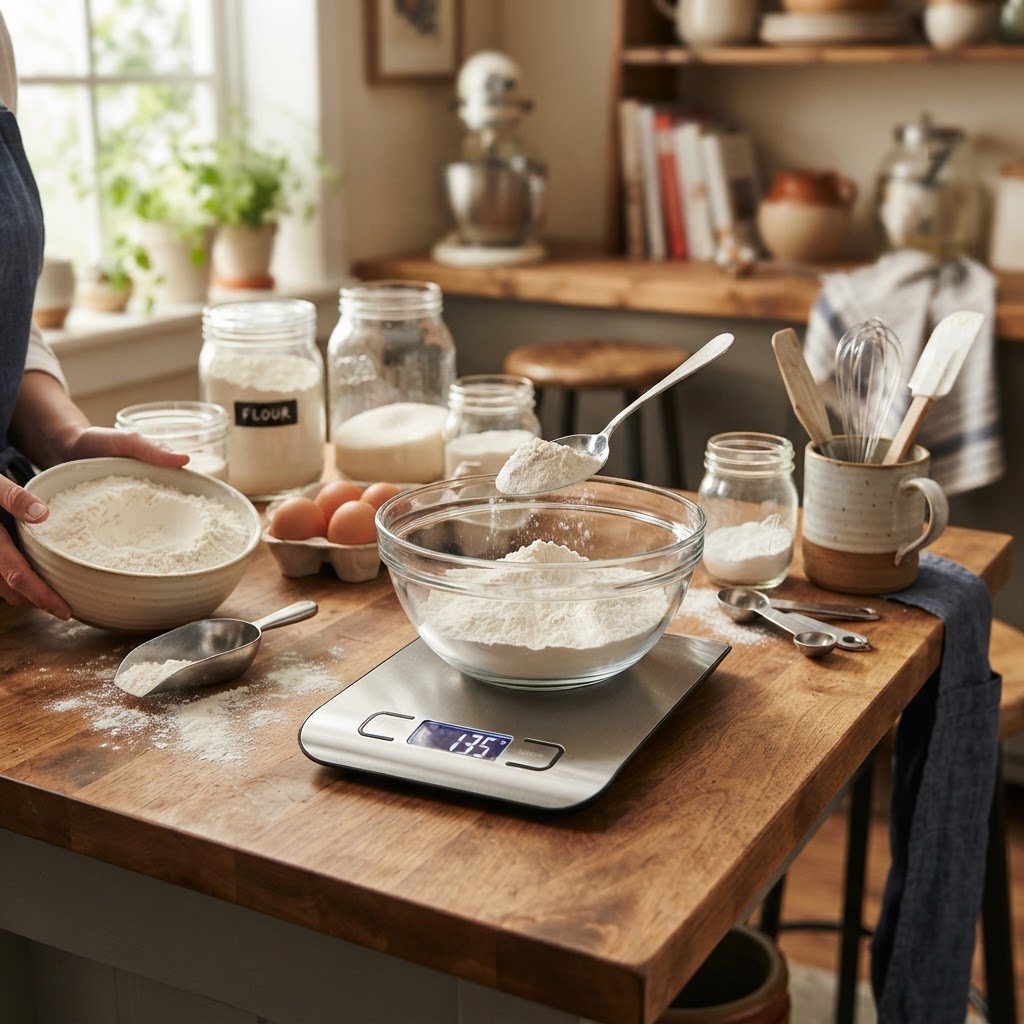
The Home Cook’s Guide to Kitchen Weights: Why Switching to a Digital Scale Will Revolutionize Your Cooking and Baking
If you have spent any time hovering over a mixing bowl with a set of plastic measuring cups, wondering if that heaping scoop of flour is "packed" enough or if your brown sugar is truly leveled, you have already experienced the primary frustration of the home cook. We are taught from a young age that recipes are lists of volumes: a cup of this, a tablespoon of that, and a pinch of something else. This method, while culturally embedded, is fundamentally flawed when it comes to the science of food preparation. When you rely on volume, you are essentially guessing, leaving the success of your meal up to the variable density of ingredients rather than the precision of chemistry.
Transitioning to a digital kitchen scale is not merely an upgrade in equipment; it is a fundamental shift in how you approach your craft. By measuring by mass rather than volume, you strip away the ambiguity that plagues so many kitchen disasters, from rock-hard scones to gummy risotto. When you weigh your ingredients in grams, you are speaking the universal language of the professional kitchen. Whether you are tempering chocolate, hydrating sourdough, or perfecting a delicate custard, the scale acts as the ultimate equalizer, ensuring that your results are replicable, professional, and consistently delicious.
At Blame The Chef, we believe that the kitchen should be a place of confidence, not guesswork. Many home cooks feel intimidated by the idea of using a scale, fearing it makes cooking feel too much like a laboratory experiment. In reality, it is the opposite: once you stop worrying about whether your measurements are "accurate enough," you are free to focus on the sensory aspects of cooking—the texture of the dough, the fragrance of the aromatics, and the browning of the butter. Let’s dive into why making this single change will be the most transformative decision you make in your culinary journey.
The Scientific Argument for Weighing Your Ingredients
The Inconsistency of Volumetric Measurement
The primary reason volume fails us is the sheer instability of our ingredients. Flour is the most egregious offender; a "cup" of all-purpose flour can weigh anywhere from 120 grams to 160 grams depending on how it was scooped, settled, or sifted. This variance of 40 grams can be the difference between a light, airy muffin and a dense, flavorless brick. When we measure by volume, we are essentially at the mercy of how much air we have trapped inside the measuring cup.
Precision as a Foundation for Creativity
Professional pastry chefs understand that baking is a science of ratios. The baker’s percentage—a system where all ingredients are calculated in relation to the weight of the flour—is impossible to execute with measuring cups. By using a scale, you can easily scale a recipe up or down without needing to perform complex fractions. If you want to make exactly 75% of a batch of brioche, a scale allows you to do the math and execute the recipe with zero room for error.
"The scale is the most humble tool in the kitchen, yet it holds the greatest power. It removes the guesswork that keeps home cooks from achieving the consistency of a restaurant-grade product."
The Psychology of Cooking with Confidence
When you use a scale, you stop checking the oven every five minutes to see if your cake is collapsing or your crust is too thick. You know, with absolute certainty, that your ratios are mathematically sound. This creates a mental buffer that allows you to focus on the nuances of heat management and timing. Once you remove the anxiety of measurement, the kitchen becomes a playground of creativity rather than a source of stress.
Choosing the Right Tool for the Job
What to Look for in a Digital Scale
When shopping for a digital kitchen scale, you do not need to spend hundreds of dollars on lab-grade equipment. Look for a scale that has a minimum capacity of at least 5 kilograms (11 pounds) to handle heavy mixing bowls. A tare function is non-negotiable; this allows you to reset the scale to zero after adding each ingredient, enabling you to weigh everything into the same bowl, which significantly cuts down on cleanup.
Precision and Increments
For general cooking and baking, a scale that measures in 1-gram increments is perfectly sufficient. However, if you are planning to get into advanced bread baking or molecular gastronomy, you might consider a micro-scale for measuring yeast, salt, or additives. These small scales measure in 0.1-gram increments, ensuring that your leavening agents—which are highly sensitive—are incorporated precisely to ensure a proper rise.
Placement and Maintenance
Always keep your scale on a level, hard surface. A wobbling scale will give you inconsistent readings, which defeats the purpose of the entire exercise. Keep it away from drafts, as even a slight breeze can affect the weight of lighter ingredients like powdered sugar or cocoa powder. Finally, keep your scale clean; residue from previous ingredients can cause sensor drift. A simple wipe-down with a damp cloth is usually all it takes to keep your most important tool in top shape.
Mastering the Ratio: Moving Beyond Recipes
Understanding Baker’s Percentages
In the world of professional baking, the flour is always 100%. Every other ingredient is a percentage of that weight. For example, a standard lean bread recipe might be:
Using this method, you can easily calculate exactly how much of each ingredient you need regardless of the size of the loaf you want to bake.
Ratios in Savory Cooking
While baking is strict, savory cooking benefits from the same mathematical approach. Take, for example, a vinaigrette. A classic ratio is three parts oil to one part acid. Using a scale, you can ensure your emulsification remains consistent. If you are making a larger batch for a dinner party, simply weighing out your mustard, vinegar, and oil ensures that the flavor profile remains perfectly balanced, preventing a dressing that is too acidic or too fatty.
The Role of Density in Emulsions
When making emulsions like mayonnaise or aioli, weight is critical. The ratio of oil to egg yolk determines the stability of the final product. By weighing your oil as you add it to the processor, you can maintain a steady stream at the exact rate needed for the fats to integrate properly. This level of control is simply impossible to maintain with a measuring spoon.
"A cook who masters the scale is no longer following a recipe; they are building a dish from the ground up, with the precision of an architect and the intuition of an artist."
The Impact on Baking Consistency
The Importance of Leavening
Baking soda and baking powder are incredibly potent. Using "half a teaspoon" is notoriously inaccurate because the shape of the spoon and the way the powder is leveled can result in an error of up to 20%. In high-heat baking, that extra bit of leavening can cause a cake to rise too quickly and then collapse, leading to a sunken center. A scale ensures that your leavening agents are precise, leading to a consistent, beautiful rise every time.
Sugar, Fat, and Texture
Sugar provides structure in cakes, while fat provides tenderness. If your sugar is off by a few grams, your cake might fail to set; if your butter is off, your shortbread will be greasy rather than crumbly. Measuring your fats by weight is particularly important, as butter can be dense or airy depending on the temperature. A scale takes the temperature-dependent density out of the equation, ensuring that your fat-to-flour ratio is always spot-on.
The Science of Hydration in Dough
In bread making, hydration is the single most important factor in the quality of the crumb. Hydration is simply the weight of water divided by the weight of flour. A 70% hydration dough (70g water for every 100g flour) will handle differently than a 60% hydration dough. By weighing your water and flour, you can document the exact hydration level of your favorite loaves, allowing you to tweak your results based on the humidity in your kitchen on any given day.
Integrating the Scale into Your Daily Routine
Step-by-Step Workflow
To get the most out of your scale, change your workflow to minimize mess and maximize efficiency:
Cleaning as You Go
One of the hidden benefits of using a scale is the reduction in dishwashing. Because you are adding ingredients directly into the bowl on the scale, you eliminate the need for those sets of plastic measuring cups that inevitably clutter the sink. You are left with just your bowl, your spoon, and your scale. It is a cleaner, more minimalist way to work that encourages you to cook more frequently.
Using the Scale for Portion Control
Beyond cooking, the digital scale is an incredible tool for portion control. Whether you are prepping meals for the week or trying to ensure that your cookies are all exactly the same size for even baking, the scale is your best friend. Even-sized cookies bake at the same rate, meaning you won't have a tray where half are burnt and half are raw. It’s the small details like these that elevate a home cook to a home chef.
Advanced Techniques and Professional Tips
Troubleshooting Common Culinary Issues
Have you ever made a sauce that was too thin, or a custard that wouldn't set? Often, the culprit isn't the technique—it's the ratio. If you find that your favorite recipe consistently fails, try weighing the ingredients you usually measure by volume. You will often find that you are using significantly more or less flour than the original author intended. Adjusting your weight ratios will almost always solve the issue instantly.
The Temperature Variable
While the scale measures mass, remember that mass is independent of temperature. However, the consistency of ingredients like butter or shortening can affect how they are incorporated. Always weigh your ingredients while they are at the correct temperature for the recipe. For example, if a recipe calls for 100g of room-temperature butter, weigh the butter first, then let it sit until it hits the correct temperature. This ensures your weight is accurate and your process is professional.
Documenting Your Success
The best part of using a scale is that you can finally keep a culinary log. If you make a batch of brownies that is particularly perfect, you can write down the exact weights you used. The next time you want to recreate that success, you don't have to guess—you have the formula. This is how recipes are developed in restaurants, and it is how you will build your personal library of "go-to" dishes.
"True kitchen mastery isn't found in a cookbook; it is found in the weights and measures that turn simple ingredients into a consistent, repeatable masterpiece."
Final Thoughts
The transition to a digital scale is the single most impactful change you can make to your cooking and baking repertoire. It moves you away from the chaotic guesswork of volumetric measurement and into the realm of precise, predictable, and high-quality results. While it might feel like an adjustment in the first week, you will quickly find that you can no longer imagine cooking without it. The scale provides the security that allows for true culinary experimentation; because you know your foundation is solid, you can afford to take risks with flavors, spices, and techniques.
We encourage you to embrace the scale not as a constraint, but as a tool for liberation. It frees you from the sink full of dirty measuring cups, it prevents the disappointment of a sunken cake or a tough loaf of bread, and it gives you the professional confidence to tackle any recipe you encounter. Start small—weigh your flour, your sugar, and your liquids for a few weeks—and notice the change in your output. You will be surprised at how much more consistent and professional your cooking becomes.
At the end of the day, cooking should be a source of joy. By removing the technical frustrations of measurement, you make room for more of that joy. You will find that you spend less time troubleshooting and more time enjoying the process of creating something nourishing for yourself and your loved ones. So, go ahead and pick up that digital scale. It might just be the most important ingredient in your kitchen. Happy cooking, and remember: if it turns out perfectly, take the credit, but if it doesn't, you can always blame the chef!
***
Why Flour Is the Biggest Offender
As mentioned earlier, flour is incredibly temperamental. If you simply dip a cup into a bag of flour, you are compressing the particles, often resulting in 150 grams or more of flour per "cup." However, if you spoon the flour into the cup and level it off, you might only get 120 grams. A 30-gram difference in a recipe calling for three cups of flour is nearly 100 grams of excess material. This is almost an entire cup of extra flour, which will inevitably dry out your baked goods, ruin the crumb, and create a dense, unpleasant texture.
The Magic of Tare
Never underestimate the power of the tare button. It is the secret weapon for anyone who dislikes doing dishes. By placing your mixing bowl on the scale and taring it before adding every single ingredient, you keep your workspace organized and your cleanup minimal. It also prevents the common issue of losing count when measuring out multiple cups of an ingredient. Instead of counting "one, two, three, four," you simply watch the numbers climb on the display.
The Future of Your Kitchen
As you continue to refine your skills, you may find yourself looking for more complex recipes that demand higher levels of precision. From sourdough starters that require specific hydration percentages to modernist cooking techniques like using hydrocolloids or stabilizers, your scale will grow with you. It is a gateway to a deeper understanding of food science, and once you start seeing your kitchen through the lens of ratios and weights, you will never look back at measuring cups the same way again.
A Note on Battery Life
One final, practical tip: most digital scales run on standard coin or AA batteries. Keep a spare set in your spice drawer or pantry. There is nothing more frustrating than being halfway through a recipe and having your scale die. Because your scale is such a central component of your kitchen workflow, ensuring it is always ready to go is just as important as keeping your knives sharp. Make this small habit part of your routine, and your kitchen will run like clockwork.
Cultivating Consistency
The ultimate goal of using a scale is not to become a machine, but to become a better, more reliable cook. When your base measurements are consistent, you can finally start to pay attention to the other variables—the heat of your oven, the quality of your ingredients, and the timing of your mixing. You’ll notice that your bread crusts get deeper and more caramelized, your cakes have a more uniform crumb, and your savory sauces have a more consistent viscosity.
The Joy of Sharing
When you know your recipes are built on a foundation of precision, you will feel much more confident sharing your food with others. There is a specific kind of pride that comes from serving a dish that you know is exactly right, not just "good enough." Your friends and family will notice the difference, and you will have the confidence to share your recipes with them, knowing that if they follow the weights, they will achieve the exact same results.
Moving Forward
Now that you have the knowledge and the "why," it is time to put it into practice. Clear off a space on your counter, set up your digital scale, and get ready to elevate your cooking. Whether you are a weekend baker or someone who cooks dinner every night, the digital scale is your ticket to a more professional, enjoyable, and successful kitchen experience. Welcome to the world of precision cooking—you are going to love it here.
Final Thoughts on Measurements
It is important to remember that while the scale is the gold standard, it is still a tool. Do not become so obsessed with the numbers that you ignore your instincts. If a dough feels too dry, add a tiny bit more water, even if it deviates from the "perfect" ratio. Cooking is, and always will be, a balance between science and sensory experience. The scale provides the baseline, but you provide the soul. Use the scale to take the guesswork out, and then use your hands and your senses to bring the dish to life.
Finalizing Your Setup
If you are just starting out, buy a reliable, mid-range scale. You don't need fancy features like Bluetooth connectivity or app integration. You need a clear, readable display, a responsive tare button, and a durable surface. Once you have that, you are ready to tackle anything. The recipes you've been afraid to try? They are now within reach. The cakes you’ve been struggling to master? They are about to become your signature dishes.
The Path Ahead
Thank you for joining us here at Blame The Chef. We hope this guide has inspired you to make the switch to a digital scale. It is a small investment of time and money, but the dividends it pays in the quality of your food and the reduction of your kitchen stress are immeasurable. Keep cooking, keep testing, and most importantly, keep enjoying the process. We can’t wait to see what you create next, and we know that with a scale by your side, your results will be nothing short of spectacular.
A Closing Reminder
Always remember that baking and cooking are journeys. There is no such thing as a perfect cook, only one who is constantly learning. Using a scale is just one way to shorten the learning curve and get to the "delicious" part faster. Every time you weigh your ingredients, you are investing in your own skill set, and that is a beautiful thing. If you ever find yourself getting frustrated, just remember: it’s just food. Take a breath, trust your scale, and try again. That’s the beauty of the kitchen—there is always another meal to prepare, another batch to bake, and another chance to get it right. Happy cooking!

Get the Next Recipe
Weekly recipes, techniques, and gear picks — straight to your inbox.
