The Home Cook’s Guide to Salt: Understanding Grain Sizes, Timing, and How to Season for Perfect Flavor
If you have ever stood in a professional kitchen, you likely noticed that the air feels heavy with the scent of searing protein and the frantic energy of service. Yet, behind all the high-end equipment and the shouting of tickets, there is one constant that dictates the outcome of every dish: salt. It is the invisible architect of flavor, the difference between a meal that feels vibrant and alive and one that falls flat on the palate. Many home cooks view salt as a mere necessity, something to be shaken out of a cardboard cylinder without much thought, but in the world of "Blame The Chef," we view it as a primary ingredient. Mastering the art of seasoning is the single most effective way to elevate your home cooking from edible to extraordinary.
The science behind salt is far more nuanced than simply making things taste salty. When used correctly, salt acts as a chemical catalyst that suppresses bitterness and enhances the perception of sweetness and umami in the foods you prepare. It draws moisture out of proteins, creates a protective crust during the sear, and softens the cell walls of vegetables to allow for faster cooking and better texture. If you have been struggling to replicate the complex, deeply satisfying flavors found in your favorite restaurants, the culprit is almost certainly your relationship with the salt cellar. It is time to stop looking at salt as an afterthought and start treating it as the foundational element of your culinary identity.
Throughout this guide, we are going to peel back the layers of the humble sodium chloride crystal to reveal how it behaves in different environments. We will explore the vast world of grain sizes, discuss the critical importance of timing, and look at how to build layers of flavor through proper seasoning techniques. You will learn why your pasta water should taste like the ocean, why dry-brining your steak can change your life, and why professional kitchens exclusively use specific types of salt for specific tasks. By the time you finish this post, you will possess the confidence to season with intention, turning every meal into a testament to your developing skills.
The Chemistry of Crystal Sizes
When you walk down the spice aisle, the sheer variety of salt can be overwhelming. From coarse, flaky crystals to fine, powdery dust, each grain size serves a distinct purpose in the kitchen. Understanding how these crystals dissolve and how they adhere to food is the first step toward mastering seasoning. Fine salt dissolves almost instantly, which makes it perfect for quick tasks like seasoning a vinaigrette or finishing a soup. However, using fine salt for dry-brining a thick cut of meat can be a mistake, as it tends to penetrate the surface too rapidly, potentially over-salting the outer layer while leaving the interior bland.
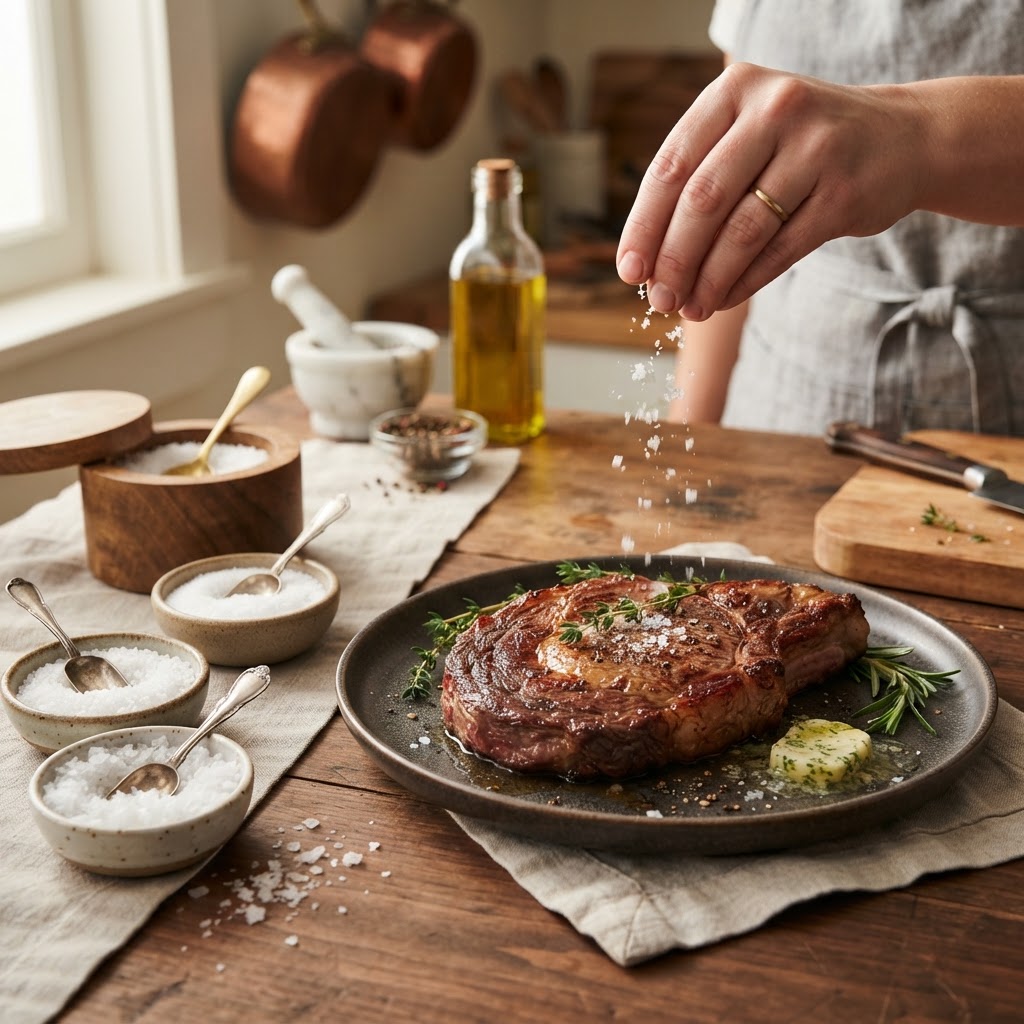
Coarse salts, such as kosher salt or sea salt, provide a tactile advantage for the home cook. Because the grains are larger, you can pick them up with your fingers, giving you a better sense of how much you are actually applying. This is why chefs prefer kosher salt; it allows for tactile control, ensuring that your seasoning is even and deliberate. When you use a measuring spoon, you lose this sensory feedback, often leading to uneven application that can result in pockets of intense saltiness or bland spots. If you learn to season by hand, you will eventually find that your internal intuition regarding flavor balance becomes incredibly accurate.
Why Surface Area Matters
The rate at which salt dissolves is directly tied to its surface area. A fine table salt has a much higher surface-area-to-volume ratio than a large, flaky Maldon salt. When you are seasoning a sauté pan, the goal is often an even distribution of flavor. If you use a very fine salt, you might find it difficult to see where it has landed. Conversely, larger grains sit on the surface longer, allowing you to gauge your progress visually. This is particularly important when working with searing heat, where you want a reliable layer of salt to interact with the natural juices of the meat to create that sought-after Maillard reaction.
"The difference between a home cook and a chef is often found in the way they handle the salt cellar. One tosses it in with abandon, while the other applies it with the surgical precision of a master artist."
Timing: The Art of Brining and Seasoning
The timing of your seasoning is just as critical as the amount. There is a common misconception that salt "sucks the juices" out of meat if applied too early. While it is true that salt draws moisture to the surface via osmosis, if you give it enough time, that liquid will be reabsorbed into the meat along with the dissolved salt. This process, known as dry-brining, is a technique that transforms the structure of proteins. By salting a steak at least forty-five minutes before cooking—or ideally, twenty-four hours in advance—you allow the salt to permeate deep into the muscle fibers, resulting in a more flavorful and tender bite.
When you fail to salt early, the salt stays on the surface, creating a jarring contrast between a salty crust and an under-seasoned center. In the professional kitchen, we emphasize the "seasoning window." For small items like fish fillets or thin chicken breasts, twenty to thirty minutes of resting with salt is sufficient. For larger roasts, such as a prime rib or a whole bird, overnight brining is the gold standard. This doesn't just improve flavor; it also ensures that the protein retains moisture during the high heat of the oven, resulting in a succulent texture that would be otherwise impossible to achieve.
Understanding Osmosis in the Kitchen
To understand why this works, think of the protein as a series of channels. When you apply salt to the exterior, the high concentration of sodium draws water out from the cells, creating a brine on the surface. If you cook the meat immediately, you lose that moisture. If you wait, the brine becomes highly concentrated and, through the process of diffusion, is pulled back into the meat. This not only seasons the interior but also modifies the protein structure so it can hold onto more liquid while it cooks. It is the single most impactful culinary hack for anyone hoping to improve their roast chicken, pork chops, or thick-cut steaks.
The Hierarchy of Salts: From Kosher to Finishing
Not all salt is created equal, and in the world of professional cooking, we categorize them based on their application. Kosher salt is the workhorse. It is additive-free, has a clean flavor, and its structure makes it ideal for everything from seasoning pasta water to curing gravies. Table salt, with its added iodine and anti-caking agents, often leaves a metallic aftertaste and is generally avoided in the "Blame The Chef" kitchen. If you find yourself reaching for the blue cardboard container, do yourself a favor and swap it for a box of coarse kosher salt. The difference in clarity of flavor will be immediately apparent to your palate.
Then there is finishing salt, a category unto itself. These are expensive, delicate, and intended for use only once a plate has been composed. Think of flaky sea salt, black lava salt, or smoked Maldon. You would never use these to season a stock or a braising liquid, as the delicate structure and subtle mineral notes would be lost in the boil. Instead, use them to provide a crunch and a concentrated burst of flavor right at the end of the plating process. This adds a level of sophistication that tells your guests you understand the importance of texture and finish.
Comparing Common Salt Varieties
Kosher Salt:* The chef's standard. Flaky, easy to grab, and dissolves evenly.
Sea Salt:* Often harvested from evaporation ponds. Can vary in mineral content and moisture.
Table Salt:* Fine, dense, and iodized. Avoid in professional-level cooking.
Finishing Salt:* Flaky and delicate. Used exclusively for texture and final seasoning hits.
"A dish is never truly finished until the final sprinkle of finishing salt has been applied. It is the final punctuation mark in the sentence of your meal."
Seasoning Vegetables and Legumes
Vegetables often suffer from under-seasoning because home cooks treat them as side dishes rather than the stars of the show. When cooking vegetables, salt does more than provide flavor; it alters the texture of the plant cells. If you add salt to your blanching water, you are not just seasoning the vegetable; you are keeping the color vibrant and ensuring the flavor is locked in. For sautéed greens, a pinch of salt at the very beginning of the process helps release water and soften the leaves, whereas for roasted root vegetables, a heavy hand of kosher salt applied before they hit the heat helps draw out natural sugars.
Legumes like lentils and chickpeas are particularly thirsty for salt. There is an old culinary myth that adding salt to beans while they cook will make them tough, but modern food science has debunked this completely. In fact, salting your cooking liquid for legumes ensures that the salt penetrates the skins, leading to a much creamier texture and a richer flavor profile. If you have been adding salt only at the end of a pot of beans, you have been missing out on the opportunity to build flavor from the core of the ingredient.
The Blanching Strategy
When blanching hardy vegetables like asparagus, green beans, or broccoli, your water should be as salty as a well-seasoned soup. This allows the vegetable to absorb a sufficient amount of sodium, which enhances its natural sweetness. After you pull them from the boiling water and shock them in an ice bath, they should taste perfectly seasoned on their own. This is the difference between a side dish that guests ignore and one that they finish completely. Always taste your cooking water; if it doesn't taste like the sea, it isn't ready for your vegetables.
The Secret to Perfect Pasta Water
We have all heard the advice that pasta water should taste like the ocean, but what does that actually mean? It means your water should be heavily seasoned, roughly 1 to 2 tablespoons of kosher salt for every 4 quarts of water. Since pasta is essentially a blank canvas of starch, the only opportunity you have to season it from the inside out is during this initial boil. If you don't salt the water properly, no amount of expensive finishing sauce or high-quality parmesan will make the pasta taste delicious. You are effectively trying to mask a bland ingredient rather than building a flavor foundation.
This salt doesn't just season the pasta; it also changes the way the starch behaves. Proper salinity helps keep the noodles from becoming gummy and ensures that the surface of the pasta is slightly tacky, which helps your sauce cling to it. When you are making a delicate pasta like cacio e pepe, the seasoning of the water is the most important step in the entire recipe. Without that initial salt, the dish will taste like hot water and cheese. With it, the salt integrates into the noodles, creating a cohesive, delicious experience that feels professional.
The Pasta Water Rule
Balancing Flavor: Salt as a Counterpoint
Seasoning is not just about the salt itself; it is about how the salt interacts with other elements like acidity, heat, and sweetness. If you have a dish that tastes "heavy" or "dull," you might think it needs more salt. However, it often needs a squeeze of lemon or a splash of vinegar. Salt acts as a magnifier; if you add salt to a dish that is already unbalanced, you will just highlight the flaws. Instead, use salt in tandem with acidity to brighten the profile. A pinch of salt combined with a squeeze of citrus can make a bland fish dish pop with vibrancy.
Furthermore, salt can be used to balance sweetness. Have you ever noticed that salted caramel tastes better than plain caramel? That is because the salt cuts through the cloying sweetness of the sugar, allowing the complex notes of the butter and cream to shine through. This principle applies to everything from fruit salads to chocolate desserts. A tiny pinch of flaky sea salt on a chocolate brownie isn't an affectation; it is a structural necessity that makes the chocolate taste more like itself. When you learn to use salt as a bridge between other flavors, you start to cook with the intuition of a seasoned chef.
The Flavor Balancing Matrix
Salt + Acid:* Increases brightness and vibrancy (e.g., a squeeze of lime on salted tacos).
Salt + Sugar:* Deepens complexity and prevents cloying notes (e.g., salted caramel, fruit tarts).
Salt + Heat:* Can accentuate spice, so adjust accordingly.
Salt + Fat:* The backbone of all savory cooking. Use liberally on fatty cuts of meat to cut the richness.
"Salt is the bridge between flavors. It pulls the disparate elements of your dish together, creating a unified masterpiece that is greater than the sum of its parts."
Final Thoughts
Mastering salt is a lifelong journey, one that starts in your kitchen and evolves every single time you cook. You will make mistakes—you will over-salt a soup, under-season a steak, and perhaps forget the salt in the pasta water entirely. That is perfectly normal. The key is to start tasting your food at every stage of the cooking process. Before you plate a dish, taste it. Is it flat? Add a pinch. Does it need a brightness to cut through the fat? Add an acid. Is the texture right, but the flavor somehow missing? Look at your salt.
By moving away from automated seasoning and embracing the tactile, sensory nature of the salt cellar, you are taking the first step toward true culinary mastery. Remember that salt is an ingredient, not just a preservative or a condiment. It requires respect, timing, and a bit of bravery to use correctly. Keep your kosher salt nearby, trust your palate, and never be afraid to taste. When you learn to "Blame The Chef" for the lack of seasoning, you are admitting that the power to create perfection is entirely in your own hands. Go forth, season with intent, and watch how your home cooking changes forever.
To summarize the pillars of great seasoning: start with the right grain size, brine your proteins in advance, ensure your cooking water is aggressive, and always use salt to balance the acidity and richness of your fats. Whether you are searing a ribeye, boiling a pot of pasta, or finishing a delicate vegetable dish, remember that you are the master of your own flavor destiny. Use these techniques as your baseline, then experiment, adjust, and refine until you find the perfect balance that suits your personal palate. Your kitchen is your laboratory, and salt is your most powerful tool. Happy cooking.
Building upon these foundational principles, it is important to remember that the environment in which you cook also plays a role in how you should use salt. High-altitude cooking, for instance, often requires slightly different seasoning because of the way water boils and evaporates. Similarly, when working with cast iron, you want to be mindful of how salt reacts with the seasoning of your pan. While salt itself won't ruin a well-seasoned skillet if removed promptly, it is always best practice to focus on seasoning your protein on a board before it hits the heat, rather than throwing handfuls of salt directly into a scorching hot pan where it might burn and become acrid.
Consistency is another hallmark of the professional kitchen. If you find a brand of kosher salt that you like, stick with it. Because different brands have different crystal densities, swapping between them can throw off your measurements if you are relying on volume. By keeping a single type of kosher salt on your prep station, you will gradually develop a subconscious "muscle memory" for how much salt you are adding with every pinch. This is exactly how the line cooks you admire in high-end restaurants achieve such consistent results night after night; they aren't guessing, they are relying on thousands of repetitions of the same gesture.
Finally, do not underestimate the power of the communal salt cellar. Keeping a small, open container of salt near your workspace is a visual reminder to season throughout the process. When you keep your salt tucked away in a cupboard, you are much less likely to use it effectively. Put it on the counter, keep it within arm’s reach, and make it as essential to your mise en place as your chef’s knife. Once you have integrated these habits, you will find that you no longer need to look at recipes for seasoning amounts. You will simply know when a dish has reached its potential, a moment of satisfaction that is truly the reward of the home cook. Keep seasoning, keep learning, and keep blaming the chef—because the chef is you.

Get the Next Recipe
Weekly recipes, techniques, and gear picks — straight to your inbox.
