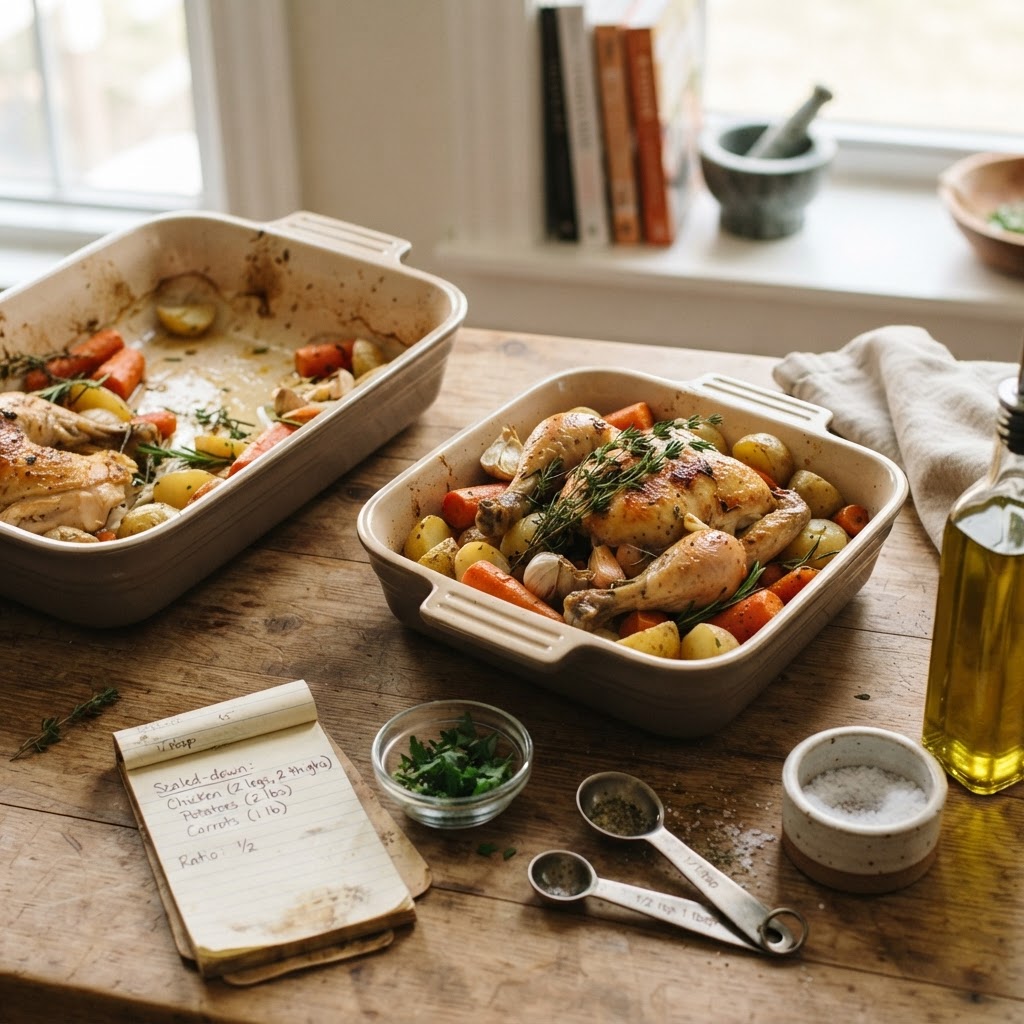
The Home Cook’s Guide to Scaling Recipes: How to Adjust Measurements Without Losing Flavor
There is nothing quite as humbling in the kitchen as the moment you realize you have invited twelve people for dinner, only to find that your favorite recipe serves exactly four. You stand in the center of your kitchen, holding a measuring cup, wondering if simply multiplying every ingredient by three will yield the same soulful result you achieved the first time. The transition from home cook to confident kitchen strategist begins the moment you stop treating recipes as gospel and start viewing them as blueprints. Mastering the art of scaling is not just about basic arithmetic; it is about understanding the symbiotic relationship between ingredients and heat. When you scale a recipe, you aren't just changing the quantity of food; you are altering the dynamics of moisture loss, surface area, and chemical leavening.
Many amateur cooks believe that doubling a recipe is a linear endeavor, but any professional chef will tell you that the kitchen is a place of variables, not fixed constants. If you double the flour, you must double the fat, but if you double the spices, you might find yourself with a dish that is aggressive rather than balanced. Seasonings, aromatics, and liquids often behave non-linearly, meaning that a simple multiplication can lead to disastrous flavor profiles. Understanding these subtle shifts is what separates a meal that is edible from a meal that is truly memorable. We are here to demystify the process so you can host with ease and cook with total precision.
In this guide, we will break down the essential techniques required to scale your favorite dishes up or down without losing that signature flavor that makes your cooking special. We will discuss the importance of ratios, the dangers of leavening agents, and the science behind how heat circulates through larger or smaller vessels. By the end of this post, you will no longer fear the daunting task of catering to a crowd, nor will you be intimidated by the prospect of halving a complex recipe for a quiet dinner for two. Get your notebooks ready, because we are going deep into the mechanics of the culinary craft.
The Foundation of Scaling: Ratios Over Recipes
The most vital tool in a home cook’s arsenal is not a fancy high-end mixer or a copper-bottomed pan; it is the humble concept of ratios. When you move away from specific measurements and start thinking in terms of percentages, you gain the freedom to create in any quantity. For instance, the Golden Ratio for a Vinaigrette—three parts fat to one part acid—holds true whether you are making a small jar for a week of salads or a gallon container for a wedding banquet. Understanding these underlying proportions ensures that the soul of the dish remains intact regardless of the volume.
When scaling, your first step should always be to convert your recipe into a ratio-based format. If a recipe calls for two cups of flour and one cup of water, recognize that as a 2:1 ratio. This allows you to scale up or down while maintaining the structural integrity of the final product. Keep a logbook in your kitchen where you note these ratios for your "go-to" recipes. This practice transforms you from someone who follows instructions into someone who understands the architecture of flavor.
Why Measurements Can Be Deceptive
Volume measurements can be notoriously inaccurate, especially with dry ingredients. One person’s "cup of flour" is another person’s "packed cup," which can result in a significant difference in the hydration levels of a dough. To avoid this, always aim to use a digital kitchen scale whenever possible. Scaling by weight (grams or ounces) is infinitely more precise than scaling by volume (cups or tablespoons). When you increase a recipe by a factor of four, even a tiny error in volume measurement is amplified, potentially ruining the texture of your final dish.
"Cooking is at once child's play and adult joy. And cooking done with care is an act of love." — Craig Claiborne
The Physics of Pan Size and Heat Distribution
One of the biggest pitfalls when scaling a recipe is assuming that you can use the same cooking vessel for a larger or smaller quantity. If you triple a lasagna recipe, putting it into a deeper pan instead of a wider one will drastically change the thermal conductivity and the time required for the heat to penetrate the center. Smaller batches lose moisture more quickly, while larger batches require more time for the heat to reach the core, often leaving the edges overcooked or burnt by the time the center is finished.
When you scale up, you need to consider the surface-to-volume ratio. If you are sautéing vegetables, overcrowding the pan will cause the produce to steam rather than sear, ruining the Maillard reaction you worked so hard to achieve. Instead of cramming everything into one pot, it is often better to use two pans or cook in batches. The goal is to maintain the intensity of the heat, which ensures that your flavors remain bright, caramelized, and properly textured.
Adjusting for Cooking Time
As a general rule, large-batch cooking requires a slight reduction in temperature and an increase in total time to ensure even cooking. Conversely, smaller batches might require a higher heat for a shorter duration to prevent them from drying out. If you are roasting a large bird or a significant roast, always use a digital probe thermometer. Relying on time-based instructions when you have significantly scaled a recipe is the fastest way to invite disaster. Your thermometer is the only truth-teller in the kitchen when dimensions change.
Scaling Spices, Herbs, and Aromatics
This is where many home cooks experience their most significant failures. It is a common misconception that if you double the recipe, you double the spices. This is rarely the case, particularly with potent aromatics like cayenne pepper, cloves, nutmeg, or garlic. These ingredients can quickly become overwhelming, turning a well-balanced dish into an acrid or overly pungent experience. When scaling up, a safe rule of thumb is to start with 1.5 times the amount of spices and then taste as you go.
For fresh herbs, the rules are slightly different. Because they provide brightness and texture as well as flavor, you can often scale them linearly, but consider the type of herb. Hardy herbs like rosemary and thyme hold up well during long cooking processes, while delicate herbs like basil, parsley, and cilantro should always be added at the final stage. Even when making a larger batch, the amount of fresh, delicate herbs added at the end should remain balanced to the volume of the plate, not necessarily the volume of the pot.
The Art of the 'Season-as-You-Go' Method
When you are scaling, the only way to ensure success is to taste the dish at multiple stages of the cooking process. As you increase the volume, the concentration of salt is particularly tricky. Salt behaves differently in larger volumes of water or sauce. Always salt in small, incremental steps. You can always add more salt, but once it is in the pot, you cannot take it out. If you accidentally over-salt, a splash of acid (like vinegar or lemon juice) or a touch of sweetness can sometimes help balance it, but it is much easier to just start with a conservative hand.
The Leavening Dilemma in Baking
Baking is chemistry, and chemistry does not always scale linearly. When you double a cake recipe, you are effectively increasing the volume, which means the structural support of the crumb needs to be managed carefully. Baking powder and baking soda are the most common culprits for baking disasters. If you simply double the leavening agents in a large-scale recipe, you risk the cake rising too fast and then collapsing under its own weight because the structure hasn't had enough time to set.
When scaling up a recipe that requires leavening, try reducing the baking powder or soda by about 10-15% after the initial doubling. This provides a more stable rise that can handle the increased volume. Additionally, ensure that your oven is properly calibrated. A larger cake or multiple trays in the oven at once will absorb more heat, which might require you to lower the temperature by 25 degrees Fahrenheit and bake for a longer period. This gentle, slower heat penetration is the secret to a perfectly uniform crumb in larger bakes.
"The discovery of a new dish does more for the happiness of the human race than the discovery of a star." — Jean Anthelme Brillat-Savarin
Managing Liquids and Reductions
Liquids are the soul of a dish, but they are also the most deceptive elements when scaling. If you double a stew, you might assume you need twice the amount of broth or wine, but remember that evaporation rates remain relatively constant based on the surface area of your pot. If you use a pot with a larger surface area, you will lose more liquid to evaporation than in a narrow, tall pot. This means that if you simply double the liquid, you might end up with a watery, diluted flavor profile.
To maintain the richness of your base, keep your liquid measurements conservative. It is much easier to add a cup of stock to a sauce that has become too thick than it is to boil down a sauce that has become too thin. If you are making a sauce, aim for your desired flavor intensity first, then adjust the viscosity. This approach allows you to control the emulsification and texture of the final sauce without sacrificing the depth of flavor you worked hard to build.
Tips for Successful Liquid Scaling
* Start with 75% of the liquid called for in the original recipe.
* Check the consistency halfway through the cooking time.
* If the sauce is too thin, create a slurry or let it reduce further.
* Use high-quality stock to ensure the flavor base remains robust, even when diluted.
Storage and Safety When Cooking in Bulk
Cooking for a crowd involves more than just taste; it involves food safety. When you increase the volume of food, you also increase the time it takes for that food to cool down. If you make a massive pot of chili, you cannot simply put the entire pot in the refrigerator. The center will stay in the "danger zone" (between 40 and 140 degrees Fahrenheit) for far too long, inviting bacterial growth. Instead, transfer your large batches into smaller, shallow containers to facilitate rapid cooling.
Additionally, consider the shelf life of your ingredients. Fresh produce, herbs, and aromatics have a shorter window of peak flavor. When scaling up, try to source the freshest ingredients possible. If you are preparing a dish that relies on fresh vegetables, try to prep them as close to the cooking time as possible to avoid oxidation and wilting. Efficient planning, which we call mise en place, is even more important when you are managing larger quantities, as the potential for chaos increases with every extra ingredient on your counter.
The Professional Chef’s Strategy for Efficiency
Professional chefs often use the "batching" method to handle large-scale cooking. By preparing components separately—roasting the vegetables, searing the protein, and making the sauce in distinct phases—they can control the quality of every element. When you combine them at the end, the integrity of the dish is much easier to manage. Do not feel obligated to cook everything in one single vessel. If your home stove cannot handle the heat output required for a massive pot, break the task down into two manageable portions.
The Psychology of Scaling: Confidence in the Kitchen
The final hurdle in scaling recipes is mental. Many home cooks are paralyzed by the fear that a dinner party will end in a culinary catastrophe. But remember: the basic principles of heat, flavor, and texture are the same, whether you are cooking for one or for twenty. If you have mastered the basics of your recipe, scaling is simply an exercise in observation. Trust your palate. Taste frequently. Observe how the food looks, smells, and feels.
Do not let the numbers on the page dictate your culinary experience. If you are scaling down a recipe and find that the seasoning feels slightly off, trust your intuition to make the necessary adjustment. Cooking is a fluid, living process. By internalizing the tips shared here, you are moving away from the role of a recipe-follower and into the role of a true home chef. The "Blame The Chef" philosophy has always been about taking ownership of the process and enjoying the creative journey.
"A recipe has no soul. You, as the cook, must bring soul to the recipe." — Thomas Keller
Final Thoughts
Mastering the art of scaling recipes is a transformative experience for any home cook. It unlocks a new level of culinary freedom, allowing you to feed your friends, family, and community without the stress that once clouded your kitchen experiences. By focusing on ratios over measurements, monitoring internal temperatures rather than time, and understanding the science of leavening and evaporation, you are now equipped to tackle any recipe with confidence.
Remember that every mistake is simply a lesson in disguise. If a sauce is too thin, learn how to reduce it properly. If a spice blend feels off, adjust your palate next time. Culinary skill is built on thousands of small observations made over years of time in front of a hot stove. Keep your kitchen tools sharp, your mind open, and your ratios noted. Whether you are scaling a recipe for two people on a quiet Tuesday or doubling your signature dish for a weekend bash, the principles remain the same. Embrace the science, respect the ingredients, and most importantly, enjoy the act of cooking. Your kitchen is a laboratory of flavor—now go forth and scale with precision.
To ensure you are fully prepared for your next culinary adventure, keep a small notebook specifically for your scaling experiments. Write down what worked and, just as importantly, what did not. If you doubled the salt and it was too much, note it so you can adjust the next time. If you halved a baking recipe and found the texture was perfect, remember which brand of flour or style of leavening you used. This data will become your most valuable resource over time, turning your kitchen into a highly efficient and creative space where fear is replaced by a sense of mastery. Never forget that the chef is the final authority in the kitchen, and with practice, your authority will only grow stronger. Thank you for joining us on this exploration of the basics; we cannot wait to see what you create next. Happy cooking!


Get the Next Recipe
Weekly recipes, techniques, and gear picks — straight to your inbox.
