The Home Cook’s Guide to "Sear-and-Deglaze": Mastering Fond Extraction and Liquid Ratios for Restaurant-Style Pan Sauces
There is a distinct, lingering mystery that often separates the amateur home cook from the seasoned professional, and it rarely has to do with the quality of the ingredients themselves. You have likely experienced that quiet moment of frustration when you sear a beautiful piece of meat, only to be left with a dark, crusty pan that feels like a chore to clean. Most novices see those brown bits as a sign of burnt food or a messy kitchen, but in the world of professional kitchens, we call that fond. It is the concentrated essence of flavor, a roadmap of the Maillard reaction that holds the potential to transform a simple weeknight dinner into a restaurant-quality masterpiece. Mastering the art of the pan sauce is the singular most important skill you can learn to elevate your cooking repertoire without spending a dime on fancy equipment.
When we talk about the "sear-and-deglaze" method, we are talking about a fundamental chemical process that relies on heat, surface tension, and the strategic introduction of moisture. The beauty of this technique lies in its versatility; once you learn the ratio of aromatics to liquid to fat, you can apply it to everything from chicken breasts and pork chops to seared scallops and braised mushrooms. You are not just cooking; you are performing an extraction, pulling the caramelized proteins and sugars off the stainless steel or cast iron and emulsifying them into a rich, velvet-smooth sauce. It is a forgiving, fast-paced dance that rewards confidence and rewards the observant cook who understands exactly when the pan is ready to sing.
In this guide, we are going to dismantle the intimidation factor surrounding pan sauces and replace it with a repeatable, foolproof system. We will explore the science of high-heat searing, the importance of pan material selection, the specific liquid ratios that guarantee a balanced reduction, and the final mounting process that makes a sauce glisten with professional luster. You might blame the chef for your past failures, but after reading this, you will realize that the power was in your hands all along. Prepare to clear your sink of those scrubbing pads, because once you realize that the "mess" at the bottom of your pan is actually liquid gold, you will never look at a dirty skillet the same way again.
The Foundation of Flavor: Understanding the Maillard Reaction
The magic begins long before you reach for the wine or the butter. It starts with the Maillard reaction, a complex chemical interaction between amino acids and reducing sugars that occurs when food is browned at high temperatures. This is not the same as charring or burning; it is a precise golden-brown transformation that adds depth, complexity, and savory umami notes to your protein. To achieve the perfect foundation for your pan sauce, you must provide your protein with a dry surface. If you toss a damp steak or a wet chicken breast into a hot pan, you are essentially steaming the meat rather than searing it. Moisture is the enemy of the crust, and without that crust, there is no fond to harvest.
The Role of Pan Surface and Heat
The material of your cookware plays a critical role in the development of fond. Stainless steel and raw cast iron are the gold standards here, as they provide the rough surface tension required for proteins to grip and caramelize. Non-stick pans, while convenient for eggs, are designed to release food, which is exactly what we do not want during the initial sear. Aim for a pan that is heavy-bottomed, as it will retain heat more consistently across the surface. When you add your oil, wait until it shimmers and just begins to smoke—that is the signal that the oil is hot enough to facilitate the rapid browning necessary to create a deep, complex base.
Managing Protein Moisture
Always pat your proteins dry with paper towels before seasoning them. If you salt the meat too early, the salt will draw moisture to the surface via osmosis, effectively ruining your chances of getting a deep, mahogany-colored crust. Season your meat immediately before it hits the pan, or better yet, salt it hours in advance so the brine has time to reabsorb into the fibers. The goal is a dry exterior that creates an immediate, audible sizzle upon contact with the oil. If the pan doesn't hiss when the meat lands, you have already lost the battle for the best flavor.
The fond is not an accident of cooking; it is the purposeful capture of caramelization. If your pan is clean after you remove the meat, you have missed the point of the exercise entirely.
The Art of Deglazing: Reclaiming the Gold
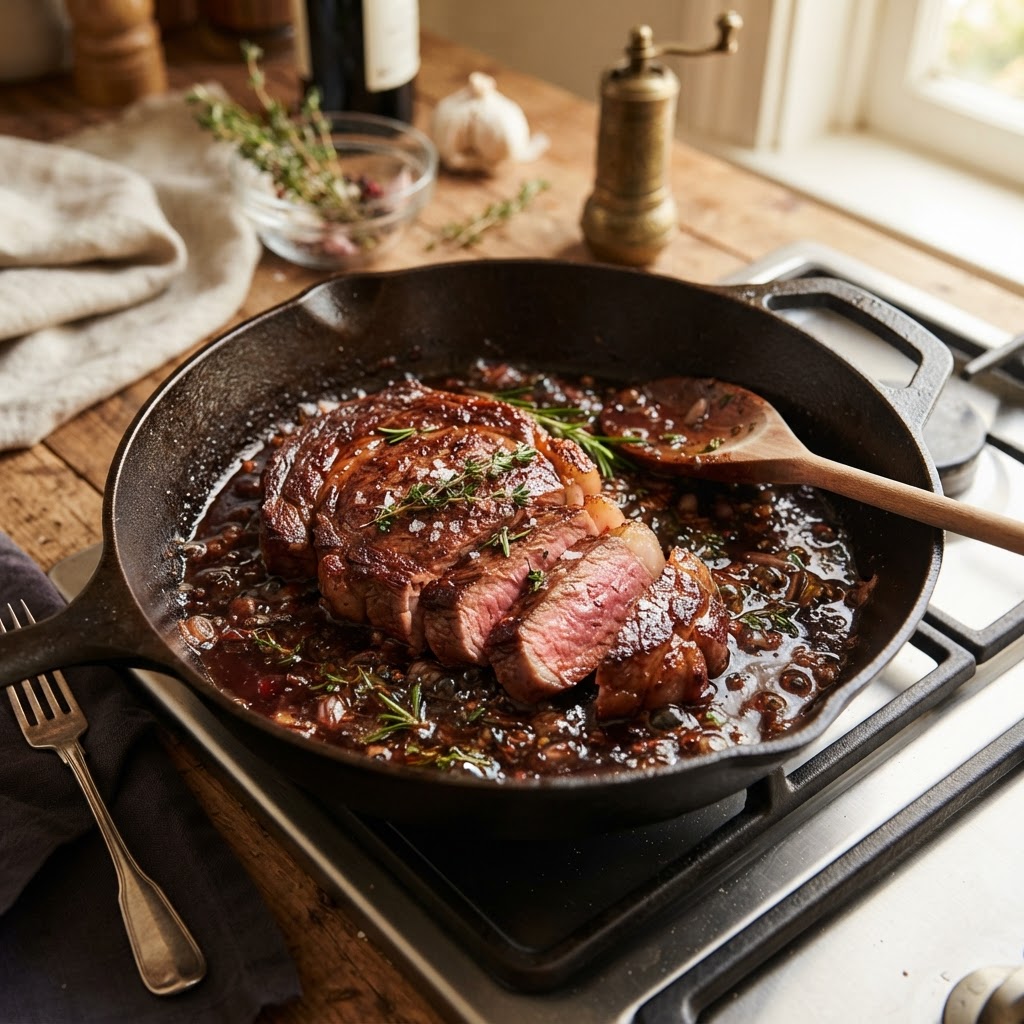
Once your protein is seared to perfection and removed to rest, you are faced with a pan that looks like a war zone. This is the moment of truth. You will see dark, caramelized remnants—the fond—clinging to the bottom of the pan. The process of deglazing is simply the act of adding a liquid to a hot pan to lift these solids. The liquid acts as a solvent, breaking the bonds between the protein and the pan surface. It is a violent, sizzling reaction, but it is exactly what you need to scrape the flavor back into your dinner.
Choosing Your Solvent
Deglazing liquids vary based on what you are cooking, but they generally fall into three categories: acidic, alcoholic, or savory. White wine, dry vermouth, and dry sherry are the classic choices for deglazing, as the acidity helps to cut through the richness of the fat you used for searing. If you prefer to go alcohol-free, a high-quality chicken or beef stock mixed with a splash of balsamic or apple cider vinegar works wonders. The key is to keep the liquid volume low; you are looking for a reduction, not a soup.
The Technique of Scraping
Using a wooden spoon or a heat-resistant silicone spatula, stir the liquid vigorously as soon as it hits the pan. The steam will rise quickly, so be prepared for a fragrant cloud. Use the flat edge of your spoon to rub the bottom of the pan, physically lifting every last speck of brown residue. You will see the liquid change color, turning from a watery translucent shade to a deep, rich brown. This is the fond becoming liquid, and it is the flavor base that will define your sauce. Continue stirring until the liquid has reduced by at least half, intensifying the flavors significantly.
Aromatics and the Building Blocks of Complexity
A pan sauce is more than just reduced fond and wine; it is an opportunity to layer in aromatic complexity. While the fond provides the savory backbone, the aromatics you introduce immediately after the deglazing step provide the character. Finely minced shallots, garlic, or fresh herbs like thyme and rosemary are the usual suspects. You want these ingredients to cook gently in the reduced liquid so that their flavors soften and integrate into the sauce rather than staying raw and pungent.
Balancing Ratios for the Perfect Sauce
The professional ratio for a standard pan sauce is roughly 1:1:3—one part aromatic, one part fat, and three parts liquid, adjusted to your personal taste. However, the true secret is the reduction. Most home cooks take the sauce off the heat too early. You want to reduce your liquid until it has a syrupy consistency, known as nappe in culinary terms. When you run a finger across the back of a spoon dipped in your sauce, it should hold a clean line. If the sauce runs off like water, it needs more time on the heat.
The Role of Herbs and Spices
Don’t be afraid to finish your sauce with fresh herbs, but timing is everything. Woody herbs like thyme or rosemary can be added early in the deglazing process so their flavors can permeate the liquid. Delicate, leafy herbs like parsley, chives, or tarragon should be folded in at the very last second, just before service, to preserve their vibrant green color and fresh, grassy aroma. Never boil your delicate herbs, as they will lose their brightness and turn muddy.
A sauce is the punctuation mark of a dish. It should clarify, enhance, and conclude the flavors of the protein without ever overwhelming them.
The Final Emulsion: Mounting with Cold Butter
The final, most important step in creating a professional pan sauce is the process of mounting with butter, or monter au beurre. This is the technique that transforms a thin, sharp reduction into a glossy, velvety, restaurant-style sauce. The key is using cold butter, cut into small cubes. When you whisk cold butter into a warm (but not boiling) liquid, the milk solids emulsify with the water-based reduction, creating a creamy, stable sauce that coats the back of a spoon perfectly.
Why Cold Butter Matters
If you use melted or room-temperature butter, the butter fat will likely separate and create an oily, broken sauce. By using cold butter, you ensure that the emulsion happens slowly, creating a thick, luxurious texture that clings to the meat. Remove the pan from the heat entirely before you start whisking in the butter. The residual heat of the pan is more than enough to melt the butter, and keeping it off the direct heat prevents the sauce from breaking or separating.
Troubleshooting the Broken Sauce
If your sauce does break—meaning you see little beads of oil floating in the liquid—do not panic. You can often fix a broken emulsion by adding a single teaspoon of cold water or a tiny splash of heavy cream and whisking vigorously. The extra moisture and protein can often bring the emulsion back together. Always serve your sauce immediately; these emulsions are delicate and will not hold their structure for very long, which is why it is the very last thing you do before putting the plate on the table.
Expanding Your Repertoire: Beyond Pan Sauces
Once you have mastered the basics of sear-and-deglaze, you will realize that this technique is the universal language of the kitchen. You can apply this to almost anything. Try searing a mixture of wild mushrooms in a cast-iron skillet, deglazing with a splash of balsamic vinegar and a bit of chicken stock, and finishing with a knob of butter and a pinch of fresh thyme. The resulting sauce is earthy, rich, and incredibly sophisticated, yet it takes less than five minutes to prepare.
Seasonal Variations
The beauty of the pan sauce is that it changes with the seasons. In the spring, deglaze with a dry white wine and finish with a squeeze of fresh lemon juice and minced chives to accompany delicate fish. In the autumn, use a dry cider or a dash of brandy, and perhaps finish with a dollop of crème fraîche instead of butter to pair with pork chops or roasted root vegetables. The structure of the sauce remains the same, but the flavor profile shifts entirely to match your mood and the produce currently in your kitchen.
Advanced Emulsions
Once you are comfortable with butter mounting, you can branch out into other finishing techniques. A squeeze of mustard can act as a stabilizer for your pan sauce, helping to keep the emulsion tight and adding a pleasant, sharp tang. A dollop of heavy cream can be reduced down after the deglazing step to create a creamy pan sauce that is perfect for steak au poivre. By mastering the core concept of fond extraction, you gain the ability to improvise based on whatever you have in your pantry.
The Essential Equipment Checklist for the Home Cook
You do not need a commercial-grade kitchen to produce professional results, but you do need the right tools. A heavy-bottomed, stainless steel skillet is your most valuable asset. Unlike non-stick pans, stainless steel allows for excellent fond development. If you are worried about cleanup, don't be. Once you deglaze, 90% of the scrubbing is already done for you by the liquid. If you use a good quality pan, a quick soak in warm, soapy water is all it takes to keep it in prime condition for years to come.
Why You Should Avoid Overcrowding
A common mistake among home cooks is putting too much food in the pan at once. If you overcrowd the skillet, the temperature of the pan will drop rapidly, and the moisture released by the meat will accumulate, leading to steaming instead of searing. If you are cooking for a crowd, work in batches. It is far better to have a perfectly seared piece of meat that you keep warm in a low-temperature oven than to have four pieces of grey, steamed meat that never developed any flavor.
Maintaining Your Utensils
Use metal or wooden spatulas rather than plastic or silicone when scraping the fond. You need a bit of leverage to get those stuck-on bits, and a sturdy metal spatula allows you to apply force directly to the pan surface. If you are using a stainless steel pan, don't worry about scratching the surface; it is meant to be used and developed over time. A seasoned skillet that has seen thousands of pan sauces actually performs better than a brand-new one because the microscopic pores in the metal have been filled with years of cooking.
The professional kitchen thrives on consistency. By using the same pan, the same heat, and the same ratio every time, you remove the guesswork from your cooking.
Final Thoughts
The transition from a hesitant home cook to one who cooks with confidence is marked by the moment you stop fearing the "mess" of the pan and start craving it. Pan sauces are the ultimate reward for your patience and your technique. By understanding the Maillard reaction, respecting the power of the fond, and mastering the delicate art of mounting with butter, you have unlocked the secret to the most delicious part of the meal. It is an efficient, elegant, and highly professional way to cook, and it is a skill that will serve you well for the rest of your life.
Remember that failure is simply a part of the process. If your sauce breaks, you learn to whisk. If your fond burns, you learn to manage your heat. If your liquid is too thin, you learn to be more patient with the reduction. Every pan of food you cook is a chance to experiment, to taste, and to refine your approach. Do not let the intimidation of professional kitchens keep you from trying these techniques. The only difference between you and the chef in your favorite restaurant is the number of times they have performed this exact dance, and with practice, you will find yourself doing it with the same effortless flow.
So, the next time you prepare a piece of protein, look at that empty pan after the sear. See the potential in the brown bits. Reach for the wine, trust the process, and embrace the sauce. You are no longer just cooking a piece of meat; you are building flavor from the bottom up, layer by layer, until it is perfect. And as for "blaming the chef"? You will find that you have become the only chef worth listening to in your own kitchen. Happy cooking, and may your sauces always be glossy, your fond always abundant, and your plates always clean.
Get the Next Recipe
Weekly recipes, techniques, and gear picks — straight to your inbox.
