The Home Cook’s Guide to Tempering Spices: How to Bloom Aromatics for Deeper, Restaurant-Quality Flavor
There is a distinct, almost intangible quality that separates the meals we cook at home from the dishes served in our favorite restaurants. You have likely experienced it: you follow a recipe to the letter, measuring your cumin, turmeric, and coriander with precision, yet the final result feels muted, thin, or simply lackluster. It isn't a failure of your skill or a lack of fresh ingredients, but rather a missing fundamental technique that professional kitchens rely on every single day. That secret is the art of blooming spices, a process that transforms dry powders and whole seeds into vibrant, aromatic powerhouses. When you skip this step and toss spices directly into a watery base, you are essentially boiling raw plant matter, leaving the delicate essential oils trapped inside their cellular structures where they can never fully reach your palate.
Learning to temper and bloom your spices is the single most effective way to elevate your home cooking, acting as a gateway to the complex, layered flavor profiles found in cuisines from India, the Middle East, Southeast Asia, and beyond. This technique is not about turning up the heat, but rather about controlling it to awaken the dormant potential hiding in your spice rack. Whether you are working with pungent mustard seeds, earthy cumin, or floral cardamom pods, applying the correct amount of fat and heat forces those aromatics to release their volatile compounds. Once you master the visual and olfactory cues—the shimmering fat, the subtle color change, and the intoxicating fragrance—you will find yourself moving away from rigid recipes and toward an intuitive understanding of how to build depth from the very first minute you step into the kitchen.
In this guide, we are going to tear down the mystery of spice tempering and give you the tools to approach your pantry with newfound confidence. We will cover the chemistry behind the process, the specific fats that work best for different spice profiles, and the danger zones you must avoid to keep your aromatics from becoming bitter. You will learn how to build a flavor base that holds its own against proteins and starches, ensuring that every bite is as aromatic as it is satisfying. By the end of this journey, you will no longer blame the chef for your kitchen shortcomings, because you will be the one commanding the pan, wielding heat and spice with the precision of a professional.
The Chemistry of Flavor: Why Heat and Fat Matter
At the microscopic level, spices are complex reservoirs of essential oils, terpenes, and phenolic compounds. When spices sit in a jar, these molecules are locked away, protected by the dry, fibrous structure of the seed or leaf. Water-based cooking, such as boiling a soup or a stew, is rarely hot enough to dissolve these compounds into your dish, as many of these oils are hydrophobic—they literally repel water. By introducing a fat medium, you create an ideal environment for extraction. Fat is a flavor carrier; it acts as a solvent that pulls those volatile oils out of the spice and carries them throughout the entire dish, ensuring the flavor is distributed evenly rather than clinging to the spices themselves.
The Role of Lipid Solubility
Most of the aromatic qualities we love in spices are lipophilic, meaning they love fat. Think of a curry made with coconut milk versus one made with water; the fat in the coconut milk captures the heat of the chiles and the earthiness of the turmeric, creating a silky mouthfeel that coats the tongue. When you bloom spices in oil or ghee, you are performing a culinary extraction that mimics the process of making an infusion. As the temperature rises, the cell walls of the spice soften, and the aromatic oils migrate into the fat, seasoning the fat itself. This seasoned fat then becomes the foundation for your dish, acting as a bridge that connects the spices to the other ingredients in the pan.
"Spices are not merely dry ingredients to be tossed into a pot; they are flavor reservoirs waiting to be unlocked. Without the medium of fat and the precision of heat, you are leaving the soul of your meal in the jar."
Understanding the Volatile Compounds
Different spices contain different types of volatile compounds, each with a unique threshold for heat. Some, like cinnamon and cloves, are robust and can withstand higher heat for longer periods. Others, like fennel seeds or coriander, contain delicate esters that can evaporate or burn off quickly if the pan is too hot. When you temper, you are balancing the extraction of flavor against the risk of degradation. If you heat your oil past the smoke point, you are effectively destroying the very compounds you intended to highlight, turning a fragrant oil into a scorched, bitter liquid. Precision is the difference between a golden, aromatic base and a blackened, acrid disaster.
Choosing Your Medium: Oils, Fats, and Tempering Agents
The foundation of your temper is the fat you choose, and the choice is never arbitrary. In professional kitchens, we match the fat to the cuisine and the spice profile to ensure that the medium supports rather than competes with the aromatic notes. If you are making a delicate, light vegetable dish, you might opt for a neutral oil like grapeseed or refined coconut oil. However, if you are looking for that rich, indulgent restaurant finish, ghee (clarified butter) is the gold standard. Ghee has a high smoke point, allowing you to get the oil hot enough to pop mustard seeds without burning the milk solids that would otherwise turn bitter in regular butter.
The Superiority of Ghee and Animal Fats
Ghee is prized because it is pure fat, free of the water and milk solids that cause smoking and sticking. When you drop cumin seeds into hot ghee, you hear an immediate, sharp sizzle as the moisture is displaced. This immediate reaction is the "pop" that signals the start of the bloom. Rendered animal fats, such as duck fat or schmaltz, also provide incredible depth, though they carry a strong flavor profile that should be used selectively. If you are working with bold, earthy spices like black cardamom or cloves, these fats can provide a savory backbone that elevates the spices to a level that vegetable oils simply cannot touch.
Selecting the Right Neutral Oils
If you are vegan or prefer a clean, neutral flavor, choosing the right oil is essential. Refined avocado oil is excellent for high-heat tempering due to its 500°F smoke point, which is far higher than most standard oils. Canola oil or grapeseed oil are also reliable, cost-effective options for the home cook. The key is to ensure the oil is neutral in taste so that the spices remain the protagonist of the dish. Always avoid extra virgin olive oil for high-heat tempering; its low smoke point and complex flavor profile make it better suited for finishing a dish rather than cooking the base aromatics.
The Art of Tempering: A Step-by-Step Technique
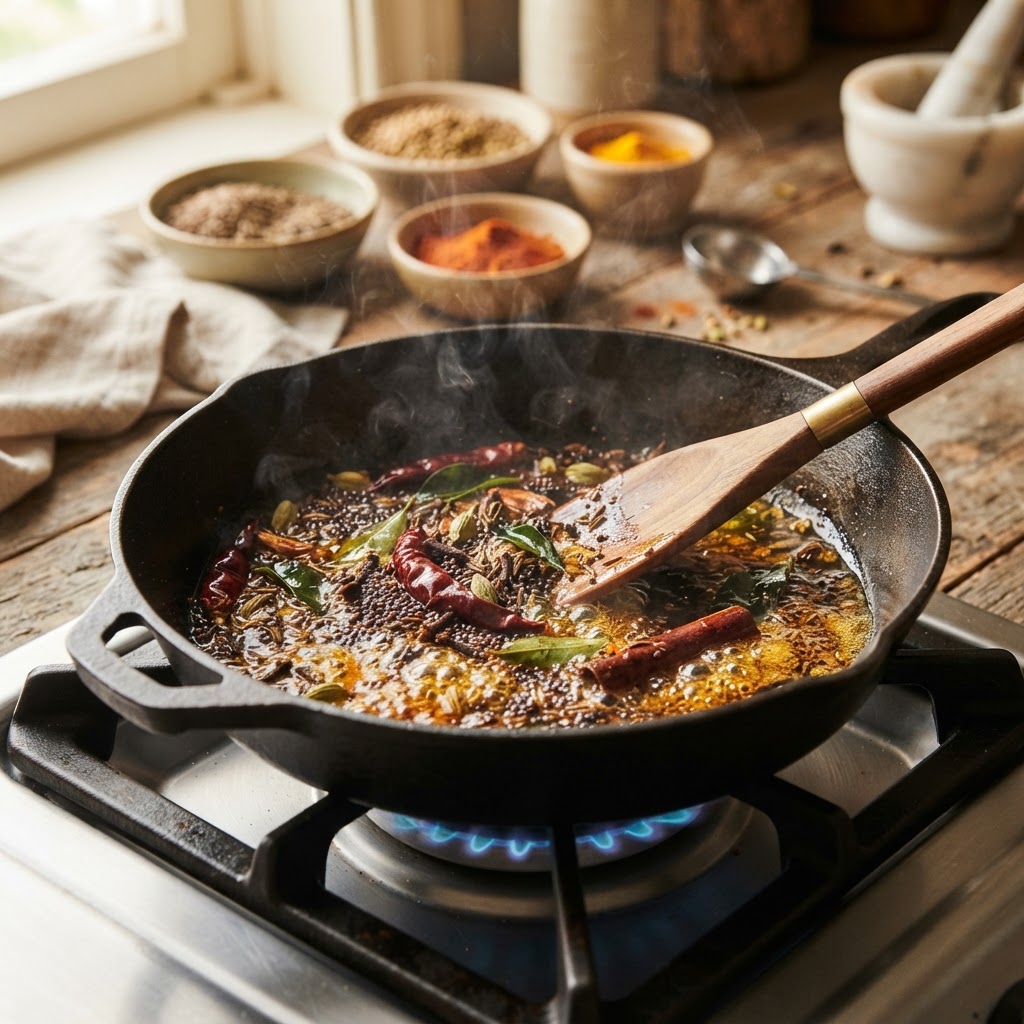
The process of tempering, often called tadka or chhonk in South Asian cooking, is a sequence of events that requires your undivided attention. You cannot walk away from the stove during this process. The difference between a perfectly tempered spice and burnt carbon is often a matter of five to ten seconds. Before you begin, have your spices measured and ready in small bowls. This is known as mise en place. If you are scrambling to open jars while your oil is smoking, you have already lost the battle. Start by heating your fat over medium-low heat. You want the fat to shimmer, not smoke.
The Sequence of Heat
Visual and Sensory Cues
Watch for the shimmer of the oil—when it flows like water, it is ready. If you are using mustard seeds, wait for them to "pop," which sounds like small, rhythmic cracks. This is the moisture escaping the seed and the oil rushing in to take its place. Once the popping slows down, your fat is fully infused. If you are using ground spices, look for the color to darken slightly—a sign of the Maillard reaction occurring on a microscopic scale—but turn the heat down if you notice any dark brown or black specks forming in the oil. That is the point of no return.
"True flavor development happens in the seconds between the sizzle and the scent. Listen to your ingredients; they will tell you when they are ready to yield their essence, and they will tell you immediately when they have had enough."
Common Pitfalls and How to Avoid Them
Even experienced cooks stumble when they get overconfident. The most common mistake is impatience. Turning the heat up to "high" to save a minute will inevitably scorch your spices. Burnt spices are not just "stronger"; they are fundamentally altered into bitter, acrid compounds that will taint the entire pot of food. You cannot mask the flavor of burnt cumin or charred turmeric once it has infused into your base fats. If you accidentally burn your temper, the only professional solution is to discard the fat and start over. It is a painful lesson, but one that prevents a ruined meal.
The "Water Splash" Technique
If you are worried about your spices burning, you can use a small amount of liquid as a safety buffer. After you have bloomed your whole spices in the hot oil, add a tablespoon of water or broth to the pan. This will instantly drop the temperature of the oil, preventing the spices from scorching while allowing the flavors to meld into a rich, cohesive sauce. This technique is especially useful when working with high-potency spices like hing (asafoetida) or ground chiles, which have a very narrow window between perfect extraction and total combustion.
Managing Delicate Spices
Some spices are heat-sensitive to the point of being fragile. Dried herbs, such as oregano or thyme, should be added toward the end of the tempering process, rather than at the beginning. If you add these to the oil first, they will turn into flavorless dust by the time your onions or garlic are finished. Similarly, saffron should be bloomed in a small amount of warm water or milk, not directly in a hot fat, to prevent its delicate floral compounds from evaporating before they ever hit the dish. Treat each spice as an individual with its own temperament, and you will find your consistency improves dramatically.
Building the Flavor Foundation: Beyond the Spice Rack
Tempering is not an isolated event; it is the opening movement of a much larger symphony. Once your spices have bloomed in the hot fat, you have created a flavored medium that is ready to accept other aromatics. This is the ideal time to add your "wet" aromatics: finely diced onions, garlic, ginger, or fresh chiles. The salt you add at this stage will help draw the moisture out of these vegetables, which will then mingle with the spice-infused fat. This is where the magic happens—you are essentially creating a flavorful paste that will form the backbone of your sauce, curry, or braise.
The Interaction with Onions and Garlic
When you add onions to the spiced fat, they don't just fry; they become seasoned from the inside out. The spices you bloomed are now coating the onion cells, which are releasing their own sugars. As the onions brown, they caramelize in the presence of these oils, creating a complex, savory, and sweet base that is far deeper than a dish where the onions were sautéed alone. This is the foundational technique used in almost every great stew recipe, from the soffritto of Italy to the mirepoix of France, though it is enhanced by the addition of the blooming spices.
Layering Your Spices
Don't be afraid to build layers of flavor throughout the cooking process. I often like to use a "split-temper" approach: one round of spices at the beginning to build the base, and a second, smaller addition of spices toward the very end. The second bloom (often called tarka in the final seconds before serving) adds a fresh, vibrant, and aromatic top note to the dish. This "layered" technique keeps the flavors bright and prevents the meal from tasting like a singular, muddy note. The initial bloom provides the depth, while the final bloom provides the lift.
Troubleshooting Your Spice Pantry
Your pantry is a reflection of your commitment to flavor. Old, pre-ground spices are the enemy of the home cook. A jar of cumin powder that has been sitting in your cupboard for three years has lost its essential oils, and no amount of blooming will bring them back to life. If you want restaurant-quality results, start by evaluating the age and quality of your inventory. If you cannot remember when you bought it, it is time to replace it. Whenever possible, buy whole spices and toast them lightly in a dry pan before grinding them at home. The difference in freshness is so significant it will feel like you are cooking with a different set of ingredients entirely.
The Freshness Test
To test the vitality of your spices, place a small pinch in your palm and crush it with your thumb. Does it release an immediate, powerful fragrance? If the scent is faint or smells dusty, it is time to discard it. Freshly ground spices contain a higher concentration of the very oils we are trying to extract through tempering. When you bloom these fresh, high-quality spices, the aroma should fill your kitchen within seconds. It is a sensory experience that tells you exactly when the fat has done its job.
Storage for Longevity
Keep your spices in a cool, dark, and dry place. Light and heat are the primary destroyers of flavor. A spice rack located above your stove may look beautiful, but it is a graveyard for volatile oils. The constant fluctuation in temperature from your oven and stovetop will cause the oils in your spices to oxidize and go rancid. Move your spices to a cabinet, away from the heat and the light, and buy in smaller quantities so you are always using the freshest stock possible. If you invest in high-quality whole spices, you are giving yourself a massive head start on achieving that professional-grade depth of flavor.
"The kitchen is a laboratory of aromatics. When you respect the biology of the seed and the physics of the fat, you transform from a cook who follows instructions into an architect who builds flavor from the ground up."
Final Thoughts
The art of tempering spices is not about perfection; it is about paying attention. It is the practice of observing the color, the scent, and the sound of your pan, and adjusting your technique based on the unique needs of the ingredients in front of you. Once you embrace this process, you will find that your kitchen becomes a far more intuitive space. You will stop blaming the chef for your lackluster dishes and start realizing that you hold the keys to professional-quality flavor in your own hands.
Remember that every spice has a personality. Some are loud and aggressive, requiring a firm hand and a steady heat; others are shy and delicate, needing nothing more than a gentle kiss of warmth to reveal their beauty. Do not be discouraged if your first few attempts result in a burnt batch. Every professional chef has a history of scorched pans and discarded temperings. The lesson is in the mistake. Keep your station clean, your spices fresh, and your heat controlled, and you will eventually develop the "culinary intuition" that separates the casual cook from the master.
The next time you reach for your cumin or your coriander, pause for a moment. Consider the fat you are using, the intensity of the heat you are applying, and the fragrant potential locked within those grains. You are not just preparing a meal; you are orchestrating an extraction, building a bridge between raw ingredients and the finished, restaurant-quality masterpiece on your plate. Enjoy the process, trust your senses, and keep cooking with passion. Your home kitchen is capable of incredible things, provided you give it the aromatic foundation it deserves. Happy tempering!
***
Quick Summary for Your Next Session:
Mastering this technique is a journey. It requires patience, focus, and a bit of trial and error. But once you have successfully tempered your first batch of spices, you will never look at a recipe the same way again. You will see the blank space where flavor should be, and you will know exactly how to fill it. Go forth and bloom—your palate will thank you for the upgrade in depth, complexity, and that unmistakable, intoxicating fragrance that only a perfectly tempered spice can provide. It is time to take charge of your kitchen, one seed at a time. The chef is no longer to blame; you are the one in control, and the results will speak for themselves on the dinner table. Keep practicing, keep experimenting, and most importantly, keep enjoying the process of creating something extraordinary from the simple, beautiful ingredients found in your pantry. Your culinary evolution starts here, with the sizzle of the spice in the pan.

Get the Next Recipe
Weekly recipes, techniques, and gear picks — straight to your inbox.
