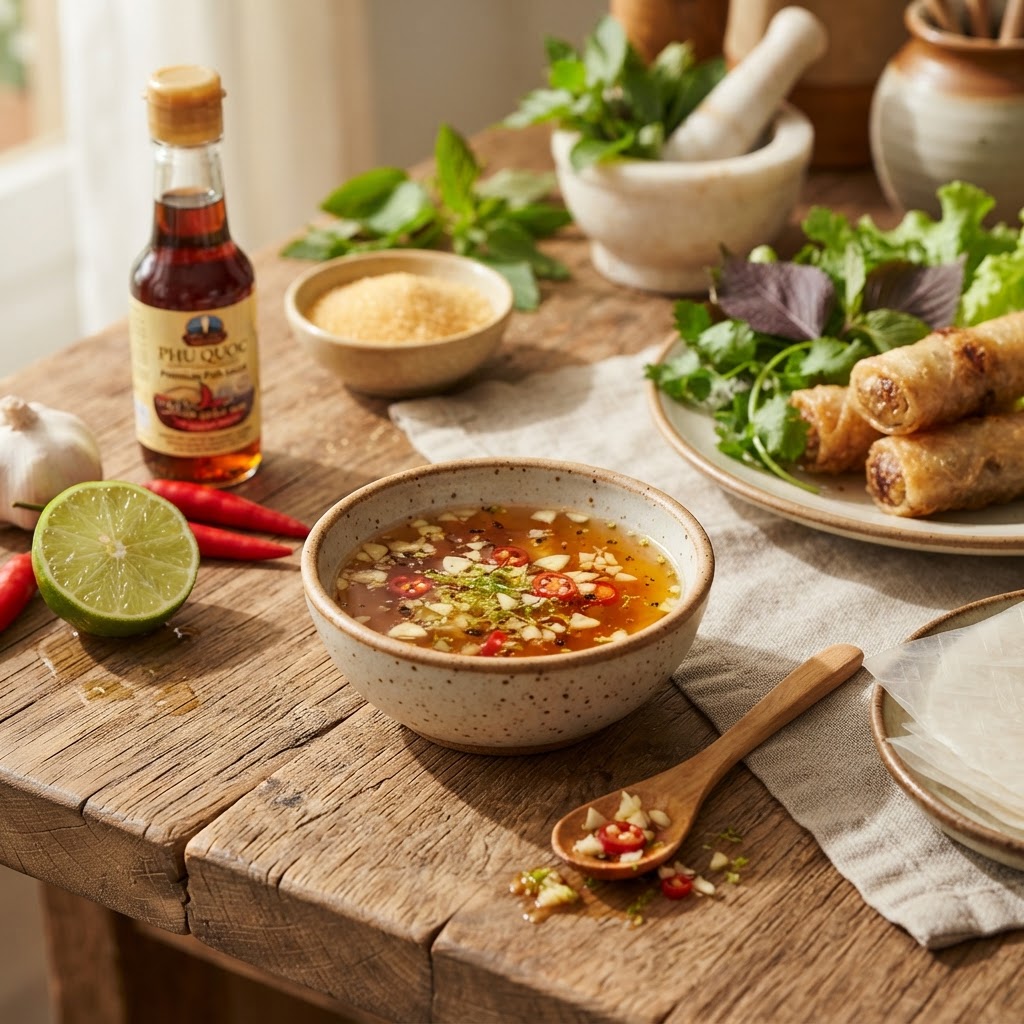
The Home Cook’s Guide to Vietnamese Nuoc Cham: Mastering the Balance of Fish Sauce, Sugar, and Lime for Essential Dipping Sauces
If you have ever sat down at an authentic Vietnamese restaurant and felt overwhelmed by the sheer vibrancy of the spread before you, chances are the secret weapon wasn't the searing heat of the chilies or the crunch of the fried spring rolls. It was that small, unassuming bowl of golden-hued liquid sitting right in the center, acting as the bridge between textures and temperatures. That, my friends, is Nuoc Cham, the essential dipping sauce that defines Vietnamese cuisine. Far from being a mere condiment, it is a masterclass in culinary balance, requiring a delicate dance between the pungency of fish sauce, the mellow sweetness of sugar, the sharp acidity of lime, and the persistent warmth of garlic and bird’s eye chilies. Mastering this sauce is the single most transformative step you can take toward leveling up your home cooking, turning a simple bowl of vermicelli or a platter of crispy pancakes into a restaurant-quality feast.
When home cooks attempt to recreate the flavors of Southeast Asia, they often find themselves frustrated by a lack of depth or an imbalance that leans too heavily into the saltiness of the fish sauce. The secret to a world-class Nuoc Cham lies in the emulsification and dissolution process; it is not just about dumping ingredients into a bowl and stirring. You must respect the order of operations, ensuring the sugar has completely surrendered into the lime juice before the fish sauce is introduced. This creates a base that is smooth rather than gritty, providing a polished canvas for the aromatics. When you achieve that perfect ratio, you’ll find that the sauce doesn’t just sit on the food; it highlights the ingredients, lifting the heavy notes of fried meats and refreshing the palate against the richness of coconut-milk-based batters.
As we dive into the anatomy of this sauce, remember that the "perfect" version is often a reflection of your own palate. While there are golden ratios to follow, the best chefs are those who learn to taste as they build, adjusting for the specific acidity of their limes or the varying salt content of different brands of fish sauce. By the end of this guide, you won't just be following a recipe; you will be intuiting the chemistry of the sauce. We are going to strip away the intimidation factor and equip you with the professional techniques necessary to keep a batch of this "liquid gold" in your refrigerator at all times. Get ready to elevate your kitchen game, because once you master the art of the Nuoc Cham, there is truly no going back to the store-bought alternatives.
The Chemistry of the Four Pillars
The brilliance of Nuoc Cham is its commitment to the four pillars of flavor: salty, sweet, sour, and spicy. When these elements align, they create an umami-rich elixir that is fundamentally addictive. The salty component comes from high-quality fish sauce, which is the backbone of the dish. The sugar provides the necessary sweetness to cut through the intense salt, while the lime juice introduces the bright acidity required to make the flavors pop. Finally, the garlic and chilies add a secondary layer of complexity, providing aromatic warmth and a slow-burn spice that lingers just long enough to invite the next bite.
Understanding Your Fish Sauce
Not all fish sauce is created equal, and this is where most home cooks run into their first hurdle. You are looking for a fish sauce with a high protein content, which is usually indicated by the "N" number on the bottle, such as 30N, 40N, or even 60N. A higher number typically denotes a richer, more complex, and less "fishy" flavor profile. Look for brands that list only two ingredients: anchovy extract and salt. If your ingredient list looks like a science experiment, put it back on the shelf. The quality of your fish sauce dictates the ceiling of your final product.
The Balancing Act
The ratio is where the magic happens, and it is usually a personal preference. A classic starting point is 1:1:1:5—one part sugar, one part lime juice, one part fish sauce, and five parts water. However, professional kitchens often dial back the water slightly to keep the flavor concentrated. If you find your sauce is too sharp, add a splash more water or a touch more sugar. If it tastes "flat," it likely needs a squeeze more lime juice to wake up the palate.
"Nuoc Cham is the soul of the Vietnamese table. It is not meant to be a heavy coating, but rather a vibrant, acidic bath that cuts through the fattiness of the fried elements and brings harmony to the fresh herbs and crunchy vegetables."
Prep Work and Technique
Before you even reach for the fish sauce, your preparation method plays a significant role in the outcome. The way you handle your garlic and chilies is not just about aesthetics; it is about how the flavor is released into the liquid. You want the aromatics to be minced finely enough that they provide flavor in every drop, but not so fine that they turn into a muddy paste. A consistent, fine mince ensures that the oils from the garlic and the capsaicin from the chilies infuse the liquid effectively over the time it sits.
Mastering the Mince
Use a sharp chef's knife and take your time. For the garlic, use the flat of the blade to smash the clove slightly before peeling, which makes mincing a breeze. Aim for a uniform mince, roughly 1/8th of an inch in size. For the bird’s eye chilies, remove the stem, slice them lengthwise, and then mince. If you prefer less heat, scrape out the seeds and the inner white pith before mincing, as that is where the bulk of the capsaicin resides.
The Dissolution Step
Never add your fish sauce before the sugar is dissolved. Sugar does not dissolve well in high-salinity liquids. By whisking the sugar and lime juice (or water) together first, you ensure the liquid becomes a syrup, which will then carry the salt of the fish sauce uniformly. This step prevents the dreaded "sandy" texture at the bottom of the bowl. Once the sugar is gone, you can whisk in the fish sauce with confidence, knowing the sweetness will be evenly distributed throughout the batch.
The Role of Water and Temperature
Temperature is a quiet variable in the world of sauces. While Nuoc Cham is typically served at room temperature, the temperature of the liquid used to dissolve the sugar can change everything. Using warm (not boiling) water to dissolve your sugar can speed up the process, but you must ensure that the mixture cools down completely before adding the fresh garlic and lime, otherwise you will "cook" the garlic, changing its flavor profile from sharp and pungent to soft and sweet.
The Importance of Filtered Water
Because water makes up a significant portion of the sauce, its quality matters. If your tap water has a high chlorine content, it will clash with the delicate fermentation notes of the fish sauce. Use filtered or spring water for the best results. You will find that the clarity of the finished sauce is much higher, and the overall flavor profile is noticeably cleaner and more professional.
Adjusting for Seasonality
The acidity of limes varies significantly depending on the time of year and the origin of the fruit. In the height of summer, limes are often juicier and slightly sweeter. In the winter, they can be incredibly tart. Always taste your lime juice before mixing. If it is exceptionally sharp, you might need a bit more water or sugar to counteract the intensity. This is why following a "rigid" recipe can sometimes lead to disappointment; you must remain an active, tasting participant in the creation of the sauce.
Enhancing with Aromatics and Variations
Once you have mastered the traditional base, you can begin to experiment with variations. While the traditional version is the gold standard for spring rolls and rice plates, there are regional nuances that can make your sauce even more compelling. Some regions of Vietnam incorporate a bit of coconut water in place of regular water to add a natural, rounded sweetness, while others might add a drop of rice vinegar for a different kind of "twang" in the acidity.
The Garlic and Chili Float
One of the most satisfying things about a well-made Nuoc Cham is seeing the finely minced garlic and chilies floating evenly throughout the sauce rather than sinking to the bottom. If your garlic sinks, it usually means your sauce is too thin. To ensure they stay suspended, some chefs add a thickening agent like a very small amount of sugar syrup or, in some cases, a tiny splash of pineapple juice. Pineapple juice not only adds a lovely, tropical sweetness but also provides a bit of body that keeps the aromatics suspended.
Regional Twists
Southern Style:* Often sweeter, with more sugar and sometimes the addition of fresh coconut water.
Central Style:* Often spicier, with a higher concentration of bird’s eye chilies and a more pronounced garlic presence.
Northern Style:* Often more balanced, leaning slightly more toward the salty/savory side with less sugar than the Southern version.
"A great Nuoc Cham is a living thing. When you add the garlic and chilies, they begin to steep, creating a secondary fermentation of sorts. The sauce you serve ten minutes after making it will be fundamentally different than the one you serve two hours later."
Storing and Serving Like a Pro
The beauty of Nuoc Cham is that it is a "make-ahead" miracle. In fact, it is often better after it has sat for an hour or two, allowing the aromatics to infuse into the liquid. However, you should not leave it out on the counter indefinitely. Store your prepared sauce in an airtight glass jar in the refrigerator. It will keep perfectly for up to two weeks, though the brightness of the lime juice will begin to fade after about five to seven days.
Service Temperatures
If you are serving the sauce with hot dishes like grilled pork (Bun Thit Nuong), do not serve the sauce ice-cold from the fridge. Take it out 20 minutes before serving. If you are in a rush, place the jar in a bowl of warm water for a few minutes. Serving it at a pleasant room temperature ensures that the flavors are vibrant and the sugar is completely liquified, creating the most harmonious eating experience possible.
Presentation Tips
For a beautiful presentation, use a small, clear glass bowl or a traditional ceramic dipping dish. If you are feeling fancy, you can garnish the top of the sauce with a thin slice of fresh lime or a few reserved slivers of bird’s eye chili. The contrast of the bright red chili against the golden liquid is visually striking and warns your guests exactly what kind of heat they are in for. Always provide a small spoon if you are serving it in a communal dish, as it encourages your guests to ladle the sauce over their noodles or vegetables.
Common Troubleshooting
Even the best chefs hit a snag occasionally. If your sauce doesn't taste quite right, don't throw it out! Here is how to troubleshoot the most common issues:
Too Salty:* Add more water, a teaspoon at a time. If that makes it too thin, add a pinch of sugar.
Too Sweet:* Add a squeeze of lime juice. If you are out of limes, a teaspoon of rice vinegar will do in a pinch.
Too Sharp:* Add a little more water or sugar.
Lacking Depth:* If it feels "thin" or "watery," add a dash more fish sauce or a small amount of finely minced shallot, which adds a subtle, savory sweetness.
The Importance of the "Fishy" Threshold
Remember that fish sauce, by its nature, is fermented. If you are new to Vietnamese cuisine, the smell might be jarring. Do not let this discourage you. When diluted correctly, that "fishy" quality transforms into a rich, savory depth that provides the elusive umami that salt alone cannot replicate. If you are truly sensitive to the smell, start with a brand that is known for being "lighter" or "milder" and slowly work your way up to the more robust, traditional brands.
Equipment Essentials
You don't need a high-tech kitchen to make this, but a few tools will make your life easier. A fine-mesh strainer is useful if you are using fresh lime and want to ensure no seeds or pulp end up in the sauce. A small whisk is essential for emulsifying the sugar and liquids. Keep a dedicated glass container for your dipping sauces to prevent the residual smell of garlic and fish sauce from lingering in your plastic Tupperware.
Advanced Techniques: Infusions and Beyond
Once you have mastered the foundational Nuoc Cham, you can explore the world of infusions. Many professional kitchens create a "base syrup" by boiling sugar, water, and aromatics like star anise or ginger, then adding the fish sauce and lime juice once the syrup has cooled. This creates a much more complex, layered flavor profile that is perfect for pairing with more intricate dishes like Vietnamese Crepes (Banh Xeo) or grilled seafood.
Infused Nuoc Cham Recipe (The Chef’s Variation)
The Power of Textural Elements
In some traditional preparations, finely shredded carrots and daikon radish are added to the sauce. These are often pickled quickly in a little sugar and vinegar before being added to the Nuoc Cham. The radish and carrots add a crunch that perfectly contrasts with the silky texture of the sauce and the softness of the noodles. This turns the sauce into a salad-like component that can actually be eaten as a light side dish on its own.
"A well-balanced sauce is the difference between a meal that you simply consume and a meal that you remember. It is the punctuation mark at the end of a beautiful sentence of flavors."
Final Thoughts
The journey to mastering Nuoc Cham is a journey of discovery. You are learning to trust your own senses, to understand how the interaction of simple, raw ingredients can create something far greater than the sum of its parts. As you continue to experiment with these ratios and techniques, keep a small notebook nearby. Write down what worked, what didn't, and what you’d like to tweak next time. Did you prefer the lime juice from the store or the ones from the farmers market? Did the sauce improve after sitting for four hours? These observations are what turn a home cook into a culinary artist.
Remember, the goal is not to be a machine that produces the exact same sauce every time, but rather a cook who can adapt to the ingredients at hand. Vietnamese cuisine is built on the concept of freshness, and your sauce should embody that. If you find yourself in the middle of summer with the best, juiciest limes you’ve ever seen, let them shine. If you have a particularly potent batch of bird’s eye chilies, adjust accordingly. Your guests and your family will notice the care you put into every drop of that golden liquid.
Finally, do not be afraid to share this. There is something inherently communal about the Vietnamese style of dining, where everyone shares plates, dips spring rolls into a central bowl, and talks over the meal. By mastering Nuoc Cham, you are providing the centerpiece for those conversations. You are providing the flavor that binds the meal together. So, head into the kitchen, gather your limes, your sugar, your fish sauce, and your garlic, and start whisking. The perfect balance is just a few adjustments away, and I promise you, the effort will be rewarded with every single, delicious, mouth-watering bite. Enjoy the process, trust your palate, and keep on cooking—because at the end of the day, it is your kitchen, your rules, and your unique expression of flavor that matters most. Whether you are serving this at a dinner party or enjoying a quiet bowl of noodles alone on a Tuesday night, you are honoring a rich culinary tradition while adding your own chapter to its story. Happy cooking, and may your sauce always be perfectly balanced.
Get the Next Recipe
Weekly recipes, techniques, and gear picks — straight to your inbox.
