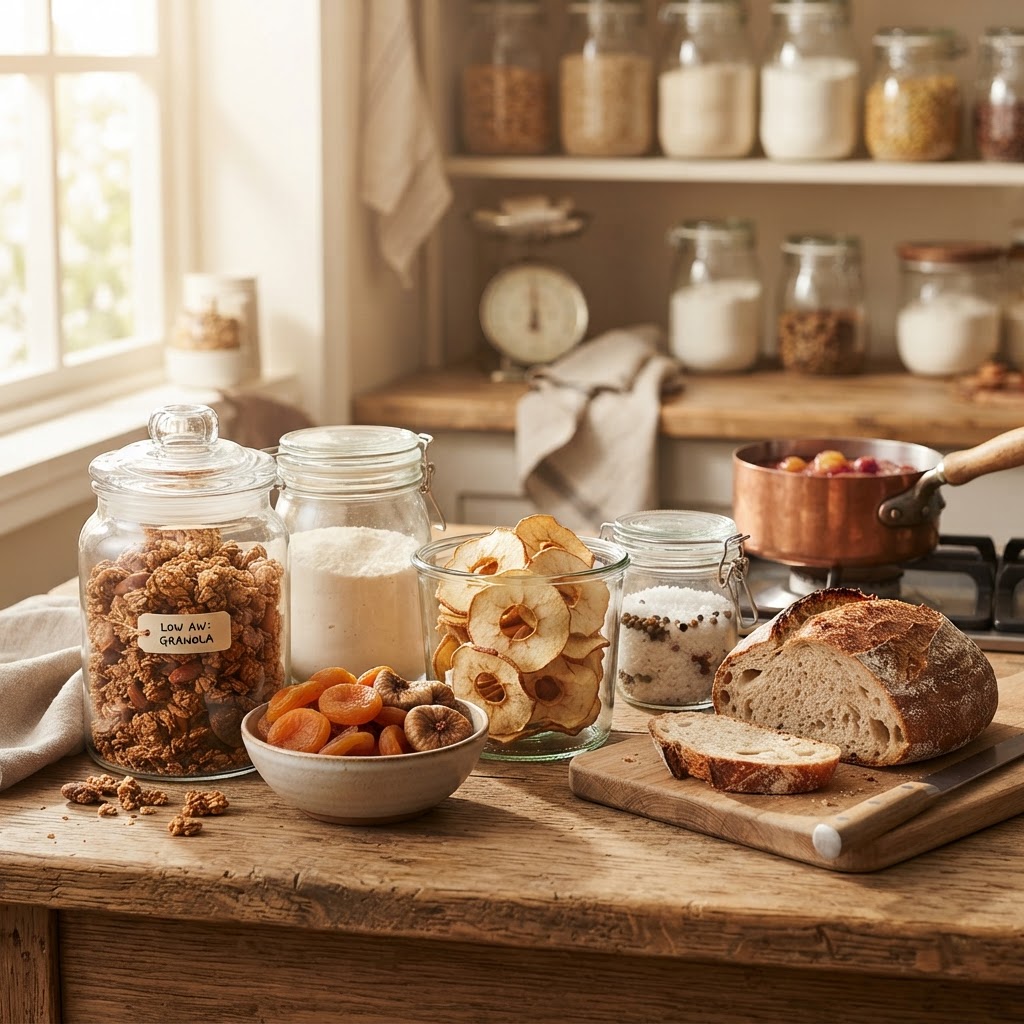
The Home Cook’s Guide to Water Activity: Controlling Texture and Shelf Life in Your Pantry Staples
We have all been there: you reach into the back of the pantry for that bag of artisanal crackers or a jar of house-made granola, only to find the contents have succumbed to a sad, chewy, or soft fate. Most home cooks immediately blame the humidity or a poorly sealed container, but in the professional kitchen, we know there is a much more precise culprit at play: water activity. While the total moisture content of a food item tells you how much water is present in a sample, water activity ($a_w$) tells you how that water is actually behaving and whether it is available to support the growth of microbes or shift the texture of your ingredients. Understanding this invisible metric is the difference between a pantry that serves you well for weeks and one that breeds spoilage and textural disappointment.
As chefs, we often manipulate the environment of our food to achieve a specific shelf life or mouthfeel without relying on chemical preservatives. By mastering the science behind osmotic pressure, solute concentration, and dehydration, you can take full control of your pantry staples. It is not enough to simply bake something until it is dry; you must understand the equilibrium between the internal moisture of your product and the atmospheric environment of your kitchen. This guide is designed to peel back the curtain on these professional techniques, offering you the tools to create crisp, shelf-stable, and safe ingredients that remain perfect from the first bite to the last.
Whether you are a hobbyist sourdough baker, a fan of home-dried fruit, or someone who loves stocking up on bulk ingredients, the principles of water activity are universally applicable. We will move beyond the guesswork and look at the physical chemistry that governs the crunch of a cookie and the safety of a fruit leather. By the time you reach the end of this deep dive, you will have the knowledge to troubleshoot your own recipes and apply professional logic to your everyday cooking. Prepare to look at your pantry with a new sense of authority, knowing that you finally have the power to stop blaming the humidity and start engineering the results you deserve.
The Chemistry of Availability: What is Water Activity?
At its core, water activity is the ratio of the vapor pressure of water in a food system to the vapor pressure of pure water at the same temperature. Think of it as the measurement of "free" water versus "bound" water. In any given ingredient, some water molecules are tightly bound to proteins, starches, or sugars, making them unavailable for chemical reactions or microbial growth. The free water, however, is the catalyst for trouble. It is this free water that migrates across boundaries, softens crispy items, and provides the necessary medium for mold and bacteria to thrive.
In a professional kitchen, we use a specialized tool called a water activity meter to give us an exact decimal reading between 0 and 1.0. For the home cook, you don't need a $2,000 device to understand the implications of these numbers. Generally, foods with an $a_w$ above 0.85 are considered potentially hazardous because they support the growth of most pathogens. Foods with an $a_w$ below 0.60 are considered shelf-stable, as almost no microorganisms can survive in that environment. Between these numbers, we find the realm of texture management, where the movement of moisture can either preserve your crunch or turn it into a soggy mess.
"Water activity is the invisible tether between culinary perfection and kitchen failure. Mastering it is not just about safety; it is about respecting the integrity of your ingredients and ensuring that your hard work survives the journey from the oven to the storage jar."
Bound vs. Free Water
It is vital to distinguish between total moisture and free water. You can have a piece of chewy jerky that has a relatively high moisture content but a very low water activity because of the presence of salt and sugar. These solutes bind the water molecules, effectively "locking" them away from the microbes that would otherwise spoil the meat. This is the fundamental secret behind charcuterie, jams, and salted caramels.
The Migration Problem
Moisture always moves from an area of high water activity to an area of low water activity. If you store a crispy, dry cookie (low $a_w$) in the same jar as a chewy marshmallow (high $a_w$), the cookie will inevitably steal the moisture from the marshmallow. By the next morning, your cookie is limp, and your marshmallow is tough. Understanding this "moisture migration" allows you to categorize your pantry storage effectively.
Solutes and Preservatives: Controlling the Environment
One of the most effective ways to lower water activity without removing water entirely is through the use of solutes. Salt and sugar are the two primary tools in a chef’s arsenal. When you add high concentrations of these ingredients to a preparation, you increase the osmotic pressure. The solutes essentially "grab" onto the water molecules, preventing them from interacting with their surroundings. This is how high-sugar preserves stay shelf-stable for months; the sugar molecules are so busy binding the water that none is left over for mold growth.
When working with fruit or vegetable purees, incorporating high levels of sugar effectively reduces the water activity to a point where the product becomes self-preserving. This is why a fruit reduction or a jam can be stored in the pantry, provided it is properly canned, while a fresh fruit puree would ferment within days. The professional trick here is to calculate the solute ratio based on the weight of the water content in your primary ingredients.
The Role of Salt
Salt is significantly more effective at lowering water activity than sugar on a molar basis. Because salt dissociates into two ions (sodium and chloride) in water, it has twice the impact on osmotic pressure compared to a sugar molecule like sucrose. When we cure meats or create long-fermented pickles, we are carefully calculating the salt percentage (often expressed as a baker’s percentage or total weight percentage) to reach a target $a_w$ that inhibits spoilage while encouraging beneficial fermentation.
The Sugar-Fat Barrier
Incorporating fat can also indirectly manage moisture. In high-fat pastry applications, the fat coats the proteins and starches, creating a hydrophobic barrier. While this doesn't strictly change the $a_w$ in the same way as salt, it slows down the rate at which moisture can migrate into the dry component. This is why a crust made with cold, well-cut butter remains flaky and crisp for longer than a crust made with oil or room-temperature fat.
Dehydration Techniques: The Professional Approach
The most direct way to control water activity is to remove the water itself. However, many home cooks make the mistake of using too much heat too quickly, which results in "case hardening." This is a phenomenon where the exterior of the ingredient dries out so rapidly that it forms an impermeable skin, trapping the moisture inside. This is a disaster for shelf stability, as that trapped moisture will eventually redistribute, causing the interior to mold while the exterior remains deceptively dry.
To avoid this, we use a technique called gradient dehydration. This involves starting with a lower temperature and a higher airflow, gradually increasing the intensity as the moisture content drops. Whether you are using a commercial-grade dehydrator or your standard convection oven, the principles of air circulation remain the same. The goal is to move the water vapor away from the surface of the food so that the internal moisture can move outward continuously.
"Case hardening is the silent killer of the home pantry. If you rush the process, you create a beautiful exterior that hides a ticking time bomb of moisture, ensuring your efforts will spoil long before you ever get to enjoy them."
Proper Airflow and Humidity
An oven set to 150°F (65°C) is useless if the air is stagnant. The air around your food becomes saturated with moisture, reaching a state of equilibrium with the food itself, effectively stopping the drying process. You must ensure convection—the movement of air—is sufficient to carry that moisture away. If you are using a standard oven, leave the door propped open slightly with a wooden spoon to allow for a continuous exchange of air.
Temperature Management
Storing Your Staples: Creating a Controlled Atmosphere
Once you have achieved your target water activity, your work is only half finished. If you leave your dehydrated or baked goods out on the counter, they will instantly begin to absorb moisture from the ambient air, especially if you live in a humid climate. This is where storage equilibrium comes into play. If your pantry has a relative humidity of 60%, your cookies will eventually reach a state of equilibrium where they have the same water activity as the air around them.
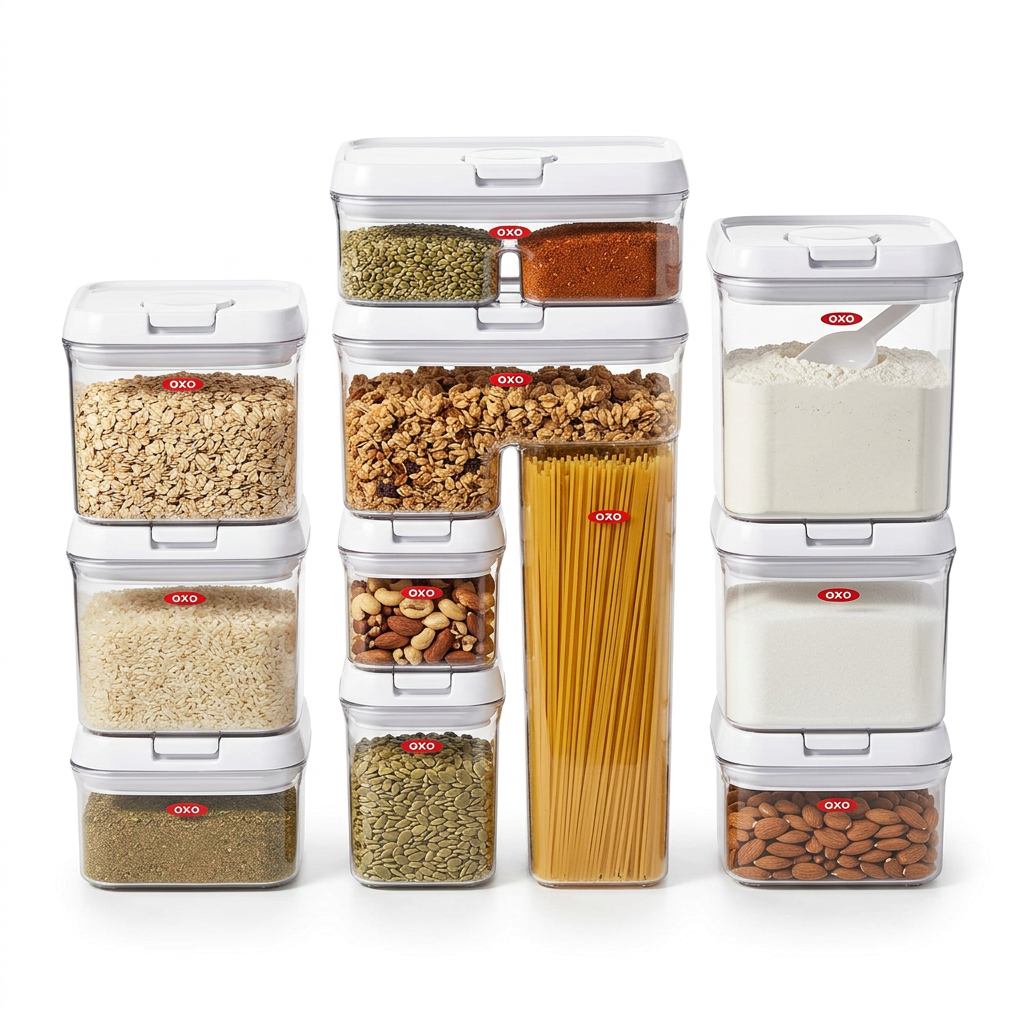
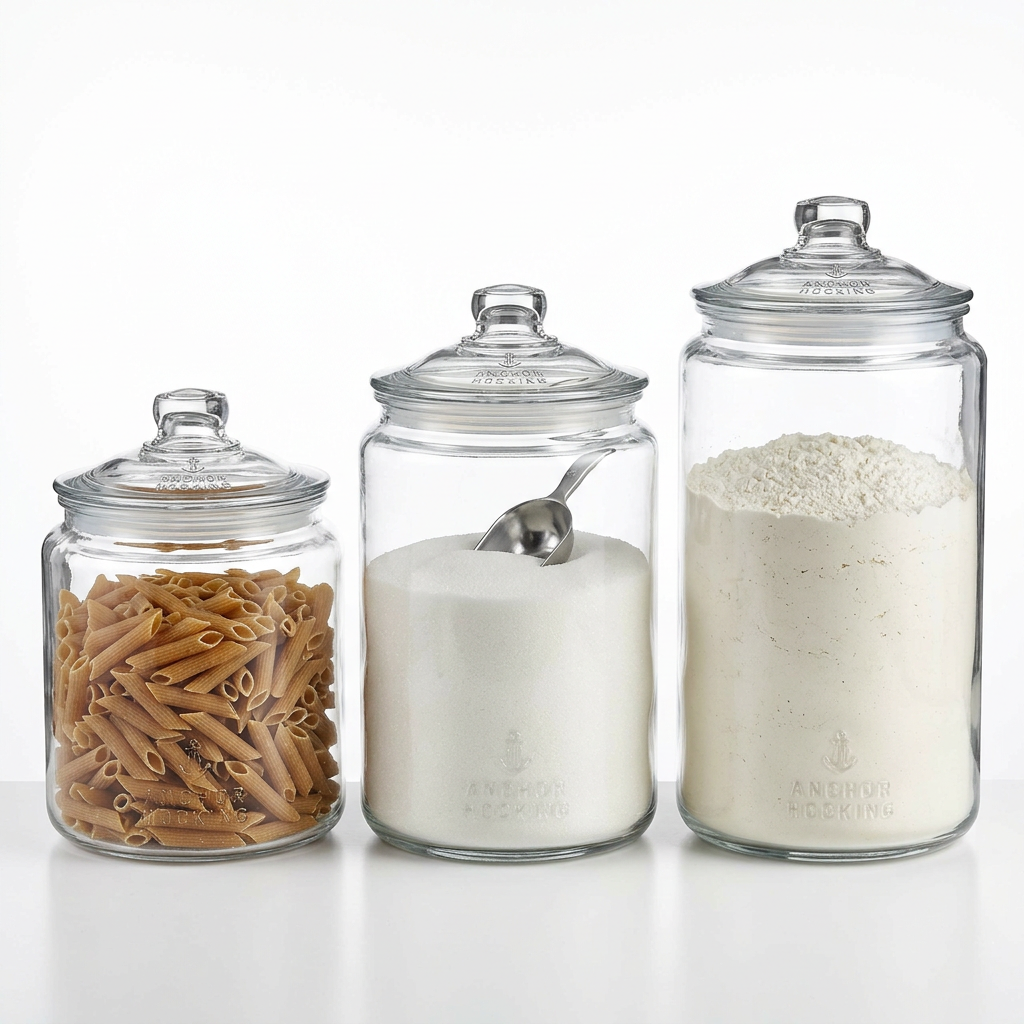
The solution is the use of high-quality moisture barriers. Glass jars with rubber gaskets (like Mason jars or Weck jars) are the gold standard for home storage. However, they only work if the internal volume of the jar is small compared to the amount of food, or if you use a desiccating agent to manage the head space. For larger quantities, vacuum sealing is the most professional route available to the home cook, as it removes the air that carries the moisture in the first place.
The Desiccant Advantage
Do not be afraid to use food-grade silica gel packets in your pantry storage. These are not just for shoe boxes; they are highly effective at absorbing excess moisture in the headspace of your jars. If you have dehydrated a batch of jerky or fruit leather, placing a packet in the jar ensures that any minor moisture remaining in the food is pulled into the silica rather than the surrounding atmosphere.
Oxygen Absorbers vs. Desiccants
It is crucial to distinguish between these two tools:
For maximum shelf life in long-term pantry storage, professionals often use a combination of both inside a vacuum-sealed Mylar bag.
Troubleshooting Texture Issues: When to Re-Hydrate
Sometimes, you may overshoot your goal. You might have dried your crackers too much, or your salt-curing process resulted in a product that is too hard for the intended application. This is where the concept of controlled re-hydration becomes useful. If your product is too dry, you can introduce a specific amount of moisture back into the system to reach the "ideal" texture without crossing the threshold into spoilage territory.
One of my favorite professional techniques is the use of a damp paper towel method for crackers. If your homemade crackers have gone stale or overly hard, you can place them in an airtight container with a slightly dampened (not wet) paper towel for an hour. The moisture will migrate from the towel into the crackers, softening them just enough to achieve a pleasant texture. Once achieved, you can briefly reheat them in a 300°F (150°C) oven for two minutes to crisp the surface, resulting in a perfect, "fresh" product.
The Hierarchy of Texture
If you are struggling to keep a product in its desired category, look at your storage medium first, then look at the ingredient ratios. If you have too much honey or corn syrup in a cookie, it will pull moisture from the air and become soft, regardless of how well you store it.
Adjusting Recipes
To change the texture of a shelf-stable baked good, manipulate your humectants. Humectants are ingredients that hold onto water, such as honey, molasses, or glycerin. If you want a cookie that stays soft for weeks, increase the ratio of honey to granulated sugar. If you want a product that remains crisp, eliminate the honey and stick to crystalline sugars, which do not hold onto water as effectively.
Advanced Techniques: The Science of Freeze-Drying
For the home cook who is truly obsessed with shelf life and texture, freeze-drying is the final frontier. Unlike dehydration, which uses heat, freeze-drying uses a process called sublimation. The food is frozen to extreme temperatures, and then the surrounding pressure is reduced, causing the ice to transition directly from a solid to a gas, bypassing the liquid phase entirely. This preserves the cellular structure of the food, resulting in a product that retains its original shape, color, and nutrient density while having an almost zero percent water activity.
While freeze-dryers are a significant investment, they are the most effective way to store pantry staples for long-term use. A freeze-dried strawberry, for example, will maintain its texture and flavor for years if stored in a sealed, oxygen-free environment. This is because the cellular structure is not collapsed by heat, and there is no free water left to participate in chemical degradation.
"Freeze-drying is essentially time travel for your food. By removing the water without heat, you are locking the ingredient into a permanent state of preservation that defies the natural timeline of decay."
When to Consider Investing
If you are regularly preserving harvests from a garden or buying in bulk to save money, a home freeze-dryer can pay for itself over time. You are essentially turning perishable inventory into long-term assets. The convenience of being able to grab a handful of "fresh" raspberries in the middle of winter—or having shelf-stable meals ready for an emergency—is invaluable for the organized home cook.
Comparing Methods
Dehydration:* Cheap, accessible, but can degrade flavor and texture due to heat exposure.
Canning:* Effective for high-moisture foods, but changes the texture significantly to a cooked, soft state.
Freeze-Drying:* Expensive, but retains raw-like texture and nutrient integrity.
Final Thoughts
The art of the pantry is rarely spoken of with the same reverence as the art of the plate, yet it is the foundation upon which every great home kitchen is built. By understanding water activity, you stop being a cook who reacts to the environment and start being a chef who commands it. You gain the ability to predict how your ingredients will behave, how long they will last, and exactly why they might have failed in the past. It is a transition from intuition to precision, and it is perhaps the most empowering shift you can make in your culinary journey.
As you begin to apply these principles, don't feel discouraged if your first attempts at perfect shelf stability aren't immediate. Start small—try drying a single batch of herbs, or experiment with the salt-to-sugar ratio in your favorite biscotti recipe. Keep notes. Track the temperatures, the storage methods, and the environmental conditions. These records are your personal cookbook of logic and science, and they will become the most valuable tool in your kitchen arsenal over time.
Remember that water activity is not a static concept; it is an ongoing interaction between your food and the world around it. Your kitchen, with all its unique quirks, humidity levels, and temperature fluctuations, is a laboratory. You have the knowledge now to navigate it with confidence. Stop blaming the chef, the humidity, or the packaging—take control of the molecules, and you will find that your pantry becomes a pantry of perfection, one that serves you exactly as you intend, every single time. Happy cooking, and may your pantry staples always be as crisp and vibrant as the day you made them.
Get the Next Recipe
Weekly recipes, techniques, and gear picks — straight to your inbox.
