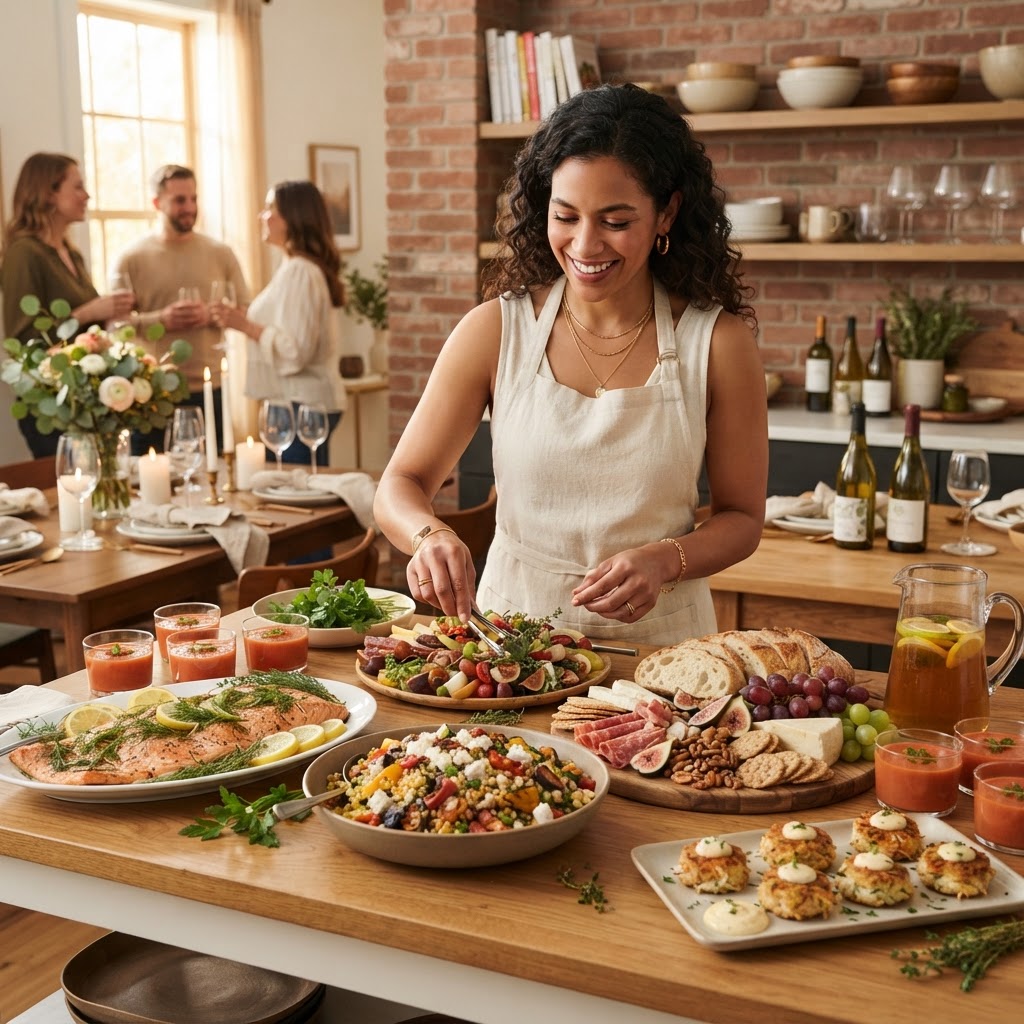
The Low-Stress Host: A Masterclass in Pre-Party Prep and Batch-Fire Menus
There is a pervasive myth in the world of home entertaining that suggests a successful dinner party requires the host to spend the entire evening tethered to the stove, frantically juggling pans while guests mingle in the living room. We have all been there: the sizzle of garlic in a pan acting as a lonely soundtrack to our own isolation, while the faint sound of laughter drifts from the other room, reminding us exactly what we are missing. I am here to tell you that this martyrdom is not a culinary necessity, but rather a failure of logistical planning. The true mark of a sophisticated host is not the ability to sweat through a silk blouse while searing scallops, but the ability to sit calmly with a glass of wine, having already completed the heavy lifting hours before the doorbell rings.
The secret to hosting without the frantic kitchen panic lies in the art of the batch-fire menu. By shifting your perspective from "cooking for the moment" to "executing a multi-stage process," you reclaim your role as a host rather than a short-order line cook. This methodology borrows heavily from professional kitchen mise en place, where every element is accounted for, prepped, and staged for rapid assembly. When you remove the pressure of the live fire, you allow yourself the luxury of time, which in turn leads to better flavor development, more consistent plating, and, most importantly, a house that doesn't smell like burnt butter and stress.
This masterclass will guide you through the transition from stressful kitchen chaos to the serene confidence of a seasoned pro. We will explore how to select menus that thrive on rest, the nuances of thermal management for large-scale reheating, and the secret weapon of compositional plating. You will learn to manipulate temperatures to your advantage, utilizing the oven as a holding chamber rather than just a cooking vessel. By the time we reach the final section, you will view your kitchen not as a theater of war, but as a well-oiled machine capable of delivering restaurant-quality experiences that leave you just as refreshed as your guests.
The Philosophy of the Passive Menu
The foundation of a stress-free party is the selection of dishes that actually improve with time. In the restaurant world, we often speak of stewing and braising as the ultimate insurance policy. Unlike a delicate piece of fish that requires precise, second-by-second attention, a slow-braised short rib or a deep, aromatic vegetable ragu is essentially immune to the pressures of a clock. When you choose dishes that rely on long, slow transformations of connective tissue or starch, you are choosing a menu that is inherently forgiving of delays.
The Science of Resting and Flavors
Many home cooks mistakenly believe that "freshly cooked" is always synonymous with "best quality." However, in many preparations, resting is the most critical component of the flavor profile. When you cook a large roast or a complex stew, the fibers need time to relax and the fats need time to redistribute through the muscle. By preparing your proteins or bases a day in advance, you allow the osmotic pressure to pull seasoning deep into the core of the ingredients, a feat that is impossible to achieve in a 45-minute pan sear.
Strategic Ingredient Selection
Focus on high-impact, low-maintenance ingredients that hold their structural integrity under heat. Root vegetables, hardy legumes, and dark meats are your best friends in this scenario. Avoid ingredients that oxidize quickly, such as sliced avocados or delicate, thin-skinned greens that wilt into unappealing sludge. Instead, opt for textures that can be revived with a simple flash-finish or a quick steam, ensuring that your final dish looks vibrant even if it has spent time in the refrigerator.
The goal of the host is not to prove you can work hard, but to prove you can plan well. If you are doing the hard work while the guests are eating, you have already lost the game.
Masterful Mise en Place and Station Setup
Mise en place is often translated as "everything in its place," but it is truly a state of mind. It is the practice of breaking down every recipe into its granular components—peeling, chopping, measuring, and arranging—long before the heat is ever turned on. For a home cook, this means you should never be chopping an onion while a pan is smoking. By having small bowls of pre-measured ingredients, or "preps," ready at your workstation, you eliminate the cognitive load that leads to burnt garlic and forgotten salt.
Organizing Your Workspace
Divide your kitchen into zones: a "wet" prep station for proteins, a "dry" prep station for aromatics and spices, and a "clean" assembly area. By physically segregating your tasks, you prevent cross-contamination and keep your workspace clutter-free. Use the towel-and-trash-bin strategy: keep a damp side-towel tucked into your apron for spills and a large, dedicated bin nearby for scraps. A clean station keeps your mind clear, and a clear mind keeps the cooking rhythm steady.
The Role of Temperature Control
Professional kitchens utilize different temperature zones, and you should too. Keep your cool prep in the refrigerator until the very last second and keep your holding equipment (even if that is just a low-temp oven) ready to accept items. Always ensure that your pots and pans are sized appropriately; a crowded pan leads to steaming rather than searing, which is the quickest way to ruin a dish’s texture. Never crowd your pan—leave at least an inch of space between proteins to ensure that moisture escapes, allowing the Maillard reaction to develop that crucial golden-brown crust.
The Art of the Batch-Fire Sequence
Batch-firing is the act of prepping components to 80% completion, leaving only the final structural assembly for the moments before serving. This involves understanding the carry-over cooking time of your ingredients. If you are serving a steak, for example, you can sous-vide or sear it to a rare state hours in advance. When the guests arrive, a quick, high-heat flash on a cast-iron skillet for 60 seconds per side provides the crust, while the interior remains a perfect, uniform edge-to-edge pink.
Thermal Management and Holding
If your oven is the engine, it must be used with precision. A low-temperature oven, set between 140°F and 160°F, acts as a perfect holding cabinet. You can keep braised meats, roasted root vegetables, and even mashed potatoes in this zone for hours without degradation. Just remember to cover your dishes tightly with heavy-duty aluminum foil to prevent surface dehydration. If you are worried about moisture loss, a small ramekin of water in the corner of the oven creates a gentle, humid environment that preserves the succulence of your proteins.
Execution Timelines
T-Minus 24 Hours:* Stocks, sauces, and braises are finished and cooled.
T-Minus 4 Hours:* Vegetable prep is completed; garnishes are organized.
T-Minus 1 Hour:* Set your "finish" temperature and organize plating vessels.
T-Minus 15 Minutes:* Rapid assembly; reheating sauces and flashing proteins.
A dinner party is not a race to the finish line; it is a synchronized dance of flavors. If you are sweating, you are doing it wrong.
Menu Design for Maximum Elegance
When designing a menu for a stress-free event, you must balance texture, acidity, and umami. A menu consisting entirely of heavy, creamy dishes will tire the palate, while a menu of only raw items can feel sparse. Aim for a structure that incorporates at least one "low-maintenance hero" dish—something that occupies the oven for a long duration—and two or three bright, acid-forward sides that can be dressed at the last minute. This ensures that your kitchen work is staggered throughout the day.
The Power of the Cold Appetizer
Start your evening with a cold appetizer that can be plated and left on the table before the guests even arrive. Cured fish, high-quality cheeses, or a well-structured charcuterie board allow you to greet guests with a drink in hand. By starting the evening with a cold component, you effectively move the "pressure" of the meal back by twenty minutes, giving you a cushion to handle any last-minute kitchen adjustments without the guests noticing a lapse in service.
The Final Flourish: Garnishes
The difference between a good dish and a great dish is often found in the finishing fat or acid. Keep a "garnish kit" prepared: fresh herbs, citrus zest, toasted seeds, or high-quality finishing oils. These components should never be cooked; they should be added at the final second to provide a pop of color and a spike of flavor. This gives your food a "fresh from the pan" vibrancy that belies the fact that the bulk of the work was done hours earlier.
Mastering the Oven as a Finishing Tool
The oven is the most underutilized tool for the home host. Most people use the oven strictly for baking or roasting, but it is an essential piece of equipment for gentle reheating. If you are serving a grain-based side like risotto, you can par-cook the rice in broth until it is al dente, spread it on a sheet pan, and then finish it with butter and cheese under a quick broiler blast. This technique, often used in catering, ensures that your starch remains creamy rather than turning into a gluey mass from over-mixing.
High-Heat Finishing Techniques
If you are dealing with proteins that need a crispy skin, the broiler is your best friend. A quick two-minute hit under a high broiler can crisp skin or caramelize a glaze in a way that slow roasting cannot. Always keep a close eye on your broiler; the gap between "perfectly caramelized" and "incinerated" is often less than sixty seconds. Use this time to move around the kitchen, but never step out of the room.
Moisture Control and Hydration
When reheating, moisture is your biggest challenge. Always incorporate a small amount of liquid—be it stock, wine, or even a splash of water—at the bottom of your reheating vessel. This creates a steam bath that prevents the edges of your food from becoming tough or rubbery. When you remove the foil, a quick stir of the sauce will integrate that extra moisture, making the dish feel fresh and luxurious rather than "reheated."
The Psychological Art of Hosting
A host who is constantly checking the clock or apologizing for the food is creating a frantic environment for their guests. Your guests take their emotional cues from you. If you are relaxed, they will be relaxed. If you act as if the kitchen is a war zone, they will feel obligated to stay out of your way or, worse, try to "help," which usually ends up creating more mess. Confidence is the ultimate seasoning. By following the batch-fire method, you are not just managing food; you are managing the atmosphere of the room.
Managing the "Helpful" Guest
We all have that friend who wants to help in the kitchen. To avoid having them hover, give them a task that is entirely non-essential but makes them feel involved. Ask them to pour drinks, arrange bread on a platter, or light the candles. By directing their energy away from your workstation, you keep your sequence intact while making them feel like a valued part of the evening. Keep your primary prep zone a "no-go" area, maintained by your own established rhythm.
The Post-Dinner Transition
The end of the meal should be as seamless as the beginning. Never attempt a deep-clean of the kitchen while guests are still present. Your priority is to transition from the dining table to a relaxed post-dinner setting. If you have been utilizing the batch-fire method, your main cleanup should consist of little more than clearing the plates. The pots and pans used earlier in the day should already be washed or soaking. By keeping the kitchen tidy as you go, you avoid the crushing weight of the "after-dinner cleanup" that discourages so many people from hosting in the first place.
Final Thoughts
Mastering the art of the low-stress host is a journey of refinement. It requires moving away from the ego-driven desire to perform "chef theatrics" and moving toward a mindset of culinary logistics. When you treat your party as a production that requires rehearsal, scheduling, and precision, you transform the act of entertaining from a source of anxiety into a genuine joy. Remember that the goal is not to demonstrate how much effort you can expend, but how well you can facilitate a beautiful evening of conversation and connection.
Use the techniques of mise en place, embrace the passive menu, and trust in your ability to control the thermal environment of your kitchen. By prepping in stages and finishing with precision, you provide your guests with food that is technically perfect and emotionally comforting. Do not blame the chef for a busy night; instead, become the chef who has mastered the clock. With these tools in your arsenal, you will find that the most stressful part of the dinner party is no longer the cooking—it is simply deciding which wine to pour for your next round of toasts.
Always remember that every mistake is a learning opportunity, and every party is a chance to refine your workflow. Start small with a dinner for four, applying these principles strictly, and watch how your confidence grows. As you become more comfortable with these methods, you will find that you are able to handle larger groups and more complex menus with the same ease as a quiet, intimate evening. Your kitchen is waiting to be conquered, not as a source of stress, but as a gateway to elegant, stress-free hospitality. Host with intention, serve with pride, and always, above all else, remember to enjoy the company of those you have brought to your table.
Get the Next Recipe
Weekly recipes, techniques, and gear picks — straight to your inbox.
